29.10.2026 11:06
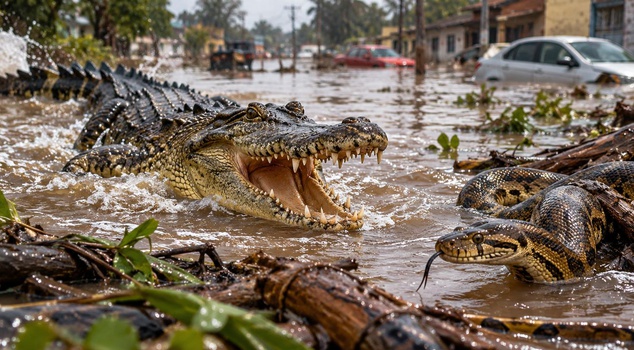
Floods caused by heavy rains in Argentina have also hit wildlife. Crocodiles, venomous snakes, and many wild animals whose habitats were flooded by overflowing rivers descended into residential areas. Two people lost their lives in the flood disaster, while more than 2,000 people had to leave their homes. Authorities warned citizens not to approach dangerous animals.
Floods affecting the Corrientes and Misiones provinces in northeastern Argentina submerged natural habitats around the rivers.
As water levels rose in the Paraná and Uruguay rivers, yacare caimans from the alligator family, rattlesnakes, venomous yarara snakes, capybaras, armadillos, and small deer species reached residential areas in search of safe ground.
Rescue teams sprang into action after wild animals were spotted, especially in the riverside walking areas of Corrientes. Experts stated that most of the animals were swept away by the current while trying to escape the floodwaters.
A CAIMAN WAS SEEN IN THE PARK, A VENOMOUS SNAKE WAS FOUND ON THE SHORE
A yacare caiman was seen in the morning at Parque Mitre in Corrientes. In the coastal part of the city, two small deer were rescued by police and maritime security teams.
Near the coastal area close to Pellegrini Street, an armadillo swept along by the water was taken to safety, while in the same area a venomous rattlesnake and a water bird injured in the wing were found. Two otters that had left their habitat due to the flood were also seen in the Paso de la Patria area.
A 15-YEAR-OLD CHILD WAS BITTEN BY A RATTLESNAKE
The danger caused by the floods was once again highlighted by an incident near Goya in Corrientes province. On October 16, 15-year-old Ezequiel, who was helping his family evacuate animals, was bitten by a rattlesnake.
The child, who suffered serious organ function problems due to the venom, was taken to intensive care. Local media reported that his treatment was ongoing. Experts asked people to be careful of snakes hiding in grass and rocky areas, especially in areas where floodwaters have receded.
LARGE INCREASE IN THE NUMBER OF RESCUED ANIMALS
The Aguará Wildlife Conservation Center in Corrientes announced that rescue efforts increased significantly after the floods. It was stated that more than 100 wild animals are under rehabilitation at the center, including 53 orphaned opossum babies. Monkeys, deer, birds, and various reptile species were also rescued and taken under protection.
Center official Catalina Mancedo said that many animals reached the shore after being swept for kilometers, and were therefore exhausted and stressed. It was reported that the rescued animals underwent health checks, those in good condition were released back into their natural habitats, and the injured were treated.
TWO PEOPLE LOST THEIR LIVES IN THE FLOOD DISASTER
Two people died and more than 2,000 people had to leave their homes due to the floods affecting northeastern Argentina. It was announced that approximately 1,200 to 1,300 people were evacuated in Chaco province, while more than a thousand people left their homes in Corrientes.
It was reported that two agricultural workers trying to save their animals from the flood drowned in Corrientes. In Misiones province, more than 100 houses were damaged due to heavy rain and storm. Some roads and bridges were closed to traffic.
CRITICAL WARNING FROM EXPERTS TO CITIZENS
Wildlife experts emphasized that animals seen in residential areas should never be approached. They asked that the animals not be caught, fed, or surrounded for photographs.
Noting that wild animals feeling threatened may attack in self-defense, experts asked citizens to inform police, fire brigades, or specialized rescue teams. They also reminded that pet dogs should be walked on a leash along riverbanks.
THE EFFECTS OF THE FLOOD MAY LAST A LONG TIME
Experts from the National University of the Northeast explained that the floods narrowed animals' shelter and feeding areas, increasing the risk of exhaustion, starvation, and drowning. According to experts, the gathering of animals fleeing the flood in narrow areas can also facilitate the spread of diseases. It was stated that the risk continues in both residential areas and natural habitats due to the possibility that river levels may rise again in the region.