02.09.2026 15:01
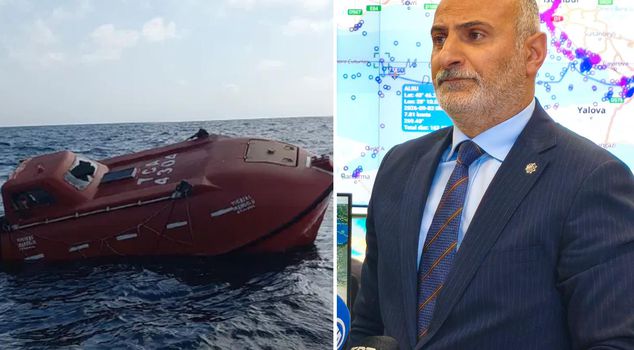
It has emerged that the two ships that collided in the Marmara Sea spoke on the radio before the accident, and the captains saw each other and made a course separation. The General Director of Maritime Affairs, Ünsal Baylan, said, 'There was a conversation in the radio records. These two ships spoke with each other. In this case, I can say that the two captains saw each other and spoke to be able to proceed on their courses without acting against each other at that moment.' There are 10 Turkish personnel on the sunken ship, and search and rescue efforts are ongoing.
General Director of Maritime Affairs Ünsal Baylan said, "There was communication in the radio records. These two ships spoke with each other. In this case, I can say that the two captains saw each other and communicated to proceed on their routes without acting contrary to each other at that moment."
"FIRST SIGNAL CAME AT 03:26"
Search and rescue efforts continue following the accident in the Sea of Marmara caused by the collision of two ships, which resulted in one ship sinking. General Director of Maritime Affairs of the Ministry of Transport and Infrastructure, Ünsal Baylan, made statements regarding the accident at the Main Search and Rescue Coordination Center (MSRCC).
Stating that the Main Search and Rescue Coordination Center (MSRCC) is where initial notifications and confirmations of maritime accidents are made, Baylan said, "The first signal to this center came at 03:26 from a satellite-assisted search and rescue system we call Cospas-Sarsat. Our colleagues identified it. After determining that this signal belonged to the Tuğberk İmamoğlu Ship, the Ministry also received the location of this signal in Marmara. A call was made to the ship, but the ship did not respond."
IT WAS UNDERSTOOD IT HAD SUNK WHEN NO SIGNAL CAME
Stating that no response was received to the call from the ship, Ünal Baylan emphasized that they accessed personnel information and tried to establish communication with the crew, saying, "Using the means of our center, the personnel list declared by the ship at its last port of departure, İskenderun, was accessed through our Ministry's Rudder Management Information System. From the personnel list, through our Seafarers Information System, since all personnel were Turkish, their mobile phones were reached and these people were called. After all these procedures, when no response was received on the phones either, we understood that the ship had sunk, could not send a signal, and that we had a serious situation on our hands, and our center initiated search and rescue activities."
SEARCH AND RESCUE EFFORTS CONTINUE
Stating that after the accident, relevant institutions promptly dispatched maritime assets and search and rescue teams to the region, Baylan expressed that efforts continue and they hope to receive good news as soon as possible.
Saying that the accident occurred as a result of the collision of two ships and providing information about the routes of the ships, Baylan said, "It is a very tragic event; two ships collided. One of the colliding ships was en route from Kocaeli to Aliağa, and the other was heading out to the Black Sea from İskenderun. The accident occurred within the traffic separation scheme in Marmara that ships must follow at sea."
10 PERSONNEL INCLUDING THE CAPTAIN WERE ON BOARD
Answering the question about how many people were on the sunken ship, Baylan said, "According to İskenderun's declaration, there were 10 personnel on board the sunken ship, including the captain. All were Turkish citizens. The Alsu Ship is also a Turkish-flagged vessel. Thank God, it has no damage."
Stating that the signal received from the EPIRB (Emergency Position Indicating Radio Beacon) device is important data regarding the sinking of the ship, Ünal Baylan drew attention to the short time between the information provided by the captain and the arrival time of the signal, saying, "We already say 90 percent because we haven't seen the ship sink with our own eyes, but after the EPIRB device, the systems confirm with 99 percent certainty that the ship sank. Because in the captain's statement, he reports colliding with the Tuğberk İmamoğlu ship at 03:15, and the signal we received was at 03:26. There is a very short time in between."
Stating that EPIRB devices are activated manually or in the event of a ship sinking, Ünal Baylan stated that the devices send signals to satellites.
SHIPS HAD COMMUNICATED WITH EACH OTHER BEFORE THE ACCIDENT
Also providing information about the cargo carried by the ships, Baylan said, "The ship, the Alsu tanker, was empty. The other ship was sailing from İskenderun loaded with iron and steel products and rolled sheet metal. Think of the separation scheme like highways. On this highway, there are ships going in one direction and ships entering this lane. According to maritime rules, which we call the International Regulations for Preventing Collisions at Sea, they need to enter certain routes and communicate with each other. There was communication in the radio records. These two ships spoke with each other. In this case, I can currently say that the two captains saw each other and communicated, making a route separation to proceed on their routes without acting contrary to each other at that moment, but the audio recordings will be listened to."
Stating that the aforementioned information will be confirmed by relevant institutions through systems, records, and statements, Baylan stated that his statement was in the nature of initial information. Expressing that search and rescue efforts continue, Ünal Baylan said they hope to reach the casualties safely as soon as possible and deliver good news.