06.09.2026 22:51
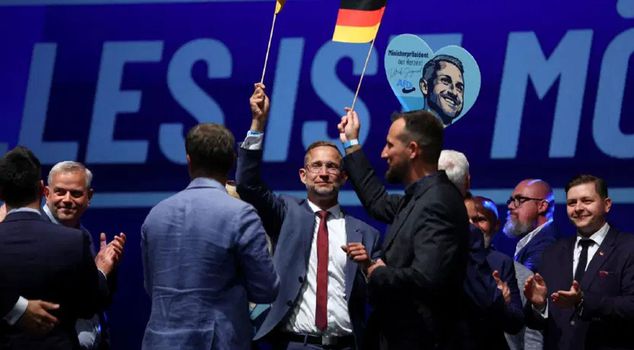
Germany's far-right populist party Alternative for Germany achieved a record result in the state elections of Saxony-Anhalt, becoming the clear leading party with 44.4 percent of the vote. As the ruling Christian Democratic Union suffered major losses, the process of forming a government in the state has reached an impasse, while the outcome has brought the rise of the far right in Germany back into the spotlight.
The parliamentary elections held in the German state of Saxony-Anhalt have revealed a picture that could shake the country's political balances.
THEY BECAME THE CLEAR WINNER WITH A RECORD VOTE
The far-right Alternative for Germany (AfD) became the clear leading party with 44.4 percent of the vote, achieving its highest ever vote share in a state election. According to initial counts, the AfD more than doubled its 20.8 percent vote share from the 2021 elections. This result highlights the extent of the party's rise in state politics.
The ruling Christian Democratic Union (CDU), on the other hand, suffered a historic loss of votes. The CDU, led by State Premier Sven Schulze, remained at 18.4 percent. The party had received 37.1 percent of the votes in the 2021 elections under former Premier Reiner Haseloff.
In the election, the Left Party came in third with 9.3 percent, while the Greens received 8.7 percent and the Social Democratic Party (SPD) received 8.4 percent. With this result, the Greens achieved their highest ever vote share in Saxony-Anhalt, while the SPD maintained its 8.4 percent result from 2021. The Sahra Wagenknecht Alliance (BSW) received exactly 5.0 percent of the vote, just above the 5 percent threshold. The FDP remained at 2.2 percent and failed to enter the state parliament.
CAN THE AFD COME TO POWER ALONE?
Following the election results, all eyes have turned to the process of forming a government. Although the AfD's goal is to come to power alone, it does not need to receive 50 percent of the votes for this. The party needs to secure more than half of the seats in the state parliament. According to the current picture, the AfD cannot achieve this majority. Moreover, while other political parties refuse to form a coalition with the AfD, the AfD is also unwilling to form a government with other parties. This situation makes the process of forming a government in Saxony-Anhalt quite complicated.
Whether the BSW enters parliament is critically important in the government equation. The BSW's top candidate for premier, Claudia Wittig, stated that they are open to cooperation with the AfD on some issues, arguing that completely excluding the party from government after its election success would not be democratic.
The continuation of the current CDU-SPD-FDP coalition seems unlikely after the election results. The number of seats also appears insufficient for a possible three-party coalition between the CDU, SPD, and Greens.
One alternative option is forming a minority government led by the CDU and seeking the support of the Left Party in critical votes. However, the CDU's internal decisions rejecting cooperation with both the AfD and the Left Party could place such a government formula at the center of serious political debates.
IS THE AFD'S RISE A HARBINGER OF A NEW ERA IN GERMANY?
The Saxony-Anhalt elections hold historical importance in showing the extent of the AfD's rise at the state level. Since 2023, the AfD has been classified as a confirmed far-right organization in Saxony-Anhalt by the state Office for the Protection of the Constitution. The institution cites the party's stance towards the fundamental principles of Germany's free democratic basic order as the reason for this assessment. The AfD, however, is pursuing legal action against this classification.
If the results are confirmed, the AfD becoming the leading party in Saxony-Anhalt will indicate that the influence of the far right in state politics in Germany has strengthened even further. However, the current seat distribution does not allow the party to form the state government on its own.