05.11.2026 00:11
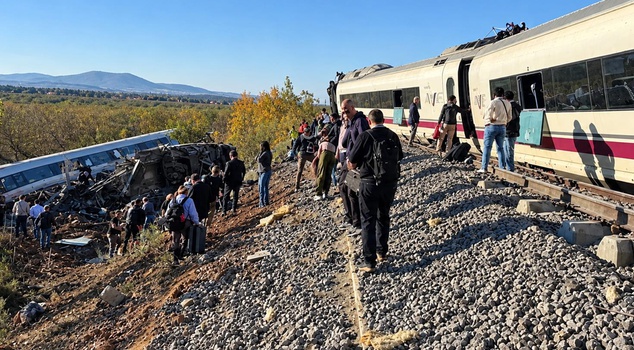
In Spain, a second resignation came after the accident near Toledo on October 28 in which 69 people lost their lives as a result of the collision of two high-speed trains. Following the Minister of Transport and Sustainable Mobility, the President of ADIF, the public institution responsible for railway infrastructure, Luis Pedro Marco de la Pena, resigned.
After the collision of two high-speed trains in Spain that killed 69 people, Luis Pedro Marco de la Pena, president of ADIF, the railway infrastructure organization affiliated with the Ministry of Transport, resigned.
SECOND RESIGNATION IN SPAIN
A second resignation came in Spain after the high-speed train accident that occurred near the city of Toledo on October 28.
After Minister of Transport and Sustainable Mobility Oscar Puente Santiago resigned yesterday, Luis Pedro Marco de la Pena, President of ADIF, the public body responsible for railway infrastructure, resigned today.
De la Pena submitted his resignation to current Deputy Prime Minister and Minister of Economy Carlos Cuerpo, who was appointed temporarily as Minister of Transport and Sustainable Mobility in place of Puente.
De la Pena had served as president of ADIF for 2 years.
TRAIN ACCIDENTS IN SPAIN
There were 2 major high-speed train accidents in Spain this year. In the first, 46 people died in the accident caused by a high-speed train derailing in the Adamuz district of Córdoba on January 18.
In the accident in which two high-speed trains collided between the Urda and Los Yébenes districts of Toledo on October 28, 69 people also lost their lives.
A Renfe AVE train traveling on the Madrid-Seville high-speed line had crashed into the rear of an Iryo Frecciarossa 1000 train that had stopped on the track due to a computer failure in the LZB signaling system, at a speed of approximately 200 kilometers per hour.
The biggest factor causing the accident was cited as human error.
After the accident, the Spanish government took additional measures to increase safety in railway transport.