25.10.2026 10:10
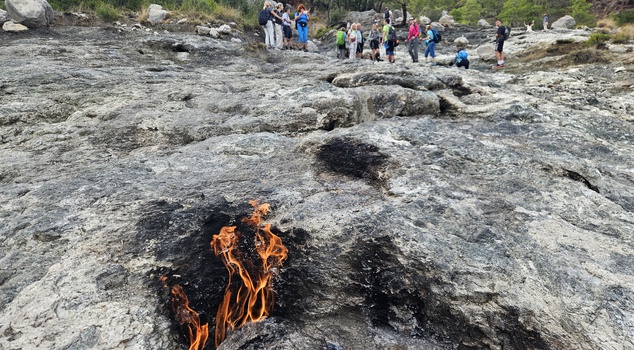
In Yanartaş, located in the Kemer district of Antalya and known for the legend of the "first Olympic flame," it was observed that the fire had gone out at some points where flames had previously emerged. While flames continue to rise in other cracks between the rocks, no determination has yet been made as to why some vents went out or whether the situation is temporary. The area on the Lycian Way continues to be a stop for visitors, mostly foreign tourists.
Yanartaş, in the Kemer district of Antalya and associated with the legend of the 'first Olympic flame,' is one of the stops visited by tourists, most of them foreign. In other parts of the area, where some fire outlets among the rocks appear to have gone out, flames have been rising for thousands of years.
Located within the boundaries of the Beydağları Coastal National Park under the responsibility of the Nature Conservation and National Parks in Çıralı, Yanartaş attracts visitors with its natural fire emerging from among the rocks and its mythological narratives. In the area along the Lycian Way, groups of domestic and foreign tourists out on nature walks take a break to examine the flames and the surrounding historical ruins. Some visitors also roast marshmallows in the fire.
THE FIRE HAS GONE OUT AT SOME POINTS
In observations made at Yanartaş in recent days, it was seen that there were no flames at some points where fire had previously emerged, while burning continued in other rock cracks. The flames rising from separate points on the rocky surface form the focus of the area visited by hikers. There is as yet no determination regarding the reason why the fire has gone out at some outlets or whether this situation is temporary.
A FIRE BREAK ON THE LYCIAN WAY
Tourist groups walking this section of the Lycian Way also add a visit to Yanartaş to their route. Visitors reaching the area with backpacks and trekking poles take a break around the fire rising from among the rocks and take photographs. At Yanartaş, where there is heavy visitor activity, it is noteworthy that the groups consist mainly of foreign tourists.
THE SOURCE OF THE FIRE IS A NATURAL GAS LEAK
Prof. Dr. Fuzuli Yağmurlu from the Faculty of Engineering at Süleyman Demirel University, who conducted investigations in the region in the past, stated in a statement he made to DHA in 2017 that the fire was caused by a natural gas leak. Expressing that the gas may have been ignited by lightning or human influence in ancient times, Yağmurlu said, 'This fire shows that there is a very important natural gas leak in this region.' Yağmurlu also made assessments regarding the source of the gas reaching the surface from underground.
THE FORMATION OF METHANE WAS INVESTIGATED
The origin of the gas feeding Yanartaş has also been the subject of international scientific research. In the study by Giuseppe Etiope and Artur Ionescu, it was demonstrated through experiments that methane can form at low temperatures without a biological source, through the catalytic effect of the element ruthenium. This finding took its place among the scientific explanations regarding how methane can form in rock environments with gas emissions such as Yanartaş.
CHIMERA, BREATHING FLAMES FROM UNDERGROUND
On the other hand, the flames of Yanartaş are associated with the monster named 'Chimera' in mythology. According to the legend conveyed on the Culture Portal of the Ministry of Culture and Tourism, Chimera, with a lion's head, a goat's body, and a serpent's tail, breathes fire from its mouth. Bellerophontes, who confronts the monster with his winged horse Pegasus, buries Chimera deep in the earth. However, the monster continues to breathe flames, and it is believed that the fire at Yanartaş is these flames.
THE LEGEND OF THE OLYMPIC FLAME
According to the same narrative, races are held in Olympos to celebrate Bellerophontes' victory. Athletes light their torches with the fire of Yanartaş, which is considered sacred, and run to Olympos. On the Culture Portal, these races are described as the first example of the Olympic Games in Anatolia. Also known by the description 'first Olympic flame,' Yanartaş is today one of the stops of Lycian Way hikers with this legend and its natural flames.