07.11.2026 22:31
President of the Council of Higher Education (YÖK) Prof. Dr. Erol Özvar said that they are working to restructure undergraduate programs over 180 credits so that they can be completed in three years, that the transition could be spread over several years, and that legislative changes are required. Noting that there are approximately 60 courses in undergraduate education and that this number is 20-25 in Europe, Özvar announced that the system that will reduce the number of courses will start operating next year and that law quotas have been reduced from around 16,000 to around 8,000.
President of the Council of Higher Education (YÖK) Prof. Dr. Erol Özvar said that they are working on restructuring undergraduate programs over 180 credits so that they can be completed in three years, and that the transition to the three-year model may be spread over a period of a few years. Noting that while undergraduate programs in Türkiye have approximately 60 courses, this number is around 20-25 in Europe, Özvar stated that the system for reducing the number of courses will begin to operate next year.
President of the Council of Higher Education Prof. Dr. Erol Özvar made statements on the higher education agenda on the Weekend program hosted by Hakan Çelik on CNN Türk.
Özvar explained the work carried out in higher education, from preparations for completing undergraduate education in three years to simplifying the curriculum, from quota planning to artificial intelligence and digital skills, and from vocational education to scientific production.
Drawing attention to the fact that in Türkiye a student remains in the formal education system for a total of 16 years, following 12 years of compulsory education and a four-year undergraduate program, Özvar said that with the addition of military service, internship and job-seeking processes after graduation, the age at which young people enter working life rises.
Stating that demographic change, aging, changing living conditions and technological developments make a new structuring necessary in higher education, Özvar recalled that undergraduate education in the European Higher Education Area ranges between 180 and 240 ECTS.
A TRANSITION OF SEVERAL YEARS IS ENVISAGED FOR THREE-YEAR UNDERGRADUATE EDUCATION
Reporting that they are working on restructuring undergraduate programs in Türkiye over 180 credits so that they can be completed in three years, Özvar noted that they have been preparing universities for this process for about a year and that they asked the senates and boards of directors of the universities he visited to carry out the necessary work.
Stating that the authority regarding how many credits students will graduate with lies with the Council of Higher Education, Özvar said that the practice will not be implemented with a top-down approach and that they have asked universities to review their programs in line with their own conditions. Stating that the transition to the three-year undergraduate model may be spread over a period of several years, Özvar reported that for this, changes are needed not only in Law No. 2547 but also in some other laws. Expressing that contacts with professional organizations continue, Özvar noted that they aim to implement the model with social consensus.
THE NUMBER OF COURSES WILL BE REDUCED STARTING NEXT YEAR
Stating that in addition to the duration of education, the course load in universities also needs to be reconsidered, Özvar said that while undergraduate programs in Türkiye have approximately 60 courses, this number is around 20-25 in Europe.
Drawing attention to the fact that when the weekly courses in four-year undergraduate programs are added up, they correspond to a curriculum that can be completed in 2-2.5 days, Özvar stated that with the simplification of the curriculum, students will be able to devote more time to practice, projects and professional experience.
Stating that work aimed at reducing the number of courses has been ongoing this year, Özvar stated that next year the system will begin to operate in this direction. Emphasizing that course contents also need to be updated, Özvar said that artificial intelligence should be included in courses and that students' digital skills and artificial intelligence literacy should be developed.
LAW QUOTAS HAVE FALLEN TO THE 8,000 LEVEL
Stating that the issue of universities and employment was not addressed together in the past as much as it is today, Özvar said that universities now need to monitor whether their graduates find jobs and to what extent they can participate in working life.
Stating that in quota planning, in addition to employment opportunities, students' orientation toward programs is also taken into account, Özvar stated that quotas are rearranged in fields where demand and employment opportunities have decreased. In this context, recalling that the Justice program was closed, around 40-50 two-year programs were removed from the system, and second education was ended, Özvar reported that quotas were also reduced in architecture, pharmacy, dentistry, communication and some engineering fields. Stating that quotas were significantly reduced in some programs such as history, literature, sociology, philosophy and art history, Özvar said that the total quota in law faculties was reduced from the 16,000s level to the 8,000s level. He also noted that the success rank requirement for choosing law programs is applied as 100,000.
TWO-THIRDS OF NEW PROGRAMS ARE ASSOCIATE DEGREE
Stating that while regulations are made in fields with decreasing needs, new fields needed by working life are being brought into the higher education system, Özvar stated that nearly 80 new types of programs have been created in the last three years, and that about two-thirds of these are at associate degree level and one-third at undergraduate level.
Reporting that programs related to artificial intelligence and digital technologies opened in fields such as artificial intelligence, machine learning, data science and analytics, autonomous systems, robotics, cybersecurity, and digitalization in agriculture and health have reached 724 at 160 universities, Özvar said that the occupancy rates of the new programs are approaching 100 percent.
Stating that the programs will be expanded in a controlled manner, Özvar noted that faculty capacity is also taken into account in planning. Also referring to the survey conducted by the Council of Higher Education among university students, Özvar announced that the rate of students' use of artificial intelligence exceeds 60 percent. Emphasizing that artificial intelligence should be used with a sense of responsibility, Özvar stated that, in addition to students, faculty members and administrative staff should also undergo training in this field.
233,000 APPLICATIONS TO THE DIGITAL UNIVERSITY PLATFORM
Stating that they launched the Digital University Platform to provide digital skills not only to university students but also to graduates and individuals in working life, Özvar said that the trainings are offered free of charge, online, live and interactively.
Stating that there are 16 different trainings on the platform, to which Marmara University, Boğaziçi University, Istanbul Technical University, Middle East Technical University and Yıldız Technical University contribute, Özvar reported that 233,000 applications were received this year and approximately 55,000 people participated in the trainings.
MICRO-CREDENTIALS CAN BE ADDED TO TRANSCRIPTS
Drawing attention to the fact that with technological transformation, knowledge, skills and competencies are no longer acquired only at universities, Özvar said that with the micro-credential practice implemented this year, it has become possible to add achievements obtained outside the university to transcripts within the framework of the quality standards set by the Council of Higher Education.
He stated that in this way, the skills students acquire through different education and will need in working life have become visible within the academic process.
Özvar, who explained that they plan to offer dentistry and pharmacy students who meet certain success conditions the right to do a double major in some engineering programs at their own universities, cited computer, electrical-electronic and materials engineering as examples.
Stating that the right is planned to be offered directly to students, Özvar reported that those who successfully complete both programs will receive two diplomas and that they aim to have this practice ready for the 2027-2028 academic year.
VOCATIONAL EDUCATION IN ENTERPRISES TO START IN 7 PROVINCES
Stating that vocational schools have an important place in meeting Türkiye's need for qualified human resources, Özvar said that employment rates of graduates from vocational schools operating in organized industrial zones rise to 90 percent.
Noting that more than 20 universities have vocational schools in organized industrial zones and that over 7,000 students study in these programs, Özvar noted that thematic vocational schools are also becoming widespread.
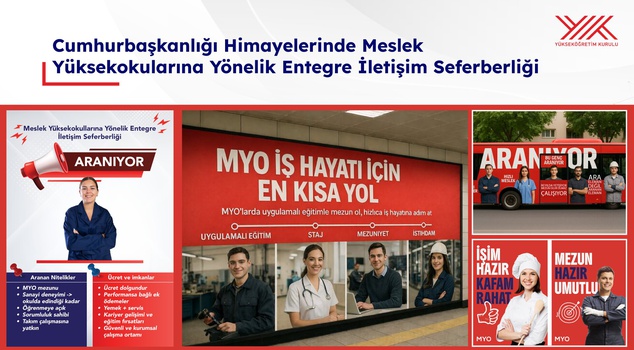
Explaining that a new initiative has been launched under the auspices of the Presidency to ensure these programs are preferred by more students and to increase their visibility, Özvar reported that comprehensive efforts will be carried out to promote vocational school programs.
Stating that the current internship approach does not provide sufficient practical experience, Özvar said that with the Vocational Education in Enterprises model they aim for students to spend at least one of the four semesters in enterprises. He stated that in programs where possible, an education model of two semesters at school and two semesters at an enterprise can also be implemented.
Noting that the model will initially be implemented in Ankara, Bursa, Gaziantep, Istanbul, Izmir, Kocaeli and Konya, Özvar said they aim for students to encounter the real working environment more before graduating.
RESEARCH UNIVERSITIES CATCH OECD AVERAGE IN QUALITY PUBLICATIONS
Stating that Türkiye has gained significant momentum in scientific output in recent years, Özvar said that the increase in resources allocated to higher education and scientific research has positively reflected on universities' performance.
Expressing that one of the Council of Higher Education's main policies is to ensure universities differentiate according to their competitive strengths, Özvar reported that there are 23 research universities in Türkiye, 20 state and 3 foundation universities.
Stating that the results of the resources provided under the Research Universities Support Program carried out with the Presidency's Strategy and Budget Office have begun to be seen, Özvar drew attention to the increase in Q1 and Q2 category publications of research universities over the last three years. Stating that research universities have caught the OECD average in quality publication performance, Özvar evaluated this development as one of the most important momentum gains of Turkish higher education in the last 40-50 years.
ENGINEERS GRADUATED FROM 129 UNIVERSITIES TAKE PART IN NATIONAL TECHNOLOGY INITIATIVE
Touching on the role of the human resources trained by Turkish universities in the country's technological development, Özvar said that according to data received from the Presidency of Defense Industries, the number of engineers working in the defense industry has exceeded 30,000.
Noting that more than 99 percent of these engineers are Turkish, Özvar drew attention to the fact that 99.5 percent of Turkish engineers are graduates of universities in Türkiye. He noted that Turkish engineers working in the sector were trained at 129 different universities.
Stating that the human resources trained by universities have a large share in the global successes of defense industry organizations, particularly ASELSAN and BAYKAR, Özvar emphasized that young people graduated from Turkish universities are among the main actors of the national technology initiative.
Özvar, who also made assessments regarding qualified Turkish young people working abroad, said, 'I look at it from the perspective of brain power rather than brain drain.' Stating that it is also important for young people raised in Türkiye to succeed abroad, Özvar expressed that the main issue is for brain power to contribute to Türkiye from within or from outside.
GOAL OF TOP 100 FOR TWO STATE UNIVERSITIES IN FIVE YEARS
Touching on the rise of Turkish universities in international rankings, Özvar stated that in the 2026 rankings, six Turkish universities are among the world's top 500, and two of these are among the top 300 universities. Explaining that they aim to carry at least two state universities into the world's top 100 within the next five years, Özvar said that at least one foundation university also has the potential to enter the top 100.
Emphasizing that international rankings are important but that the success of universities cannot be evaluated only through these lists, Özvar noted that scientific output, the impact of research, the quality of graduates, and the contribution offered to society are also fundamental indicators.
Stating that in the Global University Employability Ranking, based on the evaluations of more than 15,000 employers worldwide, six Turkish universities are among the 300 universities whose graduates are most preferred, Özvar expressed that this is important in terms of showing the correspondence of the education provided at Turkish universities in the international business world.
INTERNATIONAL STUDENTS' CONTRIBUTION TO THE ECONOMY IS $3 BILLION ANNUALLY
Stating that approximately 380,000 international students are studying in Türkiye and that more than 3,000 international academics work at universities, Özvar said that Türkiye is among the top 7 countries in the world in international student mobility.
Expressing that more than 95 percent of international students continue their education with their own means, Özvar reported that these students contribute approximately $3 billion annually to the Turkish economy.
Underlining that the issue should not be evaluated only in terms of its economic dimension, Özvar noted that the bonds that young people studying in Türkiye establish with Türkiye continue after they return to their countries, and that this contributes to the country's influence in the world and its science diplomacy. Stating that President Recep Tayyip Erdoğan has set a target of one million international students, Özvar expressed that Türkiye has the higher education capacity to meet this number.
SCIENTIFIC STUDIES SHOULD TURN INTO ENTREPRENEURSHIP AND ECONOMIC VALUE
Stating that technoparks play an important role in transforming the knowledge produced at universities into entrepreneurship, Özvar said that they want the work academics put forward in laboratories and research centers to turn into intellectual property rights, incorporation, and economic added value.
He stated that when evaluating the performances of rectors, they also look at how many academics and students at universities have launched ventures, the level of company formation, and the extent to which academics are encouraged toward entrepreneurship. Emphasizing that academic freedom is among the priorities of the Council of Higher Education, Özvar stated that they do not expect university administrators to tell faculty members what topic to work on or what scientific research to conduct. He underlined that academics must carry out their scientific activities freely.
YÖK President Prof. Erol Özvar, noting that university education is not limited to a diploma and professional skills, said that raising good people is also one of the fundamental responsibilities of higher education. He stated that values such as honesty, courage, volunteerism, humility, and trustworthiness should be brought more to the fore in the education process.
.