11.06.2026 17:00
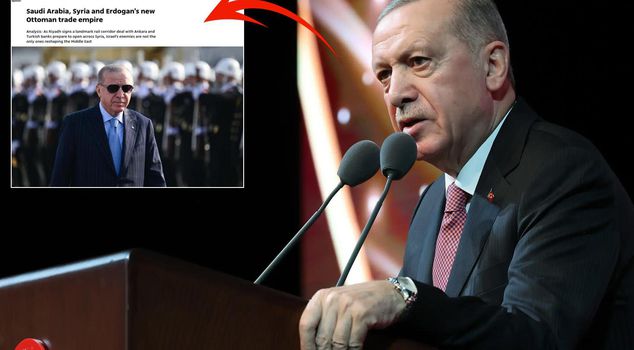
Israel-based Ynet Global analyzed Turkey's moves in the crisis environment where cards are being reshuffled in the Middle East. Noting that President Erdogan turned the regional disaster into a strategic gain, the publication confessed, "Erdogan is laying the groundwork for a new regional order reminiscent of the Ottoman era in the Middle East after the Iran war."
Three months into the US-Iran war that began in late February, the region's map and trade routes are being reshaped. In this devastating process where some countries are on the brink of collapse, Turkey's strategic plans have become the focus of international media.
Ynet Global, a respected Israel-based news site, has penned a much-discussed analysis on "Turkey's future in the reshaping Middle East." The analysis examines President Recep Tayyip Erdoğan's moves under striking headlines.
TURNED A REGIONAL DISASTER INTO A STRATEGIC GAIN
It is noted that at a time when the Israeli Air Force destroyed Iran's nuclear infrastructure and the Israel Defense Forces are fighting on multiple fronts, Turkey not only weathered the process unscathed but also gained new advantages. The most striking finding of the analysis is that President Erdoğan turned a regional disaster into a major strategic gain. The most concrete step of this move was the new road and railway corridor agreement signed between Turkey and Saudi Arabia on Tuesday.
A $5.5 BILLION CORRIDOR BYPASSING HORMUZ
The new corridor, aimed at bypassing the nearly fully closed Strait of Hormuz, will reactivate supply chains in the Gulf. The project, which will reduce cargo transit time by sea from over 30 days to less than two weeks by land, starts from Istanbul, extends through post-Assad Syria to Jordan, and connects to Saudi Arabia's railway network via the Haditha Border Gate. The estimated investment cost of this massive project, with its ultimate goal being Oman and the Indian Ocean, is calculated at $5.5 billion. The Asian Infrastructure Investment Bank (AIIB) has already committed $750 million in investment to Turkey's railway infrastructure.
BIDEN'S "ISRAEL-CENTERED" IMEC PROJECT IS HISTORY
Ynet Global reminded that this move also dealt a major blow to projects that previously sought to bypass Turkey. The IMEC project, announced by US President Joe Biden in September 2023 and aimed at connecting Indian ports to Europe via the UAE, Saudi Arabia, Jordan, and Israel, assumed making Israel an indispensable center of Middle Eastern trade. However, President Erdoğan loudly opposed this situation, not accepting Turkey being ignored. The Saudi Arabia-Turkey corridor announced today, effectively replacing the IMEC project that ended with the Hamas attacks in October 2023, has emerged as the strongest alternative.
"THE STRUCTURE RECEP TAYYİP ERDOĞAN HAS BUILT..."
The analysis states that Turkey is not just on the map but has become one of the most important actors at its center, including the following statements: "The geopolitical structure President Erdoğan has built deserves careful observation from Jerusalem. Because this structure was largely constructed while Israel was preoccupied with war."
TURKISH INFLUENCE IN POST-ASSAD SYRIA
It is reported that in Syria, which forms the operational backbone of the corridor, Turkey has positioned itself as Damascus's indispensable economic patron. The analysis, noting that Turkish companies are active in Aleppo, Turkish banks are preparing to open branches, and the trade target for 2030 is $10 billion, also touched upon the Islahiye railway crossing announced by Trade Minister Ömer Bolat at the Anatolian City Economies Summit in Gaziantep. The fact that freight trains departing from Istanbul will pass through Aleppo and Damascus means that the Eurasian land bridge effectively falls under Ankara's economic influence.
A NEW REGIONAL ORDER REMINISCENT OF THE OTTOMAN ERA
Saudi Arabia's cautious approach to a potential normalization process with Jerusalem and its choice to make a historic logistics deal with Turkey under President Erdoğan's leadership shows that Riyadh prefers to invest in functional infrastructure. Ynet Global concluded its analysis with these striking sentences: "Billions of dollars in trade passing through Turkey's railway network, Turkish banks in Damascus, and Saudi freight passing through Erdoğan's sphere of influence are not ordinary economic transactions. President Erdoğan is laying the groundwork for a new regional order reminiscent of the Ottoman era in the Middle East after the Iran war. Turkey is rising to a stronger and more decisive position, unaffected by the tremors of war."