23.08.2026 15:11
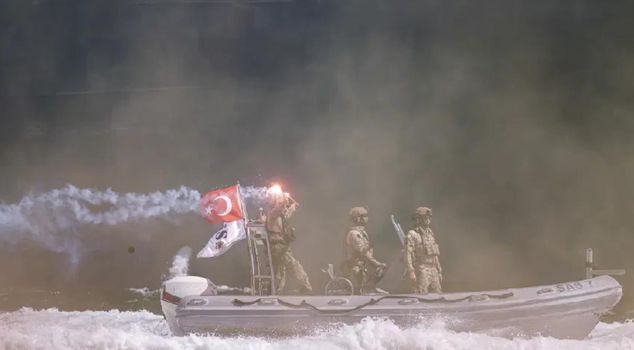
Within the scope of TEKNOFEST Blue Homeland, demonstrations were held by the Underwater Attack (SAT) and Underwater Defense (SAS) commandos affiliated with the Naval Forces Command. Citizens coming to TEKNOFEST from many parts of the country were fascinated by the mesmerizing shows.
TEKNOFEST Blue Homeland is being held at the Gölcük Shipyard Command under the main leadership of the Ministry of National Defense and the Turkish Technology Team Foundation (T3 Foundation).
On the last day of the organization, citizens who took advantage of the weekend began arriving at the event area from the early morning hours.
Visitors, who created density at the entry points, were admitted to the event area after the necessary checks.
In the organization that brings together technology and defense industry enthusiasts with a maritime focus, a wide range of products and technologies, from platforms of different classes of the Turkish Naval Forces to unmanned systems, from aerial vehicles to air defense and missile systems, are being exhibited.
Children who came to the area with their families also showed interest in the technology stands, while visitors took photos in front of the exhibited platforms.
In the event where Turkey's capabilities in the seas are showcased, citizens have the opportunity to closely examine domestic and national defense industry products.
Despite the hot weather, visitors coming to the area toured the stands and followed the shows.
CHILDREN ADMIRED SCIENCE WITH EXPERIMENTS
In the science show, children followed with interest experiments prepared with liquid nitrogen, dry ice, and different materials. The staff invited some children to the stage during certain experiments, including them in the activity. In the experiment utilizing the temperature difference between liquid nitrogen, which reaches minus 190 degrees Celsius, and hot water, dense white vapor formed in a short time.
In another experiment, the pressure created by dry ice inside a closed bottle as it turned into gas was demonstrated. The bottle bursting with increasing pressure gave children exciting moments.
In different shows using liquid nitrogen, the behavior of substances at very low temperatures was conveyed to children in an entertaining manner.
ITU YOUTH TO CONTRIBUTE TO NATIONAL TECHNOLOGY
In the 27-person team consisting of Istanbul Technical University (ITU) students, students from different departments also take part, in addition to space, aircraft, electrical-communications, automation, and computer engineering.
The ITU SUNGUR Rocket Team, which includes Zeynep Betül Köroğlu, a 2nd-year Space Engineering student, aims to contribute to national technology goals with the underwater rocket it developed within the scope of TEKNOFEST Blue Homeland.
Köroğlu, stating that seeing products developed with domestic and national means at TEKNOFEST Blue Homeland makes them proud, said that seeing the technologies they previously followed firsthand increased their desire to produce.
Köroğlu noted that organizations like TEKNOFEST strengthen young people's interest and excitement in technology, saying, "Seeing them one-on-one also makes us proud."
Köroğlu, stating that if the underwater rocket they developed is used in larger projects in the future, it would be very proud for them, noted that contributing to the country and national technology is one of their biggest motivations.
"WE ARE INCREASING CAPABILITIES"
Turkish Aerospace Industries (TUSAŞ) General Manager Mehmet Demiroğlu stated that TUSAŞ is conducting work on 3 main platforms with the Naval Forces, the first of which is the unmanned aerial vehicle AKSUNGUR.
Demiroğlu, explaining that in addition to maritime patrol and surveillance missions, they are carrying out studies for the integration of payloads such as sonobuoys and torpedoes into AKSUNGUR, spoke as follows:
"We are also increasing AKSUNGUR's capabilities based on needs. We aimed to increase its payload capacity, currently 750 kilograms, to 1250 kilograms next year. We are working on this. This is a significant increase for both the Naval Forces and our other users.
At the same time, we planned to do these without reducing, even increasing, the flight duration. We aim to extend the flight duration, which is over 50 hours, to around 60 hours. These are, of course, maximum figures. In our integration activities, we are integrating and will integrate torpedoes, sonobuoys, and different radars for both the Naval Forces and other users. This provides the user with significant capability on the unmanned systems side."
SONAR INTEGRATION FOR GÖKBEY AND 10-TON HELICOPTER
Demiroğlu, stating that the second work area for the Naval Forces is helicopters, said that both GÖKBEY and the 10-ton class helicopter, planned to make its first flight next year, are being prepared in different configurations according to the needs of the Naval Forces. Demiroğlu said, "We have started sonar integration for both GÖKBEY and the 10-ton helicopter. We will have provided the Naval Forces with a serious additional capability in the seas with a domestic sonar."
Demiroğlu, noting that TUSAŞ also conducts work in the unmanned helicopter field, reported that these have made significant progress and they are conducting final tests for different configurations.
"IT WILL BE DIFFERENT FROM THE HÜRJET WE KNOW"
Reminding that work on the ship-deployable version of HÜRJET has been ongoing for some time, Demiroğlu said, "Our work on this has actually been continuing for quite a while. Now it is becoming clearer. The needs will take shape with the formation of our aircraft carrier. This is a long-term project. I can already say that it will be a completely different platform, different from HÜRJET. You will see that it will be different from HÜRJET. Because the requirements are different."
AKSUNGUR ON DUTY IN FIRE FIGHTING
Also touching on forest fire fighting efforts, Demiroğlu said TUSAŞ platforms are used both in the early detection of fires and in extinguishing activities.
Demiroğlu provided the following information:
"We are conducting the fight against fire through two main platforms. The first is ANKA and AKSUNGUR. Here, AKSUNGURs are used more because they can stay in the air for long periods. Because catching the fire at an early stage is very important. So that it can be intervened quickly and extinguished swiftly. In this sense, an eye in the sky telling you where the fire is and which direction it is heading, regardless of day or night, is very important. We have communication systems integrated into AKSUNGUR. We can also provide communication when GSM does not work in mountainous areas. This provides a significant advantage in fighting fires."
Demiroğlu, stating that almost all T-70 helicopters were delivered with firefighting capability, said that 3 helicopters are in the inventory of the General Directorate of Forestry, and if needed, helicopters in the inventory of other forces can also be used for firefighting.
Noting that the 10-ton class helicopter developed by TUSAŞ will also be used in firefighting missions, Demiroğlu made the following assessments regarding the project:
"We currently have our 10-ton helicopter we are working on. We showed its mock-up at IDEF last year. That work has now come to an end, and the product has started to emerge. We will be conducting its tests next year. In 2028, we aim to deliver 8 helicopters for firefighting purposes, capable of carrying up to 4 tons of water. It being over 2.5 tons is very important. Those below are not effective, but when it is 2.5-3 tons, up to 4 tons, it is much more effective. These will be able to carry 4 tons. The other helicopters we will build for the land and air forces will also have this feature. All our helicopters will have the infrastructure to be used in firefighting when necessary."
KAAN PREPARING FOR NEW FLIGHTS
Mehmet Demiroğlu, answering questions about the latest status of the KAAN project, stated the following:
"KAAN's first prototype flew, but the second and third prototypes we will use in the main tests are under intense work. The first has started taxi tests. The second has now moved to the final assembly line. Our goal is to prepare these two prototypes for flight within this year. Hopefully, we will see two prototypes flying side by side in our skies this year. The armed configuration will come next year. That is, we will first use these two in envelope expansion tests. Then, a configuration where we integrate the weapons and systems will emerge. Let's say this time next year, we will be conducting an intensive test campaign with 3 KAANs."
Also making assessments regarding KAAN's localization rate, Demiroğlu said, "KAAN is the most domestic prototype we have made to date. Except for the engine and the ejection seat, all the others have either been domestically produced and installed, or will be made during the second and third prototype stages. So we can say around 90 percent. If you are talking about a 90 percent localization rate when you are building a fifth-generation aircraft, that is a tremendous success."
Demiroğlu, stating that domestic engine work is also continuing intensively, said, "Hopefully, the work on our domestic engine continues intensively. We will start its tests around 2032. When we make that domestically, nothing non-domestic will remain. We will start deliveries as a fully domestic and national platform."
Demiroğlu, stating that flight and certification activities continue in the HÜRJET program, said the agreement with Spain was an important export success for TUSAŞ, the Turkish defense industry, and Turkey.
Demiroğlu stated, "The contract with Spain was a very important agreement both for us as TUSAŞ and for our sector and country. We have demonstrated the success of exporting a jet trainer aircraft to a NATO country. This is truly prideful. It is a great success in showing the point we have reached as a country and as a sector."
Demiroğlu, announcing that the two prototypes of HÜRJET have reached approximately 550 hours of test flights, continued his words as follows:
"We are currently making 4 more prototypes. The first two of these will start flying this year, just like KAAN. We can even say they are weeks away. Then 2 more will follow. We will be conducting an intensive test activity with a total of 6 HÜRJETs, together with KAAN, buzzing like a beehive in the coming months and year. We have a commitment to start deliveries to the Turkish Air Force at the end of 2027 and to the Spanish Air Force in 2028. We have to keep this; we are doing our best for this, and deliveries will start on the given dates."
Mehmet Demiroğlu, in response to the question of whether HÜRJET would seek new missions abroad, answered, "Definitely, because there is serious demand and interest. England, Japan, Canada, Malaysia, and other countries. Our discussions with many countries continue. We will see whether they will conclude successfully, but we can easily say this: HÜRJET is an aircraft positioned in a very good place. It is an aircraft positioned at the right time and capable of meeting needs. In the coming months and years, we will hopefully share export successes like Spain and experience the joy together."