16.10.2026 12:51
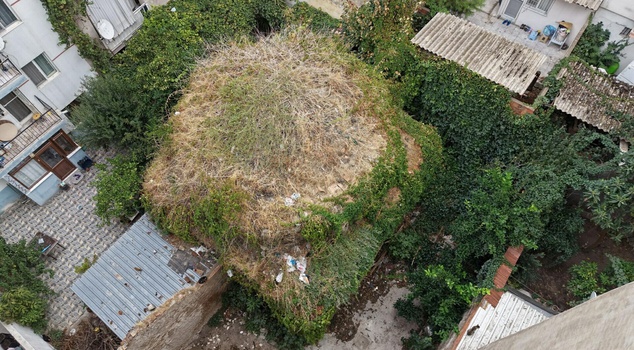
The Hindistani Madrasa, estimated to have been built in 1461 in Manisa, has been squeezed between apartment buildings. While most of the structure remaining from the Ottoman period has been destroyed, its last surviving part is being used as a coal cellar, and garbage is thrown into it. Local history researcher Erkan Akbalık said that the last remaining part of the madrasa must be saved.
The Hindistani Madrasa, estimated to have been built in Manisa in 1461, became squeezed between buildings over the years. While most of the historic structure that has survived from the Ottoman period to the present has been lost, it was stated that the last remaining part standing is used as the coal cellar of apartment buildings. Local history researcher Erkan Akbalık said that the madrasa, one of the city's important educational structures, should be protected and restored to be passed on to future generations.
Located on Terzi Street in Ege Neighborhood, the Hindistani Madrasa stands among the city's historical heritage with a history of approximately 565 years. The madrasa, stated to have been commissioned by Velet Bey, son of Besayiş Ağa, one of the umera, is considered to have been an important educational center in the second half of the 15th century. The structure, notable for its square plan, stone walls, and domed architecture, carries traces of the past to the present with the part that remains standing despite the passing centuries. The madrasa, where students once studied, mudarrises taught, and activities were maintained with foundation revenues, is today left between apartment buildings. It was stated that most of the historic structure has not survived to the present, and the remaining part is used as a coal cellar of apartment buildings.
ONE OF MANISA'S OLDEST MADRASAS
Manisa local history researcher Erkan Akbalık, noting that the Hindistani Madrasa should not be considered merely as an old structure still standing, drew attention to its historical importance. Pointing out that the madrasa's construction date dates back to the 1460s, Akbalık said, "This madrasa is actually very important. In terms of its history, it is one of Manisa's old madrasas. Its construction date is approximately the 1460s. In other words, it is accepted as the second half of the 15th century. The madrasa was commissioned by Velet Bey, son of Besayiş Bey, one of the umera of the period. His father was also a figure who lived in Manisa during the reign of Fatih Sultan Mehmet. Therefore, the structure witnesses an important period of Ottoman history."
Explaining that Velet Bey also had income-generating structures built around the madrasa so that it could continue its activities, Akbalık stated that revenues obtained from the caravanserai, inn, garden, and shops were used to cover the madrasa's expenses. Stating, based on archival documents, that the madrasa had an annual income of approximately 14,480 akçe, Akbalık recorded that with these resources the mudarrises' salaries were paid, students' food, drink, and other needs were met, and guests' expenses were also covered from these revenues. Emphasizing that the madrasa's past size was not limited to the section seen today, Akbalık said, "According to experts' assessments, the structure that has survived to the present is considered the madrasa's masjid or small classroom. However, the madrasa's main building was much larger. We can see this from historical photographs. The structure had features similar to the Sinan Bey Madrasa in Manisa. In addition, there was an inn nearby for the accommodation of visitors from outside."
Expressing that they have not yet reached a definitive document regarding when the madrasa lost its function, Akbalık said that in archival records, information about educational activities up to 1906 is found. Stating that during this period mudarrises served in the madrasa and students studied, Akbalık expressed that in the following process the structure may have lost its function, but this cannot be definitively documented. Conveying that they think the fires during the Greek occupation may have been effective in the main part of the structure not surviving to the present, Akbalık said, "Unfortunately, the main building located on the northern side of the madrasa, toward Kurşunlu Han, has not survived to the present. This madrasa was one of the 8 madrasas in Manisa in the 16th and 17th centuries. It was among important educational structures such as the Muradiye, Sultan, Ulu Cami, and Sinan Bey madrasas. Therefore, the history and importance of the Hindistani Madrasa must not be forgotten."
WE MUST SAVE THE LAST REMAINING PIECE
Emphasizing that the Hindistani Madrasa must be protected and restored, Akbalık stated that due to development plans and surrounding construction, it may be difficult to reveal the historic building again. Expressing that the condition of existing surrounding structures should also be taken into account, Akbalık said that nevertheless the madrasa should not be left to its fate. Akbalık said, "We must save the last remaining part of the building. Rearranging this place may be difficult and costly. However, we must prevent the building from being demolished before our eyes. This is one of Manisa's historic educational structures where important figures were raised. We must have it repaired and at least ensure it remains standing."
GARBAGE IS THROWN INSIDE, THERE HAVE BEEN THOSE WHO LIT FIRES
Neighborhood resident İsmail Avşar, on the other hand, said that the current condition of the historic structure also creates a problem for those living around it. Arguing that the building's entrance and use should be rearranged, Avşar stated that during periods when the structure was open, they experienced discomfort because of people entering inside. Avşar said, "When we bought this place, we had no idea about such a situation. Later it was said that this place would become a road. Since this place has remained like this, I do not understand why its entrance was not made from the other side. It is currently used as a coal cellar. People also throw their garbage here. When this place was open, there were people entering inside. There were those who entered and lit fires. Families live here. A solution must be found for how this structure will be used and how it will be protected."