25.08.2026 12:10
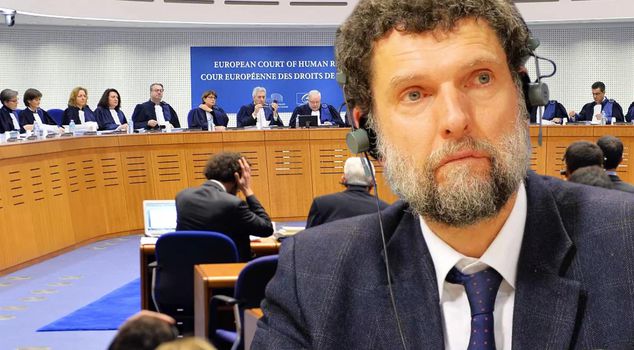
The Grand Chamber of the European Court of Human Rights (ECHR) has announced its decision regarding Osman Kavala, a convict in the Gezi case. The Grand Chamber ruled that Kavala's release should be secured as soon as possible and that Turkey must pay compensation to Kavala.
The Grand Chamber of the European Court of Human Rights (ECHR) has announced its decision regarding Osman Kavala, who was convicted in the Gezi Case.
"WITHOUT DELAY"
The decision regarding Osman Kavala was announced by ECHR President Mattias Guyomar. The Grand Chamber ruled that Kavala's "release must be ensured at the earliest possible opportunity" and that Turkey must pay compensation to Kavala.
Guyomar stated, "The judgment notes that, given the seriousness of the violations found, the respondent state must ensure the applicant's release at the earliest possible opportunity."
The ECHR also ruled that Turkey must pay compensation to Osman Kavala.
NO FURTHER APPEAL AVAILABLE
As this is a Grand Chamber judgment, Turkey's avenues for appeal against the decision have been exhausted. The ECHR Grand Chamber is the highest court of this judicial body. Therefore, Turkey, as a state party to the ECHR Convention, has no remaining appeal options regarding Kavala.
The judgment requested that Osman Kavala "be placed in the legal position he would have been in had the European Convention on Human Rights not been violated." The ECHR argued that Kavala's conviction should be considered "null and void" under Convention law.
HERE IS THE ECHR'S DECISION ON OSMAN KAVALA
The ECHR decision is summarized as follows:
"The acts underlying the conviction consisted largely of participating in public debates, supporting civil society initiatives, disseminating information, and engaging in advocacy activities connected to the Gezi Park events. The Court concluded that these constituted an interference with the rights protected under Articles 10 and 11 of the Convention.
The judgment stated that this interference could not be considered 'prescribed by law' within the meaning of Articles 10 and 11 of the Convention and ruled that these articles had been violated. Although the offense defined in Article 312 of the Turkish Penal Code involves the use of force and violence, the domestic courts failed to establish a concrete causal link between the applicant's actions and the violent incidents that occurred during the Gezi Park protests.
The judgment concluded that the applicant's detention before and after his conviction was unlawful under Article 5, paragraph 1, of the Convention, and that his deprivation of liberty since 10 December 2019 constituted a violation of the Convention. The present judgment states that subsequent proceedings did not remedy this violation. No new, specific, or convincing evidence was presented. The applicant's conviction was not based on any specific act of violence. Kavala must be released without delay.
The applicant's prolonged deprivation of liberty undermines the freedom of political activity. These principles are fundamental to a democratic society. The Court ruled that the applicant should be paid compensation for the non-pecuniary damage he suffered, as well as for legal costs and other expenses."