17.11.2026 09:11
Assoc. Prof. Dr. Hayrettin İhsan Erkoç from ÇOMÜ and Prof. Dr. Gürhan Kirilen from Ankara University revealed that Bilge Kağan had a palace city built in the Orkhon Valley. The clue emerged from an explanatory note in a poem written in the 13th century by the poet Yelü Zhu, son of Genghis Khan's vizier. It was determined that the city is in the Hotont town of present-day Mongolia; traces of structures were seen in satellite images, and excavation is needed for a definitive result.
As a result of his studies, Çanakkale Onsekiz Mart University faculty member Assoc. Prof. Dr. Hayrettin İhsan Erkoç discovered that Bilge Kagan had a palace city built in the Orkhon Valley.
Professor Dr. Gürhan Kirilen, Head of the Department of Sinology and faculty member at Ankara University Faculty of Languages, History and Geography, noticed in an explanatory note that Kitan-origin poet and statesman Yelü Zhu added to a poem he wrote that Bilge Kagan mentioned a palace city. Thereupon he shared the matter with Assoc. Prof. Dr. Hayrettin İhsan Erkoç, faculty member of ÇOMÜ Faculty of Humanities and Social Sciences, Department of History, Division of General Turkish History. As a result of the academics' extensive research, the city was determined to be located in present-day Hotont town in Mongolia. In his statement about the new discovery, Erkoç said, “We understand that a situation like ‘the Göktürks were nomads’ in the stereotyped expressions in Chinese sources is actually not that simple. There are many settlements. In the advancing processes, perhaps within decades, our knowledge about the history of ancient Turkic urbanism in the region, that is, in Mongolia, may perhaps change a great deal.”
THE CLUE EMERGED IN A POEM FROM THE 13TH CENTURY
Stating that they started this research with a note in a poem read by his colleague, faculty member Assoc. Prof. Dr. Hayrettin İhsan Erkoç said, “As a result of our work, we determined that Bilge Kagan had a palace city built in the Orkhon Valley. The person who first noticed this was my esteemed colleague and friend Prof. Dr. Gürhan Kirilen. The professor noticed this in an explanatory note within a poem written in the 13th century. A few weeks ago, I did not know that such a text existed. Because I am a historian, and historians generally do not look at literary texts very much. However, one needs to look. We have come to understand this as well. A poet named Yelü Zhu gives us this information. He is of Kitan origin, not originally Chinese, but from a community related to the Mongols. Yelü Zhu passed through this region in his youth. His father was a vizier of Genghis Khan; the son of a vizier named Yelü Chucai. He gives us the following information: ‘Thirty-five kilometers northwest of the Mongol capital Karakorum, or at the same time thirty-five kilometers southwest of the Kül Tigin inscription, lies Bilge Kagan’s palace city,’ he says. This means that during his own lifetime the ruins were still visible. We understand that he knew the region well, so he did not sit in the capital in China and write. He went there himself and saw these places. We understand that he is a reliable source. Karakorum, the capital of the Mongol Empire, was founded by Ögedei Kagan in the 1230s. In fact, he tells us that this was a revival of a tradition there. ‘These places were actually Bilge Kagan’s old lands; at such and such a distance there was a palace city,’ he says. Gong means palace, and cheng means city in Chinese; it means a structure surrounded by walls, a settlement, actually. The poet wants to tell us here that Karakorum was already founded very close to there, inspired by this. He was also a statesman,” he said.
TONYUKUK HAD OPPOSED IT
Drawing attention to the fact that Hotont town and its surroundings were the administrative center of Turkic and steppe states, Assoc. Prof. Dr. Hayrettin İhsan Erkoç said, “When we look at satellite images, the Uyghurs dominated this region immediately after the Göktürks. Again on the banks of the Orkhon River, they had a capital known as Ordu Balık or Karabalgasun, and this is very close to the place we mentioned, that is, about 15 kilometers away. The Orkhon Inscriptions are again in this region. The Mongol capital was later founded here as well. This place has actually been the administrative center of all these Turkic and steppe states since the Huns. Therefore, it is not a coincidence. In the main Chinese sources that mention the Göktürks, in dynastic annals and other official lists, the following anecdote is told: ‘Bilge Kagan wanted to have a city surrounded by walls built, to have a capital built. He also wanted to have Buddhist and Taoist temples built inside.’ Indeed, when he submitted this to the state council, the advisors and statesmen accepted it. However, his main advisor Tonyukuk objected. He warned, ‘This is contrary to our way of life; the reason we are advantageous is that we live mobile lives, that we are nomadic. If we build a fixed city, this place could fall into the enemy’s hands.’ According to what this source tells us, Bilge Kagan and the statesmen gave up. However, as far as we understand, the matter did not end that way. The anecdote I mentioned is not found in the Göktürks’ own inscriptions; it is found in Chinese sources. Frankly, we have doubts about its accuracy. We historians and linguists approach it somewhat skeptically. But as far as we understand, Bilge Kagan may have been initially convinced by his advisor Tonyukuk’s views, but afterward we understand that he had this city built,” he said.
TRACES OF STRUCTURES IN SATELLITE IMAGES
Assoc. Prof. Dr. Erkoç continued his words as follows:
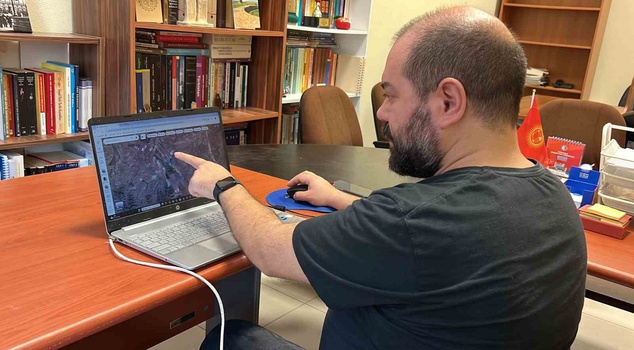
“Today it corresponds to a town called Hotont. When we look at satellite images and the distances given, Professor Gürhan was already the first to notice this with his calculations. Today there is a town called Hotont in the region I mentioned. When we look at satellite images, we saw traces of structures here. There are several such different structures. Of course, whether these structures belong directly to Bilge Kagan’s palace or are works from a later period, we do not know at present. I think we will probably be able to speak more clearly with archaeological work to be carried out in the region. A surface survey needs to be conducted there, perhaps excavations are needed. We will have initiatives regarding this. Chinese sources use very stereotyped expressions, especially about the Göktürks: they live by following water and pastures, they have no fixed places, and they give such prejudiced information. But, for example, from the Göktürk Inscriptions we know that there were actually some cities and fortresses in these regions. It already seemed very strange to think that they had no capital when there were such cities and fortresses. And from the Uyghurs immediately afterward, around 50 settlements have currently been identified in the Orkhon Valley alone. We understand that a situation like ‘the Göktürks were nomads’ in the stereotyped expressions in Chinese sources is actually not that simple. There are many settlements. In the advancing processes, perhaps within decades, our knowledge about the history of ancient Turkic urbanism in the region, that is, in Mongolia, may perhaps change a great deal.”