04.11.2026 10:22
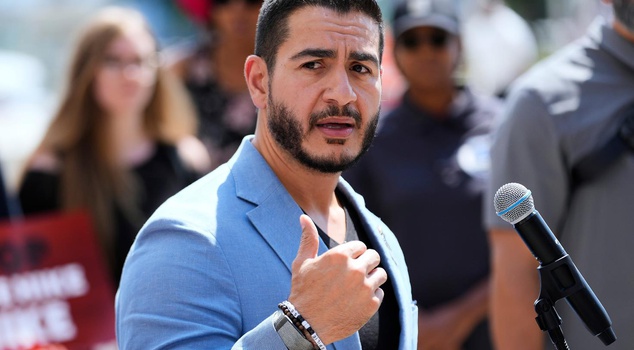
A historic first took place in the US midterm elections. The Democratic Party’s Michigan candidate, Abdul El-Sayed, defeated his Republican rival Mike Rogers to become the first Muslim elected to the Senate in US history. The Egyptian-origin politician had been targeted by Donald Trump’s harsh criticism throughout his election campaign.
A historic result came from the state of Michigan in the midterm elections held in the US on November 3. Democratic Party candidate Abdul El-Sayed won an election victory against Republican Party candidate and former House of Representatives member Mike Rogers. Thus, 42-year-old El-Sayed entered history as the first Muslim politician elected to the Senate since the founding of the US. The election result gained particular significance after US President Donald Trump's statements targeting El-Sayed.
FIRST MUSLIM SENATOR IN US HISTORY
According to the election projection announced by Decision Desk HQ on November 4, Abdul El-Sayed won the Senate race in Michigan. At the stage when approximately 77 percent of the votes had been counted, the Democratic candidate reached 50.88 percent with 1,897,833 votes, while Republican Mike Rogers remained at 47.14 percent with 1,758,007 votes.
Thus, El-Sayed left his opponent behind by a margin of approximately 140,000 votes. The projection announced while the official count continued demonstrated the Democratic candidate's victory and also opened a new page in the history of the US Senate.
TRUMP HAD TARGETED HIM IN THE ELECTION CAMPAIGN
Abdul El-Sayed's election victory also drew attention because of the fierce disputes he had with US President Donald Trump. At an election rally he held in Michigan on October 25, Trump targeted the Democratic candidate over his Muslim identity and referred to the September 11 attacks.
While Trump explicitly stated that he wanted to prevent El-Sayed from being elected to the Senate, he accused the Democratic politician of being a jihadist and a member of the Muslim Brotherhood. El-Sayed, in turn, rejected these claims and reacted to Trump's rhetoric directed at him.
According to Reuters, Trump also said that if El-Sayed were elected, he would be the only senator required to pass through a metal detector when entering the Senate. These statements were among the most controversial topics of the election campaign.
HE OPPOSES MILITARY AID TO ISRAEL
Throughout his election campaign, El-Sayed also stood out with his criticism of US policy toward Israel. The Democratic politician, who criticized the Israeli government because of the war in Gaza, stated that he opposed providing military aid to Israel with American taxpayers' money.
This stance also caused disagreements within the Democratic Party. In particular, some Democratic politicians who support Israel reacted to El-Sayed's statements, while progressive voters supported the candidate's foreign policy approach.
In his election campaign, El-Sayed also focused on promises such as making healthcare accessible to everyone, reducing economic inequalities, and limiting the influence of large corporations in politics.
WHO IS THE POLITICIAN OF EGYPTIAN ORIGIN?
Born on October 31, 1984, in Rochester Hills, Michigan, as the child of an Egyptian immigrant family, Abdul El-Sayed continued his education at the University of Michigan, the University of Oxford, and Columbia University. El-Sayed, who earned a doctorate in public health, also received medical training.
Appointed as Detroit's health director in 2015 when he was only 30 years old, El-Sayed later served as the head of the Wayne County Department of Health, Human Services, and Veterans Services.
Entering his first major race in his political career for the Michigan governorship in 2018, El-Sayed lost to Gretchen Whitmer in the Democratic Party primaries. The politician, who announced his Senate candidacy in April 2025, won the Democratic Party primary in August 2026 and became the rival of Republican Mike Rogers.
HE WON DESPITE THE CRISIS WITHIN THE PARTY
The Senate race in Michigan also drew attention with an unexpected development within the Democratic Party just before the elections. House of Representatives member Haley Stevens, who lost to El-Sayed in the Democratic Party primary, announced two days before the election that she supported Republican candidate Mike Rogers.
Stevens's decision caused debates within the Democratic Party. El-Sayed, when faced with questions about this development, stated that he was focused on voters' problems such as the high cost of living.
Despite the disagreements within the party, El-Sayed won the Senate race in Michigan and earned the right to take over the seat of Democratic Senator Gary Peters, who is leaving office.