17.10.2026 10:50
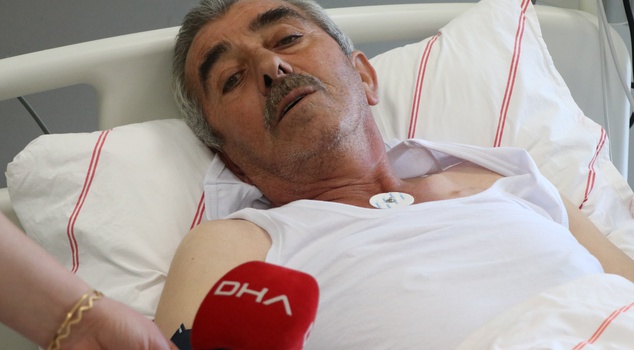
Mustafa Küçük, 64, who had a pacemaker implanted due to heart failure in Kayseri, experienced nearly 60 pacemaker shocks in one day. The patient, who did not respond to medication or the shocks, was urgently taken into surgery at Kayseri City Hospital; when the areas in his heart causing a rhythm storm were burned with ablation, his condition stabilized. Küçük described what he experienced with the words, 'The palpitations were killing me and bringing me back to life again and again.'
In KAYSERİ, Mustafa Küçük (64), who has a pacemaker in his heart, regained his health through an ablation (heart burning) procedure performed at Kayseri City Hospital, where he was taken into surgery because he experienced nearly 60 pacemaker shocks in one day. Assoc. Prof. Dr. Serhat Karadavut from the Cardiology Department of Kayseri City Hospital said, 'If this treatment could not have been applied, a serious problem would have occurred because he did not respond to the shocks and medication. His heart rate rising to 180-300 would then have caused cardiac arrest, and we could have lost the patient.'
Mustafa Küçük, living in Kayseri, had a pacemaker implanted at a private hospital some time ago due to heart failure. Afterwards, Küçük, who experienced many shocks in his heart, applied to Kayseri City Hospital. After the necessary examinations were performed in the cardiology department, Küçük was taken into surgery; a map was created of the areas in the left ventricular part of the inside of the heart that caused the storm, and the areas causing the shocks were identified. With the ablation procedure applied to these areas, Küçük overcame the shocks in his heart and regained his health.
Explaining the process, Mustafa Küçük said, 'I have been a heart patient for 10 years. Four days ago I was very distressed. My heart was beating like lightning. The palpitations were killing me and bringing me back to life. Thanks to the doctor, I hope I will be well.'
NEARLY 60 SHOCKS IN ONE DAY
Assoc. Prof. Dr. Serhat Karadavut from the Cardiology Department of Kayseri City Hospital said, 'Our patient is 64 years old. He has a pacemaker that was previously implanted due to heart failure. He came to us with a complaint of multiple shocks. We first admit such patients and try to stop the ventricular tachycardia (VT) storm with medication in intensive care, and we usually get a response. Because he has a pacemaker, it can also be stopped by shocking. However, in our patient, despite medication or multiple shocks, we could not stop the VT storm. In fact, he had nearly 60 shocks in one day, and afterwards the battery ran out anyway. In a VT storm, the heart rate rises to 180-200, the patient's blood pressure drops and therefore his consciousness is impaired. We took the patient into surgery urgently. By mapping the areas in the left ventricular part of the inside of the heart that caused the storms, we found the relevant areas. After applying ablation to these areas, the patient's storm stopped and his condition stabilized. Since the battery ran out, we also planned a battery replacement in the following period.'
IF NOT TREATED, WE COULD HAVE LOST THE PATIENT
Assoc. Prof. Dr. Karadavut, stating that it is a source of pride that such operations can be performed at Kayseri City Hospital, said, 'If this treatment could not have been applied, it would have caused a serious problem because there was no response to the shocks and medication. His heart rate rising to 180-300 could then have caused cardiac arrest and led to the patient losing his life. In that respect, it was of vital importance. The procedure we performed made a vital contribution to our patient.'
IF YOU HAVE HEART COMPLAINTS, DO NOT FORCE YOURSELF
Emphasizing that rhythm disorders are confused with heart attacks among the public, but that this is a different condition, Karadavut concluded his words as follows:
'Heart rate rising after intense exertion, especially if there is also a genetic predisposition, can cause a sudden electrical deterioration. The heart rate can rise to as high as 250, as if the heart were short-circuiting. This situation can cause cardiac arrest in the patient and lead to loss of life, so it is very important. It is of great importance not to say, 'I open up my heart by pushing myself, it will get even better' while exercising, and not to force the body the moment a complaint is felt in the heart.'