02.11.2026 04:50
It is thought that the three-year-old Australopithecus africanus infant known as the Taung child, who lived in South Africa 2.8 million years ago, was killed by a giant bird of prey. The puncture marks below its eye sockets match the claw marks of eagles. According to experts, the hunting pressure of birds of prey may even have influenced human socialization and the evolution of language.
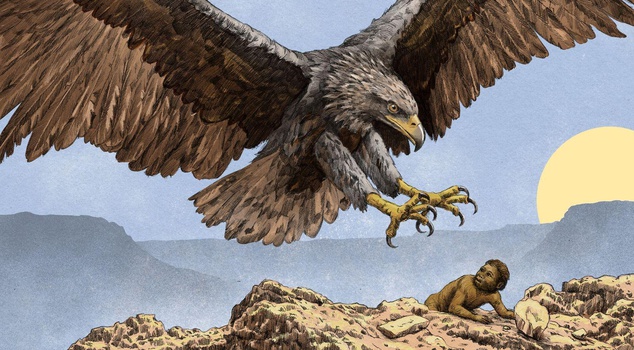
A child descended from our ancient ancestors, only three years old and teething, was wandering among the swaying grasses of the South African savanna 2.8 million years ago. This little one, of the species Australopithecus africanus, was unaware of being watched from above.
Without any warning, a huge bird of prey swooped down. It seized the little one and killed it.
Warning: Some readers may find the details in this article disturbing.
It is not known for certain which species of bird ate this early human infant, known as the “Taung Child.” But the puncture marks just below its eye sockets match the claw marks of eagles that seize their prey in this way, hiding some of their prey in trees and carrying the rest to their nests.
The Stone Age was a time when life was extremely dangerous. The world was dominated by megafauna (giant animals). Early humans lived alongside mammoths, mastodons, giant sloths, saber-toothed cats, and enormous birds capable of eating children.
For tens of millions of years between the extinction of the non-avian dinosaurs and the Great Ice Age, these giants ruled the skies. Their dominance may have shaped the course of human evolution in profound and often overlooked ways. It is even thought that these birds may have inspired legends of “child-snatching birds” that continued to live in cultures around the world long after they became extinct.
WHERE DID THESE MONSTER BIRDS COME FROM?
When the non-avian dinosaurs were wiped from the planet, the sky was covered with dust and most plants disappeared. For animals, almost only seeds remained as food. This suited birds very well. When their natural enemies disappeared, some small, ground-dwelling, beaked birds that managed to survive evolved into enormous sizes.
Some of these were herbivores. For example, the species that lived in Australia and were called “demon ducks of doom” (Dromornithidae). They looked like today's ducks but were 100 times larger and even heavier than cows. Some took to the skies, transforming into giant oceanic predators such as Pelagornis sandersi, known as the largest flying bird ever to have lived, with a wingspan of seven meters.
Others took over the roles left vacant when dominant land predators such as Tyrannosaurus went extinct. Where there were large prey, even larger predators evolved.
These were the terrifying birds that our ancestors had to contend with.
MODERN AND ANCIENT CLUES
Primatologist Scott McGraw of Ohio State University in the US says, “Birds of prey have existed for as long as primates have existed.” “Moreover, these birds of prey have always hunted primates, including us and our relatives.”
Traces of the ancient conflict between our ancestors and giant birds can still be found in the wild today. When McGraw examined the remains of more than 600 modern primates killed by birds of prey such as African crowned eagles in the Taï Forest in Ivory Coast, he saw a striking resemblance to the claw marks on the remains of the “Taung Child.”
McGraw notes that some skulls had damage at the base of the eye socket, that is, on the bony surface inside the eye socket. “The eagle either gouged out the eyes with its beak or pulled them out with its talon.”
“When one of the reviewers evaluating our study went to the fossil repository and examined the Taung Child, he saw that the damage was exactly the same.”
McGraw believes that birds of prey regularly hunted human ancestors. In fact, according to him, this predation pressure from birds may have been one of the most important selection pressures in the evolution of primates, including humans.
McGraw says, “If we now go back and examine human fossil collections gathered over the years more closely, since we now know what to look for, there is a very high chance that we will find other traces of damage caused by birds of prey.” “If what we observed in the Taï Forest is taken as an indicator, this is actually quite an ordinary thing.”
HOW DID BIRDS OF PREY SHAPE OUR EVOLUTION?
James Cole, an archaeologist and applied sciences specialist at the University of Brighton in the UK, states that there is little doubt in the paleoanthropological record that early humans were prey.
“In particular, older hominins such as the infant Australopithecus africanus eaten by an eagle are one example.”
Cole says that our earliest ancestors were “food” for many predatory species. “We were definitely in the prey position.”
The need to escape various predators, from birds to leopards and from hyenas to giant crocodiles, must have placed significant evolutionary pressure on our ancestors. The possibility of becoming food for giant birds is thought to have shaped both our bodies and our minds.
For example, our ability to stand on two legs may have made it easier for us to notice predators. Behaviors such as cooperation, mutual dependence, and protecting one another may also have helped us. Cole emphasizes that group size became very important and says, “There is safety in numbers.”
McGraw adds that when it comes to avoiding birds of prey, the larger the social group, the better.
Unlike predators such as lions or wolves that actively chase their prey, birds of prey generally hunt by ambush. These highly stealthy animals, such as crowned eagles, hide among the trees until the right moment comes. This suggests that humans' tendency to be social may have stemmed specifically from the need to avoid birds of prey. A large number of individuals within a group can stand watch against a sudden attack, and this is called the “many eyes effect.”
Cole adds that larger groups may also have contributed to the emergence of language. “In a large group, roles begin to specialize. When some people do one task while others deal with another, this requires coordination. Once the group begins to split into parts in this way, coordination can no longer be achieved simply by seeing one another.”
According to Cole, for simple forms of communication such as hand gestures to work, people need to be able to see one another. But when coordination beyond the line of sight is required, such as warning of an approaching predator, “that is exactly where language comes in,” he says. McGraw states that the pressure to avoid the danger of death from above may have triggered the evolution of language. The available evidence shows that most primates use general warning signals for different predator species, for example giving the same vocal warning for a lion or a leopard. However, when it comes to birds of prey, they respond with specific vocal warnings. McGraw notes that this kind of signaling behavior can be interpreted as a precursor to language.
MEET THE CULPRITS: EAGLES AND TERATORNS
The Americas are thought to be the most important place where giant birds of prey and our human ancestors crossed paths.
The first Americans may have encountered teratorns. These were enormous carnivorous birds capable of swallowing their prey whole. These birds, which soared through the sky and resembled vultures, had wingspans of six meters. They both scavenged carrion and were predators. Joanne Cooper, senior curator of bird anatomy collections at the Natural History Museum in London, says it was large enough to get airborne just by spreading its wings and using rising air currents. Teratorns, which dominated the skies for about 25 million years, went extinct about 10,000 years ago, long after the first humans arrived in the Americas. Cooper says teratorns may have inspired Thunderbird legends. Native American mythology includes the figure of the "Thunderbird," believed to have a massive wingspan and to control thunder and lightning.
Aiolornis incredibilis, also known as the "incredible teratorn," spread terror across southern California and Nevada, and its wingspan reached up to five and a half meters. Further north, in Oregon, lived Teratornis woodburnensis, with a wingspan of four meters. This sky monster existed about 12,000 years ago. Its fossils were found alongside the remains of mammoths, mastodons, giant sloths, and the first humans.
At the other end of the world, in New Zealand, the giant eagle "Te Hokioi," which appears in the legends of the island's indigenous Māori people and is said to have snatched children away, is thought to be based on the extinct giant Haast's eagle.
Cooper describes the Haast's eagle as "practically a flying tiger." This bird weighed about twice as much as the harpy eagle, one of the largest eagle species alive today. The Haast's eagle fed on a bird species that was just as gigantic as itself but lived on the ground—the four-meter-tall moa. The giant eagle would swoop down and, with the serious momentum provided by its weight, drive its 10-centimeter-long talons into its prey's back and bring it to the ground.
"We see these giant claw marks on some moa pelvic bones," says Cooper, drawing attention to the fact that the Haast's eagle may have been just as capable of attacking humans. "Children were definitely at risk. It must have been both awe-inspiring and terrifying. "
Perhaps this is why, in addition to Māori and North American cultures, legends about child-snatching birds have survived to the present day in Greek mythology, where storks are believed to abduct babies rather than bring them.
Cooper says, "These birds cast a shadow as they fly over us, and they have also left a long cultural shadow around the world."
HOW DID WE SURVIVE THE FIGHT AGAINST GIANTS?
Giant birds of prey ruled the skies for about 50 million years in total. Then, 2.6 million years ago, Earth entered the Great Ice Age of the Pleistocene epoch. The Pleistocene was a period of severe climate changes thought to have accelerated human evolution.
By contrast, by the end of that epoch—11,700 years ago—nearly all giant mammals had become extinct, and the largest birds of prey had disappeared. Experts do not have a definitive view on whether climate change or human hunters were responsible for the extinction of the megafauna. But the spread of humans and the changes we made to ecosystems coincided with the extinction of up to 95 percent of the megafauna.
Cooper says, "We were either trying to eat them or competing with them." Perhaps this explains the tension between humans and birds of prey that has continued to this day. "We admire them, we hold them in great respect, but it cannot be said that we are very happy to live side by side with them. "
As we left the Pleistocene behind, the climate began to stabilize. Glaciers retreated and humans turned to agriculture. This was the dawn of a new era—the age of humans.
We used artificial intelligence to translate this article, whose original is in English. A BBC journalist checked the translation before publication.