14.05.2026 21:40
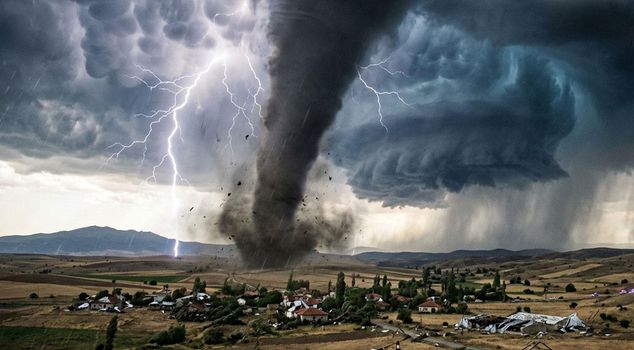
Turkey was under siege from natural phenomena today. On a day when 4 tornadoes, 8 supercells, and hail at 13 different locations were recorded, extreme weather conditions simultaneously affected all parts of the country.
Turkey today experienced a day of rare activity in meteorological history, almost showcasing a spectacle of natural events.
Images from different regions of the country revealed a wide range of extreme weather conditions, from supercells and tornadoes to desert dust and rare cloud formations.
TORNADOES HIT 3 CITIES: THERE ARE INJURED
The heaviest toll of the day came from Çorum. A giant tornado formed in the Oyaca and Kavşut villages of the Sungurlu district, ripping off roofs of houses and uprooting trees; 4 people were slightly injured. Simultaneously, a huge vortex formed in an empty area in the Kızılırmak district of Çankırı, while a tornado observed in the Seyrek area of the Menemen district in Izmir was recorded second by second over the Menemen Plain. Additionally, 1 waterspout was observed off the Mediterranean coast.
SUPERCELL AND DOWNBURST EFFECT
Extreme heating in the atmosphere triggered the formation of 8 separate supercells. These structures, particularly effective in the northern part of Central Anatolia and the Western Black Sea transition, caused walnut-sized hail at 13 different points. The sudden air current called downburst, effective in Denizli and its surroundings, instantly intensified the storm to a fierce level.
RARE CLOUDS
Along with the thunderstorm activity continuing throughout the day, approximately 1,000 lightning strikes flashed across Turkey almost simultaneously. Mammatus clouds and Undulatus asperatus clouds, known for their wavy structure, seen in the skies of Istanbul and Kocaeli before the storm, created an apocalyptic scene in the sky.
DESERT DUST IN THE SOUTH, STORM LINE IN THE WEST
While the Squall Line entering from the Aegean coast carried precipitation inland as a large mass, it was not tornadoes but intense desert dust influx that affected Southeastern Anatolia. Visibility decreased along the Mardin, Şanlıurfa, and Hatay line due to dust overload, while air quality reached alarm levels.