19.08.2026 08:20
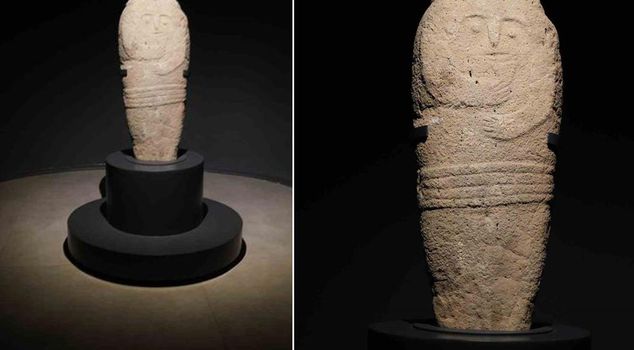
The 2,500-year-old "Stone Father" (Erzurum Stele) statue, found by chance by a farmer while grazing his animals in the Şenkaya district of Erzurum, sheds light on history as one of the most important traces of nomadic steppe culture in Anatolia. This unique artifact, with no other examples in Turkey, draws intense interest from visitors at the Erzurum Museum where it is exhibited.
The "Stone Father" statue, unearthed six years ago in the Şenkaya district of Erzurum and named the "Erzurum Stele," stands out as one of the most significant traces of nomadic steppe culture in Anatolia. The massive stele, 1.26 meters tall, which is included in the "Turkish Stone Sculptures" group in international literature, sheds light on the past with its deep-rooted history.
The 2,500-year-old Stone Father statue, exhibited at the Erzurum Museum, draws great attention from visitors at the Erzurum stop of the Culture Road Festival. The artifact represents an important example of Turkish burial traditions. The Erzurum Stele, found in the Ormanlı neighborhood of the Şenkaya district, attracts viewers with its frontally carved male figure. The statue, thought to have been made by a local stone master, features a thick belt with four horizontal bands at its waist. The figure, raising a goblet in its right hand, is depicted with its left hand resting on its abdomen. The lower part of the statue appears to have been left unworked.
THE ONLY EXAMPLE IN TÜRKİYE
In 2020, in the Ormanlı neighborhood of Erzurum's Şenkaya district, a farmer named Aytaç Alver noticed a stone with motifs on it while grazing his animals. Alver, as a conscientious citizen, immediately reported the situation to the Museum Directorate, thus ensuring the protection of this historical artifact. As a result of detailed examinations by archaeologists, it was determined that the artifact belonged to the Kipchak period. This statue, one of the museum's most prized pieces, hosts hundreds of history enthusiasts every day and particularly attracts great interest from children. Officials emphasize that this artifact is the only example in Türkiye, highlighting the importance of Stone Father in Turkish culture.
BELONGS TO THE SCYTHIANS
It is known that the earliest examples of "Stone Father" steles featuring a male figure holding a cup or goblet in his right hand were made by the Scythians in the 6th-5th centuries BC. This tradition, later adopted by the Turkic peoples of Central Asia, was intensely continued especially from the Göktürk period (6th-8th century AD) until the 11th-13th centuries AD. Although the Erzurum Stele resembles Göktürk period tombstones in its general appearance, experts state that the statue belongs to a much earlier period.
ERECTED AT UPPER-CLASS TOMBS
These steles, completely foreign to the cultures of ancient Anatolian, Mesopotamian, and Syrian civilizations, are among the clearest representatives of nomadic steppe culture. Historically, such stones were usually erected next to or directly above the graves of elite individuals belonging to the upper class of society. This tradition, intensely seen from the 2nd millennium BC in Ukraine, Southern Russia, Crimea, Southern Siberia, Central Asia, Northwestern Iran, Azerbaijan, and Mongolia, spread in the West over a vast geography from the Alps to the Iberian Peninsula. This unique artifact exhibited in Erzurum continues to shape history as one of the rarest stops of steppe culture in the Anatolian geography.