20.08.2026 07:20
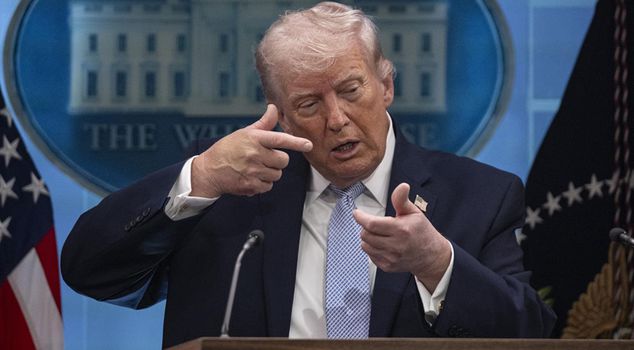
US President Donald Trump stated that he has declared an unprecedented-scale "economic operation" against Iran, and also threatened countries that support the Tehran administration with severe economic consequences.
Trump, in a post on his social media account, argued that no one other than himself had given Iran the opportunity to make a deal.
Noting that Iran failed to seize this opportunity, Trump said, "Therefore, today I am declaring the most crushing economic operation ever imposed on any country. This will be economic war and isolation on an unprecedented scale."
Trump claimed that Iran's navy had been destroyed, its air force eliminated, its military factories left in ruins, its currency rendered worthless, and the country left hanging by a thread.
THREATENED COUNTRIES SUPPORTING IRAN
US President Trump continued:
"Today I am also announcing that any country that allows financial institutions, companies, airports, or government agencies to provide any kind of lifeline to Iran will face tremendous economic consequences. Oil smuggling, swap lines, cash transfers, exchange offices, ship registries, shell companies — all of these must be terminated immediately. You know who you are."
"IRAN IS CORNERED"
Emphasizing that all allies need to stand with the US to isolate and defeat the Iranian threat, Trump stated that Iran is cornered and that these historic measures will paralyze the country's "ability to spread terrorism worldwide."
PEZESHKIAN: NEGOTIATION IS NOT SURRENDER
Iranian President Masoud Pezeshkian stated that negotiation (with the US) does not mean surrender, saying his country aims to "progress step by step on the path of negotiation," considering wisdom, honor, and interests while at the peak of its power.
Pezeshkian, who said Iran defends its territorial integrity against attacks and does not see war as a goal, expressed the following:
"During the negotiation process, at the peak of our power, we will proceed step by step, considering wisdom, honor, and interests. Our goal was to end the war, lift the siege, release blocked resources, and then conduct nuclear talks."
Stating that negotiation with the US does not mean "surrender," Pezeshkian cited China as an example, saying, "Countries like China prove themselves through economic competition. Protecting the homeland, serving the people, and feeling a sense of national belonging against foreigners is also essential. I must appreciate the people's support in difficult times."
THE 60-DAY PERIOD HAD EXPIRED
The memorandum of understanding signed on June 17 to end the war between Iran and the US allowed the parties 60 days to reach a final peace agreement.
The memorandum envisioned a negotiation process for a broader agreement covering Iran's nuclear program and US sanctions.
However, the agreement soon began to unravel due to a dispute over the control of the Strait of Hormuz, critical for global oil and liquefied natural gas trade.
After the period expired, the US announced that they would not extend the duration of the temporary ceasefire agreement.
THE AGREEMENT REACHED BETWEEN IRAN AND THE US
Iran and the US had announced on June 14 that, within the framework of the negotiation process mediated by Pakistan, they had reached a 14-article agreement envisaging the cessation of the war and the resolution of issues between the parties through talks.
The memorandum of understanding, named the "Islamabad Agreement," was signed digitally by Iranian President Masoud Pezeshkian and US President Donald Trump on June 18 and entered into force.
The agreement includes items such as ending the war, including in Lebanon, opening the Strait of Hormuz, and lifting the US naval blockade imposed on Iran.