26.10.2026 00:40
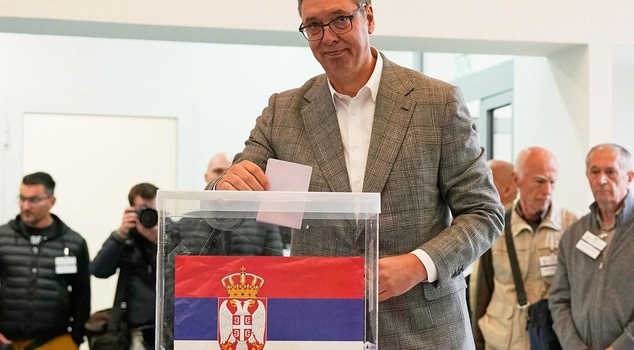
In Serbia, Aleksandar Vucic's 14-year rule ended with defeat in early general elections. Candidates supported by students who have led anti-government protests for about two years emerged victorious from the ballot box. Accepting defeat, Vucic announced that the Student List would win between 135 and 140 parliamentary seats, saying, "We will do our part as the opposition. The struggle continues." The country now has its eyes on the formation of a new government.
Early general elections held in Serbia became an important turning point in the country's political history. Candidates backed by students who have led anti-government protests for about two years came to the fore at the ballot box, while Aleksandar Vucic's 14-year rule formally came to an end.
VUCIC ACCEPTED DEFEAT
Aleksandar Vucic, who left the presidency and ran for prime minister, acknowledged in his assessment after the elections that his own alliances had suffered defeat at the ballot box.
Pointing out that final results had not yet been announced, Vucic stated that the Student List would win 135 to 140 seats in parliament, while his own alliance "Aleksandar Vucic – United Serbia" would remain at around 105 parliamentary seats.
Vucic said that, as always, he had come to the podium tonight as someone who takes responsibility, and said, "I wanted to come out and say it in advance so you wouldn't wait long. We will do what is required of us as the opposition. The struggle continues."
THE TRAIN STATION DISASTER IN WHICH 16 PEOPLE DIED BECAME A TURNING POINT
The foundations of the student movement that changed the political balance in Serbia were laid with the disaster that occurred in the city of Novi Sad on November 1, 2024. Sixteen people lost their lives when the concrete entrance canopy of the train station, which was undergoing renovation work, collapsed.
After the disaster, allegations regarding the lack of oversight in construction work, corruption, and the use of public resources sparked reactions across the country.
University students launched protests demanding that those responsible for the incident be uncovered, the relevant documents be shared with the public, and the authorities be held accountable.
The demonstrations quickly spread to different cities. With the participation of academics, teachers, farmers, artists, and citizens from various professional groups, the protests turned into a broad anti-government movement.
IT WAS FOUNDED AS AN ALTERNATIVE TO THE EXISTING OPPOSITION
The students who initiated the protests decided to establish a political formation independent of traditional opposition parties.
At meetings held at universities, it was decided to enter the elections under the name "Student List" with candidates determined.
Rather than running directly, the students aimed for the names they supported from different segments of society to enter parliament. About 70,000 signatures were collected for the list submitted to the election commission in September.
150 THOUSAND PEOPLE GATHERED IN BELGRADE
The mass demonstrations held before the elections revealed the student movement's support across the country.
According to independent crowd estimates, about 150,000 people attended the last major rally held in the capital Belgrade on October 22.
Students who reached the capital on foot from different cities of Serbia called for a change of power with Serbian flags and slogans such as "Students Are Winning."
The movement's election promises included fighting corruption, ensuring the independence of public institutions, the rule of law, and democratic reforms.
VUCIC HAD LEFT THE PRESIDENCY TO BECOME PRIME MINISTER
Aleksandar Vucic, who took on important duties in the last 14 years of Serbian politics, first became deputy prime minister and then prime minister after the Serbian Progressive Party came to power in 2012.
Vucic, who was elected president in 2017, left office in September 2026 and ran for prime minister in early general elections.
Vucic, who entered the elections at the head of the "Aleksandar Vucic – United Serbia" alliance, accused the student movement throughout the campaign of being a foreign-backed political initiative.
Opponents, meanwhile, criticized the government's influence over public institutions and the media. On election day, allegations of violence, pressure on voters, and irregularities in some areas also came to the fore.
EYES ON THE FORMATION OF THE NEW GOVERNMENT
After the Student List came to the fore at the ballot box, developments regarding the government formation process in Serbia are awaited. After the announcement of final results, it is expected that the seat distribution in parliament will become clear and negotiations will begin to form the new government.
In Serbia, a candidate country for the European Union, it is wondered what path the new administration will follow on issues such as fighting corruption, the rule of law, foreign policy, and economic reforms.