05.06.2026 01:30
In the ancient city of Side in the Manavgat district of Antalya, 31 letters were identified in studies on the language 'Sidean,' which was determined to have been spoken in a certain period. While bilingual inscriptions offer hope for deciphering the language, it was found that the city's name means 'pomegranate' and that the Sideans preserved their language for 200 years despite Hellenic dominance.
Side, located in the Manavgat district of Antalya, the most important port city of Pamphylia, attracts the attention of the scientific world not only with its historical structures but also with the mysterious language spoken thousands of years ago.
31 LETTERS OF THE 'SIDETIC' LANGUAGE IDENTIFIED
Under the Ministry of Culture and Tourism's 'Heritage for the Future Project', while traces of the past are being uncovered in the city, efforts are also underway to illuminate 'Sidetic', one of Anatolia's lost languages. Spoken over 2,000 years ago in the region, the Sidetic language is being deciphered through bilingual inscriptions unearthed during excavations.
In studies conducted by the ancient city's excavation director Prof. Dr. Feriştah Alanyalı and foreign linguists Michaela Zinko and Alfredo Rizza, 31 letters belonging to the Sidetic language were identified. Experts are working on the structure of the Sidetic alphabet, word analysis, and its connections with other Anatolian languages.
MULTI-LINE INSCRIPTIONS RAISE HOPE FOR DECIPHERING THE LANGUAGE
Prof. Dr. Feriştah Alanyalı, Head of the Side Ancient City Excavations and faculty member at Anadolu University's Faculty of Literature, Department of Archaeology, stated that they are continuing the research project on the Sidetic language with experts from Italy and Austria. Alanyalı noted that in recent excavations, they have discovered new inscriptions written in Sidetic, but the language still cannot be fully read or understood.
Alanyalı explained that this is due to the scarcity of inscriptions and the fact that existing ones often consist of only 1-2 lines, and continued: "This situation challenges researchers in deciphering the script. In recent years, the discovery of both bilingual and multi-line inscriptions ranging from 30 to 40 lines has brought renewed hope. Researchers agree that the word forms 'Siruawn' and 'Siruawan' seen in inscriptions identified as Sidetic appear to refer to the city of Side. This evaluation adds a new dimension to discussions about Side's early history and the origin of the city's name. The study continues, but the city's name likely still means 'pomegranate.' This is a very significant finding."
"SIDE WAS ONE OF ANATOLIA'S ANCIENT CITIES EVEN BEFORE THE GREEKS"
Pointing out that the Sidetic language is of Luvian origin, one of Anatolia's oldest peoples, Alanyalı said, "Like Lycian and Carian in Anatolia. We are a branch of that. Research on the ancient city's name is very important for its identity. This city existed before the Greeks arrived. Sources say, 'Those who came from Kyme forgot their own language as soon as they set foot in Side and began speaking the language of the barbarians.' 'Barbarian' means someone who speaks a language other than their own. We see here such a dominant culture that it could even cause them to forget Greek. Side was one of Anatolia's ancient cities even before the Greeks came."
"THESE CITIES ARE NOT FOUNDED AND GLORIFIED BY WESTERN IMMIGRANTS"
Describing that after Alexander's conquest of Anatolia, city inhabitants were forced to speak Greek, Alanyalı noted: "Before the Hellenistic period and even during the first 200 years of it, the Sidetans continued to speak and write their own language. Because the inscriptions we find date to the late 3rd and early 2nd centuries BC. Even 200 years after Alexander, Sidetans preserved their language. Research on this language in Side provides, I believe, very important clues about the cultural identity of these cities. These cities are not, as large and brilliant civilizations are imagined, founded and glorified by immigrants from the west. They are cities that have been here since ancient times, with their own scripts, identities, and highly developed culturally."
"IT TELLS THAT THE TEMPLE WAS BUILT WITH SPONSORSHIPS"
Alanyalı, stating that Side had intense cultural relations with eastern cities in the 7th century BC, said: "Two seals show this. One was found in our excavations: a Neo-Assyrian seal. The other dates from before the War of Independence when this area was under Italian occupation. Italian researchers took a seal from local villagers. That is a Neo-Babylonian seal. These two seals indicate cultural integration with the east."
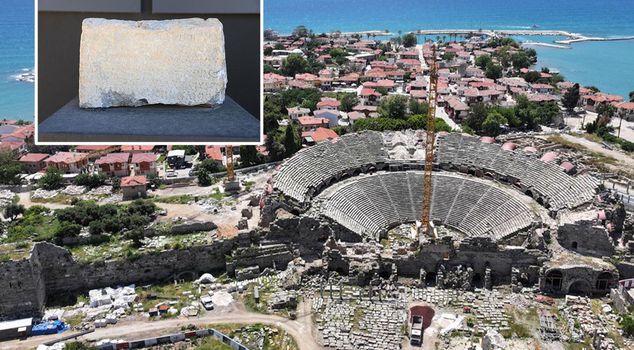
Alanyalı announced that during excavations they discovered an inscription revealing the existence of the Serapis Temple, and continued: "It is a bilingual inscription. It describes that the temple was built with sponsorships. The names of contributors and the amounts they gave are written in Sidetic. They write in Sidetic so everyone can read it. So Sidetic was still predominant. Research on the Sidetic language will provide much more information about the city. I hope the number of discovered inscriptions increases. The number of letters in the Sidetic alphabet, previously 26, has now increased to 31."
THE GREEK MEANING OF SIDE: POMEGRANATE
Alanyalı emphasized that the Greek meaning of Side is pomegranate and said: "Since this name was given in the Hellenistic period, there must have been significant pomegranate production. Even today, there is still important pomegranate production in the region. The Side pomegranate is different from others. We also see pomegranate motifs on city coins. It is a very important object for Side."