18.10.2026 10:32
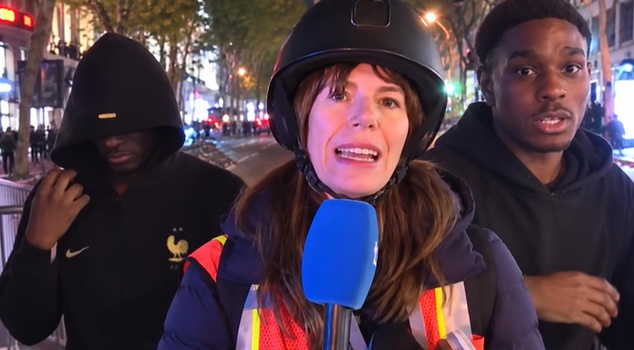
During increasingly violent protests in France, a demonstrator approaching the camera of a television crew broadcasting live put his hand to his throat and made a beheading gesture. As his threatening gesture toward the camera was broadcast live, it was reported that 1,200 people were detained and 150 police officers were injured during the protests in the country. Luxury stores also became targets of looters.
Protests that began in France against the high cost of living, problems in the education system and disruptions in public services are increasingly turning violent. While clashes between security forces and demonstrators occur in many cities across the country, an image captured live drew attention.
A protester turned toward the camera of the television crew following the protests and made a beheading gesture by putting his hand to his throat. The gesture, which carried a meaning of violence and threat, was broadcast live.
It has not yet been clarified at whom the protester directed the gesture, but the incident became one of the striking images of the tension during the protests.
1,200 PEOPLE DETAINED IN FRANCE
After mass demonstrations held on Saturday, October 17 in France, the number of detentions rose to 1,200. Prime Minister Sebastien Lecornu announced that 150 police officers were injured in incidents across the country.
According to Ministry of Interior data, approximately 550,000 people participated in the protests. The General Confederation of Labour (CGT), which supports the demonstrations, announced that the number of participants reached 800,000.
In addition to the capital Paris, violence also occurred in cities such as Marseille, Lyon, Bordeaux, Nice, Lille, Nantes, Toulouse and Strasbourg. While security forces intervened against the demonstrators with tear gas and water cannon, some groups responded to the police with stones and fireworks.
143-YEAR-OLD CITY HALL SET ON FIRE
One of the biggest destructions during the protests occurred in the city of Limoges. The historic city hall, among the city's landmarks and opened in 1883, was set on fire.
Heavy damage occurred in a large part of the building, where the flames spread quickly. While it was stated that the historic structure became unusable, an investigation was launched into the future of the building after the fire.
In Bordeaux, protesters attacked the prefect's residence. Groups that forced the door of the building and entered started a fire in the garden and caused major damage inside.
As the incidents grew, France's special police intervention unit RAID was dispatched to the area. In the incidents in Bordeaux, 23 people were injured, including 15 security officers and 8 protesters, and 55 people were detained.
THEY LOOTED LUXURY STORES
During the violence, stores of world-famous brands also became targets of looters.
In Lyon, the shop windows of brands such as Louis Vuitton, Hugo Boss, The North Face, Sephora and The Kooples were smashed. Some groups entered the stores and looted the products inside.
In Paris, around Place de la République, businesses selling mobile phones and cosmetic products were targeted, while a Hermès store in Marseille and an Apple store in Lille were attacked.
In the capital, some groups disabled the stores' security cameras and then broke the windows and entered. In the incidents where parked vehicles were set on fire, many businesses were damaged.
17-YEAR-OLD BOY LOSES HIS HAND
One of the most serious injuries during the protests occurred in the city of Saint-Etienne.
A 17-year-old boy lost his right hand as a result of the explosion of a munition used by the police during an intervention. According to initial information, the explosion occurred after the boy picked up the munition he found on the ground.
The incident reignited debates over the methods used by security forces to intervene in protests. It was reported that some complaints regarding police interventions were taken under investigation.
HARSH WARNING FROM MACRON
French President Emmanuel Macron made a statement after the looting, arson and attacks across the country.
Macron stated that those who attack public buildings and businesses and are involved in looting and destruction will be brought before the judiciary and punished.
Prime Minister Sebastien Lecornu also criticized the violence during the protests and emphasized that no group can impose its political demands on society through violence.
Interior Minister Laurent Nunez argued that some attacks on public buildings and police stations were carried out by organized groups. Nunez announced that despite the incidents, declaring a state of emergency was not on the agenda at the current stage.
WHY DID THE PROTESTS START?
The protests in France grew with the actions launched by students against problems in the education system. Reactions to staff shortages in schools, inadequate educational opportunities and disruptions in public services were joined by the high cost of living and rising housing costs.
Some groups from the Yellow Vests movement, which emerged in 2018 against fuel prices and the cost of living, also joined the demonstrations, which expanded with the support of unions.
The incidents before the presidential election planned for 2027 also increased political tension in the country.
Far-right politician Marine Le Pen blamed radical left groups for the violence during the demonstrations, while left-wing politician Jean-Luc Melenchon criticized police interventions. Melenchon also condemned the looting and arson.
While security measures are being increased across France, efforts continue to identify those involved in looting and attacks.