08.11.2026 10:00
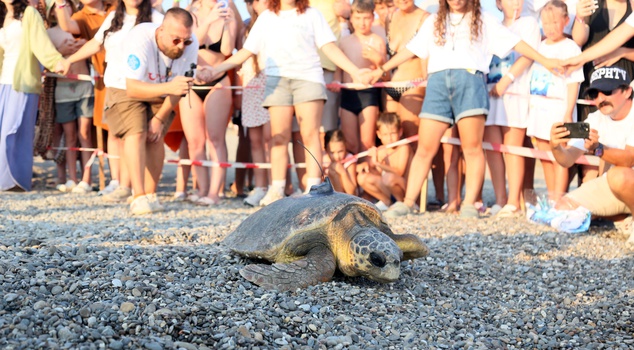
DOA, a loggerhead sea turtle (Caretta caretta) determined to have been born without a rear flipper on Antalya's Belek beach, was released into the sea on July 25 after being fitted with a satellite tracking device. According to experts, DOA, the only known sea turtle in the world that was born with an undeveloped limb and is being tracked by satellite, passed south of Cyprus and reached the Lebanese coast, 541 kilometers from Belek.
A loggerhead sea turtle born without one hind flipper, named 'DOA', was fitted with a satellite tracking device and released into the sea from Belek beach in Antalya in July. DOA, the world's first known sea turtle with an amelic condition, meaning an undeveloped limb, to be tracked by satellite, reached the Lebanese coast.
On Antalya's Belek beach, one of the Mediterranean's largest loggerhead nesting areas, a development remarkable for the scientific world occurred during the sea turtle conservation work carried out by the Ecological Research Association (EKAD) for 32 years. It was noticed that an adult loggerhead that came ashore to nest on Boğazkent beach was missing one of its hind flippers. As a result of a veterinary examination and x-ray, it was determined that the turtle, named 'DOA', had not lost its flipper later but had been born this way. It was decided to attach a satellite monitoring device to DOA to scientifically track its movements at sea and migration behavior.
IT REACHED FROM BELEK TO THE LEBANESE COAST
A satellite monitoring device provided with the support of tourism facilities in Belek was attached to DOA. The movements of the turtle, released into the sea on July 25, began to be tracked. On the satellite map, DOA was seen heading from south of Cyprus toward the Eastern Mediterranean and reaching the Lebanese coast. Its last location on the map was shown as 541 kilometers from Belek as the crow flies. The turtle's migration and wintering behavior continues to be monitored through satellite data.
THE WORLD'S FIRST AND ONLY KNOWN EXAMPLE
EKAD Board Member Prof. Dr. Onur Candan of Ordu University stated that DOA differs from similar scientifically recorded examples in the world and said, 'So far there is no publication in the literature about an amelic individual. There is no reported case. There are amputee individuals that come to nest. But there is no amelic individual.' Explaining that the condition of congenital limb nondevelopment is defined as 'ameli', Candan said DOA has this feature and is the only known sea turtle in the world with this characteristic to be tracked with a satellite monitoring device. Candan emphasized that there may be a possibility of other amelic individuals in nature, but no scientifically reported examples of them are known.
IT COULD NOT OPEN ITS NEST AND LEFT ITS EGGS NEAR THE SURFACE
EKAD President Dr. Ali Fuat Canbolat, on the other hand, stated that they first saw DOA while it was trying to open a nest and said, 'This animal has no hind limb. I saw this animal on the beach trying to make a nest. I left it to its own devices. It could not open the nest. Because these animals open it using their two hind limbs. One is present, the other is not. The eggs are ready and fertilized, waiting. That animal comes out to lay eggs, but cannot open the nest. It needs to be about 50 centimeters. This one can only open 10 to 15 centimeters. And it leaves its eggs there and goes.' EKAD teams placed the eggs DOA had left near the surface into a nest they prepared at the appropriate depth and protected them.
THIS ANIMAL HAS A STRUGGLE FOR LIFE
Stating that DOA's migration has an emotional meaning for them, Dr. Canbolat said, 'This animal has already reached at least 20 years of age in that condition. It also lays eggs. I thought a lot about whether we should attach it or not, frankly. But my curiosity came first. This animal has lived for 20 years, has mated. It also came out to lay eggs. Okay, it could not open the nest, but the animal has a struggle for life. I said, let's attach that tracking device to this animal. What is it doing? Does it wander somewhere and stay there? Does it go? Does it stay in Antalya? Or does it migrate somewhere? Yes, we saw that it migrated. It went to the Lebanese coast.'
'THE LIMB NEVER DEVELOPED'
Prof. Dr. Onur Candan also said that DOA's condition was initially assessed as a later flipper loss, but in the checks they found no scar. Candan said, 'Then we did a manual check. To see whether there was a bone fragment inside. When we could not see that either, we said, let's get an x-ray immediately. A veterinarian friend in Belek provided the x-ray service. Including the connection area, the region called the acetabulum, even that had not developed. Individuals born like this are called amelic. Amelic individuals. The limb never developed.' Stating that the x-ray findings revealed that DOA's flipper had not been torn off and had never formed during development, Candan noted that this is a scientifically important difference.
'ITS SURVIVAL IS AN INCREDIBLE THING'
Stating that DOA's survival until today and reaching reproductive age is very important, Prof. Dr. Candan said, 'In a creature like a sea turtle, where the hind legs are very important both in nesting and in its movements at sea, this animal was born like this. How did you go to the sea, how did you escape from so many things, how could you get out of that beach, that nest? The hind legs are also very important when leaving the nest. And how have you been coming and laying eggs on beaches for years? This animal's survival is an incredible thing. That alone is a story.'
IT WILL BE COMPARED WITH OTHER LOGGERHEADS
Stating that detailed analyses of DOA's satellite data have not yet been completed, Prof. Dr. Candan said that the movements of a turtle born without a hind flipper will be compared with other individuals. Candan said, 'For example, DOA's daily activities; turtles' daily activity durations are known, the distances they will travel, and so on, these are known. We are already collecting these data. In that respect, I am very curious about DOA's data, for example. It will become clear when the tracking is completed or when we carry out the analyses. Is there any deficiency compared with other turtles? Does it travel at the same speed, does it cover daily distances in the same way? At the moment, its migration route looks quite regular. There does not appear to be a problem in terms of activity, but we have not yet prepared the activity counts. Therefore, I cannot say anything definite.'