30.10.2026 00:41
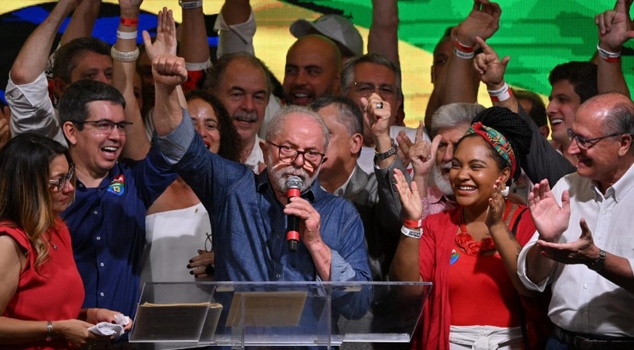
In Brazil, President Luiz Inacio Lula da Silva, who accused Israel of 'genocide' in Gaza, was elected head of state for the fourth time, defeating Flavio Bolsonaro—whom Israeli Prime Minister Benjamin Netanyahu openly supported—in the second round by a margin of more than 4 million votes. While the Israel issue deepened polarization during the campaign, Bolsonaro stood out among evangelical voters. Experts, however, believe that the result was determined by the economy and security rather than foreign policy.
The election in Brazil was also closely followed by the international public because of the two candidates’ opposing attitudes toward Israel. Lula, whom the Israeli press described as “anti-Israel,” left behind his rival, whom Netanyahu called “my friend.”
HE WAS BEHIND IN THE FIRST ROUND, HE WON IN THE SECOND ROUND
In the second round on October 25, Lula defeated Bolsonaro, who had finished the first round ahead, by a margin of more than 4 million votes. Lula became the first politician to be elected president four times since the country returned to democracy in the 1980s. Bolsonaro, citing the extension of voting time by 2 hours, announced that he did not recognize the results.
HE HAD MADE A “HITLER” COMPARISON FOR GAZA
Lula is among the leaders who most harshly criticize Israel’s attacks on Gaza. In February 2024, at the African Union summit, Lula compared what was happening in Gaza to Hitler’s decision to kill Jews. Netanyahu said that “the red line had been crossed,” and Israel declared Lula “persona non grata.” Brazil has not had an ambassador in Israel since May 2024.
The Lula government suspended the purchase of howitzers from the Israeli defense company Elbit Systems. Brazil also joined in 2025 the genocide case filed by South Africa against Israel at the International Court of Justice (ICJ). On September 22, at the UN General Assembly, Lula accused the Netanyahu government of committing “genocide against women and children” in Gaza. Lula, who also condemned Hamas’s attacks, reiterated that he supports the two-state solution.
OPEN SUPPORT FROM NETANYAHU TO BOLSONARO
In July, Netanyahu supported Bolsonaro with a video message he sent to Bolsonaro’s candidacy launch ceremony. After the first round, on October 5, Netanyahu congratulated Bolsonaro by calling him “my friend” and said he expected him to win a “great victory” in the second round.
Bolsonaro, for his part, promised that if elected he would move the embassy to Jerusalem in 2027, reappoint an ambassador to Israel, and join the initiative presented as a continuation of the Abraham Accords. Bolsonaro, who visited the West Bank in January, accused Lula of being “anti-Semitic.”
HOW DID THE ISRAEL ISSUE AFFECT THE CAMPAIGN?
The Israel issue was reflected in the campaign especially through evangelical voters, who make up about a quarter of the population. Bolsonaro, who describes himself as evangelical and was baptized in Jerusalem, described the political polarization in a church speech as a “spiritual war.” According to polls reported by Middle East Eye, support for Bolsonaro among evangelical voters reached 62 percent, while Lula remained at 32 percent.
According to data from the Pew Research Center, about half of Brazilians view Israel negatively, and more than 60 percent do not trust Netanyahu. Prof. Dr. Feliciano de Sa Guimaraes of the University of Sao Paulo stated that the Israeli-Palestinian issue reinforces the right-left divide in the country. Guimaraes emphasized that foreign policy rarely determines elections in Brazil, and that jobs, the cost of living, and security are more important to voters.
BOLSONARO IN ISRAEL, LULA IN PALESTINE
The polarization was also reflected in ballot boxes abroad. In the first round, 74.4 percent of Brazilian voters in Israel voted for Bolsonaro and 13.1 percent for Lula. In the 2022 elections, Jair Bolsonaro’s vote in Israel was about 46 percent. In the ballot box in Palestine, Lula received 93.1 percent of the vote.
SOCIAL POLICIES AND TURNOUT BROUGHT HIS VICTORY
Experts stated that turnout above expectations and social policies were effective in Lula’s victory. Lula, who highlighted the fight against poverty, increased social benefits, and workers’ rights in his campaign, also emphasized that they would pursue an independent foreign policy. Lula’s victory was also assessed as a setback for US President Donald Trump’s policy of alliance with right-wing governments in Latin America.