16.04.2026 20:54
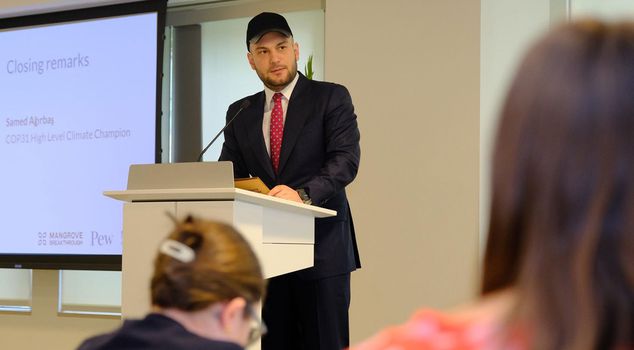
Samed Ağırbaş, President of the Zero Waste Foundation and COP31 High-Level Climate Champion, who held meetings with international financial circles and multilateral organizations in the USA, emphasized that the zero waste approach is a strategic necessity for economic stability and development, stating that global climate action must be integrated with the financial system during the COP31 process.
Zero Waste Foundation President and COP31 High-Level Climate Champion Samed Ağırbaş met with international financial institutions, think tanks, and high-level officials as part of his intensive engagement program in the United States. The visit particularly focused on global climate finance, sustainable development, resource efficiency, and the COP31 preparation process as key agenda items.
In the bilateral meetings and programs he attended, Ağırbaş emphasized that the global economic architecture must be aligned with climate goals, highlighting that the zero-waste approach is an instrument of macroeconomic transformation beyond environmental awareness.
“ZERO WASTE IS A GLOBAL CALL OF CONSCIENCE”
During his engagements, Ağırbaş stated that the vision demonstrated by Turkey in climate diplomacy has been further strengthened by the strong political will of President Recep Tayyip Erdoğan and the leadership he has shown at the international level.
Ağırbaş also drew attention to the birth of the Zero Waste vision and the response it has garnered globally. Noting that this vision has transformed into an international environmental movement under the strong leadership of Mrs. Emine Erdoğan, Ağırbaş used the following expressions:
“Under the pioneering leadership of Mrs. Emine Erdoğan, Zero Waste has transformed into a call for shared responsibility for humanity. If we can talk about resource efficiency, the circular economy, and combating waste in international financial circles today, the determined advocacy of this vision has a significant share in that.”
Emphasizing that the Zero Waste approach is a transformation model that started in Turkey and found global resonance, Ağırbaş stated that this model will also be a strong reference point in the COP31 process.
“WE WILL CONTINUE TO BRING FINANCE AND CIVIL SOCIETY TOGETHER FOR OUR COMMON HOME, THE WORLD”
Participating in a working dinner with circular economy, industry, and other experts as part of the Washington program, Ağırbaş stated that they focused on key objectives during the meeting, saying, “First, we aim to integrate climate finance with COP31 outcomes and establish concrete support mechanisms by strengthening our relations with the World Bank. Secondly, we conveyed the international vision of the Zero Waste Foundation and our work. We will continue to bring finance circles and civil society to the same table for our common home, the world.”
“MORE THAN 3 BILLION PEOPLE IN THE WORLD LIVE DEPENDENT ON THE OCEANS”
Delivering a speech at the High-Level Event on Sustainable Blue NDC Finance, Ağırbaş emphasized that more than 3 billion people in the world live dependent on the oceans, stating, “The livelihoods of 600 million people and 100 million jobs depend on the ocean economy, particularly fisheries, aquaculture, and tourism, the majority of which are in developing countries. Mangroves are at the center of this situation; they are among the planet's most powerful yet most threatened ecosystems. They are nature-based solutions critical in combating climate change and biodiversity loss, as well as supporting sustainable economies and communities.”
“OCEAN-BASED SOLUTIONS MUST BE AT THE CENTER OF CLIMATE ACTION”
Stating that these ecosystems store four times more carbon than tropical forests, Ağırbaş said, “Protecting coastlines from storms and reducing flood risk for more than 15 million people and property worth over 65 billion US dollars annually, safeguarding lives, infrastructure, and economic security. Ocean-based solutions must be at the center of climate action, including mitigation, adaptation, and resilience.”
“WE HAVE A CRITICAL OPPORTUNITY AT COP31”
Expressing that non-state actors are driving transformation through Ocean Breakthroughs via the Global Climate Action Agenda, Ağırbaş stated, “These breakthroughs are a global roadmap for transformative and ambitious actions that must be achieved by 2030 to reach carbon neutrality by 2050 across five high-impact sectors: marine conservation, aquaculture, ocean renewable energy, marine shipping, and coastal tourism. Full implementation of these solutions could reduce the 2050 emissions gap by up to 35 percent while also providing benefits for people and nature. At COP31, we have a critical opportunity to turn ambition into action across ocean and coastal systems, and concrete results are already beginning to emerge.”
“THE ROAD TO COP31 STARTS NOW”
Stating his determination to scale ocean finance by mobilizing both public and private sector investments as the COP31 High-Level Climate Champion, Ağırbaş continued as follows:
“Achieving this will require a significant increase in financing for sustainable ocean sectors and ecosystem restoration.
Despite the vital role of oceans in mitigating climate change and adapting to it, they receive a very small share of climate finance; only about 1 percent of total adaptation finance is invested in coastal protection.
We invite you to carry this momentum forward and demonstrate strong commitment on adaptation and ocean resilience at COP31 in Antalya.
The initiatives represented here today can, together, trigger new partnerships, strengthen local leadership, and enable scalable ocean solutions rooted in community ownership and innovation.
The road to COP31 starts now. And I look forward to walking this path with all of you.”
“CLIMATE RESILIENCE IS A POWERFUL ENGINE FOR MACROECONOMIC SECURITY AND JOB CREATION”
Speaking at the High-Level Meeting on Financing Resilience for Employment and Economic Prosperity, Ağırbaş said that climate resilience is one of the current economic, social, and security priorities, stating, “Climate shocks are triggering migration and instability, primarily in vulnerable countries, creating spillover effects in other regions; they are already affecting lives, livelihoods, and development. As we conclude this vital discussion, the message from this room is clear: Climate resilience is no longer just an environmental goal; it is a fundamental macroeconomic security and a powerful engine for job creation.”
“THE IMPLEMENTATION PHASE HAS BEGUN”
Ağırbaş noted that through the Climate Action Agenda, a transition has been made from a decade of negotiation process to a new implementation phase, stating, “My colleague Dan Ioschpe and I are focused on scaling the practical solutions we already have that address the climate crisis and improve people's daily lives.”