01.09.2026 16:20
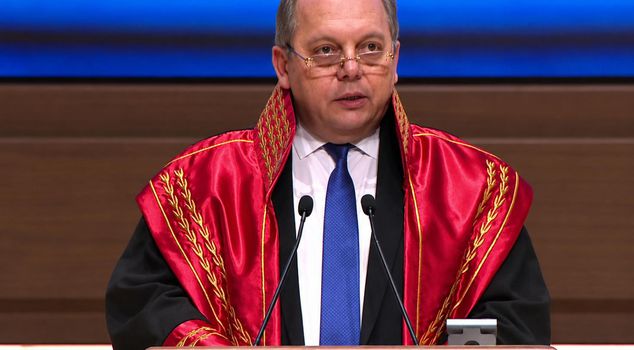
A ceremony was held at the Court of Cassation's İsmail Rüştü Cirit Conference Hall on the occasion of the opening of the new judicial year. Speaking at the ceremony, President of the Court of Cassation Ömer Kerkez said, 'A judge renders their decision without any fear or expectation. They are never influenced, positively or negatively, especially by social media. They only deal with the events and evidence in the file they are examining and decide by setting aside their own personal views and opinions regarding the case.'
The 2026-2027 judicial year began as of today. The judicial year opening ceremony was held at the Ismail Rustu Cirit Conference Hall at the Court of Cassation. The ceremony began with a moment of silence and the singing of the National Anthem.
Attending the ceremony were Vice President Cevdet Yilmaz, Chairman of the TBMM Foreign Affairs Committee and Ankara Deputy Fuat Oktay, Former Speaker of the TBMM Bulent Arinc, President of the Court of Cassation Omer Kerkez, CHP Chairman Kemal Kilicdaroglu, Chairman of the New Party Ozgur Ozel, Ankara Metropolitan Municipality Mayor Mansur Yavas, President of the Union of Turkish Bar Associations Erinc Sagkan, and members of the legal community.
EMPHASIS ON "JUSTICE" FROM THE PRESIDENT OF THE COURT OF CASSATION
Speaking at the ceremony, President of the Court of Cassation Omer Kerkez emphasized that what makes a state strong is the trust its citizens have in the state's justice. Kerkez stated, "Justice stands by the one who is right, not the one who is strong," and noted that judges should not be influenced by social media when making decisions.
The highlights of Omer Kerkez's speech are as follows:
"As we begin a new judicial year, I first wish health and peace to all my colleagues who have served our judiciary for many years and have retired or become honorary members. I also remember with mercy our colleagues who have passed away. I commemorate with gratitude our judicial members and justice workers who lost their lives while on duty.
Two days ago, we proudly celebrated the 104th anniversary of Victory Day on August 30. I commemorate with gratitude the founder of our Republic, Gazi Mustafa Kemal Ataturk, and all the heroes of the National Struggle, our dear martyrs, and our veterans. The greatest legacy they left us is an independent homeland. Our duty is to keep this independent homeland alive with justice.
"WHAT MAKES A STATE STRONG IS THE CITIZEN'S TRUST IN JUSTICE"
What truly makes a state strong is the trust its citizens have in the state's justice. For this reason, throughout history, people have sought justice while establishing and sustaining states. Sometimes at the door of a ruler, sometimes on a battlefield, sometimes in a courtroom, and sometimes in their own conscience... Justice has been shaped by the struggle of those who have been wronged to seek their rights. As of today, the sense of justice must manifest in everyone's conscience; no one should need to suffer injustice for justice to be realized.
"A JUDGE SHOULD NOT BE INFLUENCED BY SOCIAL MEDIA"
Justice stands by the one who is right, not the one who is strong. When making a choice between the right and the strong, justice bases itself solely on what is right. When deciding whether the parties are right or wrong, it does not consider whether anyone is strong or weak. The judge renders their decision without any fear or expectation. They are never influenced, positively or negatively, especially by social media. They only deal with the facts and evidence in the file they are examining; they decide by setting aside their own personal views and opinions on the case. For this reason, at the core of the judging profession lies a great solitude.
"A DECISION MEANS SOMETHING WITH ITS REASONING"
The independence and impartiality of the judge; besides being an important authority granted to them, is also a great responsibility. When making a decision, the judge must act by carefully balancing this authority and responsibility. Because within the judge's independence and impartiality lies the right of the plaintiff, the defendant, the victim, and the accused. Furthermore, the community's sense of trust is also hidden here. The judge's decision must be reasoned and convincing with its reasoning. Because a decision expresses meaning and integrity only with its reasoning. The judge announces their verdict with its reasoning; they make their reasoning visible and auditable.
At first glance, there is a legal or criminal event in a file before the judge; however, in this file, there may be a child's tomorrow or a family's future. There is a worker's labor or a consumer's receivable. There is a defendant's expectation of freedom or a victim awaiting the realization of justice. Legal or criminal files are not mathematical problems; behind every file, there is a real life. Therefore, the apple of justice's eye must be the human being."
The high bench in the courtroom is not for the judge to be distant from the parties and the events in the file; it is for them to see the whole of the case much better and to understand the situation of the parties more effectively. The judge must also manage their time very well. As we all know, delayed justice is justice denied. Sometimes, making an excessively fast decision can also hinder the realization of justice. Therefore, the duty of the judiciary is not to decide quickly but to decide on time. The judge makes the right decision, makes a reasoned decision, makes an understandable decision, makes a decision within a reasonable time, and most importantly, makes a fair decision.
"AS DISTANCES NARROW, CONFLICT DISAPPEARS"
Another important issue is the effective implementation of efforts to resolve disputes without the need for filing a lawsuit. In this regard, further developing mediation and reconciliation institutions is of great importance. A court decision ends the dispute; however, a fair solution reached by the parties through their own will can sometimes even eliminate the cause of the dispute. Because the best solution to disputes in human life is for the parties to understand each other. Understanding reduces prejudice; where prejudice decreases, distances narrow. As distances narrow, conflict disappears, peace becomes possible; social peace sprouts in this way.
One of the dizzyingly fast-developing fields of our era is information technology. The judiciary must not remain outside this transformation but must be in a position to effectively manage the process. We are pleased to see that the judiciary in our country possesses significant knowledge and practice in the digitalization of justice services, especially with the UYAP system."