11.11.2026 20:52
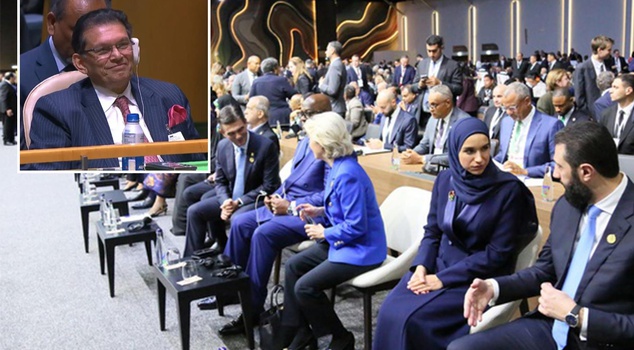
Striking data on the climate crisis were announced at the COP31 Leaders Summit held in Antalya. UN General Assembly President Khalilur Rahman said that global carbon emissions hit a record last year at 42 billion tons, and that the world is moving away from the 1.5-degree target in the Paris Agreement and toward a temperature increase of 2.8 degrees. At the summit, an urgent call to action was made to the international community on clean energy investments, climate finance, and early warning systems against disasters.
At the High-Level Segment of the COP31 Leaders Summit in Antalya, the increasingly severe effects of the climate crisis were addressed. United Nations representatives emphasized that the commitments made must be turned into concrete steps.
THE WORLD IS HEADING TOWARD A 2.8 DEGREE TEMPERATURE RISE
Speaking at the summit in Antalya, UN General Assembly President Khalilur Rahman announced alarming data on climate change. Stating that global carbon emissions reached a record level of 42 billion tons last year, Rahman said the 12 hottest years on record have occurred in the last 12 years. Emphasizing that the world remains far from the 1.5-degree target set under the Paris Agreement, Rahman stated that the current trajectory points to a 2.8-degree temperature increase. Rahman described the scale of the danger with these words: "This is not a gap; it is an abyss, and people are falling into this abyss every day. The only way to close it is to fulfill the commitments we have made."
CLEAN ENERGY INVESTMENTS HAVE OVERTAKEN FOSSIL FUELS
Simon Stiell, Executive Secretary of the UN Framework Convention on Climate Change, announced that clean energy investments have surpassed fossil fuel investments. However, he emphasized that this development is not enough to combat the climate crisis. Stiell said, "Clean energy investments now surpass fossil fuel investments, but the measures taken are not yet fast enough. Scientific data require us to significantly accelerate this process, and this is not yet being done fairly enough." Noting that vulnerable countries that have contributed least to the climate crisis need more support, Stiell said that the summit must conclude in Antalya with strong negotiation outcomes.
$300 BILLION TARGET FOR CLIMATE FINANCE
One of the key topics of the summit was climate finance. Rahman recalled the agreement reached on annual climate finance of $300 billion by 2035. Drawing attention to the fact that small island states, least developed countries and low-lying coastal areas in particular are severely affected by the climate crisis, Rahman stated that finance must be accessible. "Without finance, a commitment made is a postponed promise. And a postponed promise means lives left unprotected," Rahman said, emphasizing that reducing emissions must remain the primary priority. Rahman also thanked President Recep Tayyip Erdoğan and Türkiye for hosting the summit.
EARLY WARNING SYSTEMS REDUCE DEATHS SIXFOLD
Celeste Saulo, Secretary-General of the World Meteorological Organization, drew attention to the importance of early warning systems against natural disasters. Noting that the number of countries with these systems has more than doubled in the last 10 years, Saulo said, "Where these systems are strong, deaths from disasters are six times lower." Saulo called for more investment, noting that the biggest gaps in meteorological observation infrastructure are usually found in the regions most severely affected by disasters.
"CLIMATE CHANGE IS A REALITY WE ARE EXPERIENCING FIRSTHAND"
Chris Bowen, President of COP31 Negotiations and Australia's Minister for Climate Change and Energy, said the world is grappling with many crises at once. Pointing to energy security, cost of living, wars and developments in artificial intelligence, Bowen emphasized that climate change is no longer a prediction about the future. Bowen said, "Climate change is a reality we are experiencing firsthand; it is now part of our lives and, with its destructive effects, it is right next to us."