23.05.2026 14:40
President Recep Tayyip Erdoğan's wife, Emine Erdoğan, shared a post regarding TRT Tabii's series "Şule: Your Story," which focuses on the life of Şule Yüksel Şenler, whose life was marked by struggle.
President Recep Tayyip Erdoğan's wife, Emine Erdoğan, stated in a post on her social media account, "I hope that the production 'Şule: Your Story' inspires many hearts by bringing the life story of the valuable Şule Yüksel Şenler, woven with patience, faith, and courage, to a wide audience."
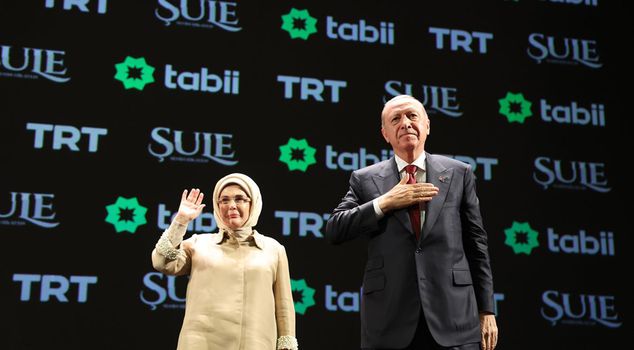
The post also included images from the series' gala program held yesterday at the Atatürk Cultural Center (AKM) with the participation of President Erdoğan and his wife Emine Erdoğan.
PRESIDENT ERDOĞAN AND HIS WIFE ATTENDED THE GALA
President Recep Tayyip Erdoğan and his wife Emine Erdoğan attended the gala program of the series "Şule Your Story," which focuses on the life story of author and intellectual Şule Yüksel Şenler, held at the Atatürk Cultural Center in Istanbul.
WHO IS ŞULE YÜKSEL ŞENLER?
Seven years have passed since the death of author Şule Yüksel Şenler, remembered for her novels "Birleşen Yollar" and "Huzur Sokağı," who left her mark on the 1960s and 1970s with her writings and conferences.
Şule Yüksel Şenler, who experienced many firsts, stood out as an uncompromising figure, and spent her life in struggle, was born on May 29, 1938, in Kayseri.
Şenler, originally from Cyprus, whose family migrated to Istanbul when she was young, faced financial difficulties while attending Koca Ragıp Paşa Primary School.
When her mother had a heart attack and became bedridden, Şenler had to leave her education in the second year of middle school.
Şenler began working for an Armenian tailor, an experience that later led her to design her own headscarf model.
She started her writing career at the age of 14 with stories in Yelpaze Magazine. Şenler, whose real name is Yüksel, added "Şule" to the front of her name in her writings to emphasize that she was not male. Thus, she became known and famous in her writing life as Şule Yüksel.
At the age of 21, she also encountered journalism. She wrote her first columns under the title "Duyuşlar" in the Kadın newspaper.
When her brother Özer Şenler, who was hospitalized for an incurable disease, recommended she read "Risale," Şenler's inclination towards covering and praying began.
In 1965, noting that her appearance no longer matched her thoughts, Şenler adopted the headscarf. She then wrote articles in the Yeni İstiklal newspaper published by Mehmet Şevket Eygi.
Many lawsuits were filed against Şenler due to her writings here. With a lawsuit filed upon the complaint of the Turkish Women's Union, a new period began in Şenler's life.
SHE LEFT HER MARK ON THE 1960S AND 1970S WITH HER CONFERENCES
Şenler, who facilitated the introduction of the headscarf into the lives of educated Muslim women, also left her mark on the 1960s and 1970s with both her writings and conferences.
She sparked debates with conferences she gave across Anatolia. As young girls imitated her by covering their heads in the same way, these debates flared up further, and the number of women who tied their heads like Şenler's covering style steadily increased. Consequently, this type of covering was called "Şulebaşı."
Şenler's writings also began to make a significant impact, leading her to join the writing staff of the Bugün newspaper, which started its publication life in 1960.
At a time when female journalists were rare, she drew attention as a female journalist wearing a headscarf.
Between conferences and her writing career, Şenler also designed modern headscarf and coat models for "Seher Vakti," a magazine she published with her brother. These models spread like wildfire among young girls in Anatolia. Girls who wore headscarves wanted to attend universities in this style as well.
SHE REJECTED THE PARDON AND SERVED HER FULL SENTENCE
In 1971, President Cevdet Sunay pointed to Şenler by saying, "The pioneers of covered women and girls on the street will serve their sentences."
In response, Şenler published a letter addressed to Sunay, arguing that "The President should apologize to God and the nation." Consequently, Şenler was arrested for insulting the President and spent 8 months in prison.
Thus, her four-year tenure as a writer for the Bugün newspaper ended. Cevdet Sunay pardoned Şenler two months later. However, Şenler rejected the pardon and served her full sentence in Bursa Prison.
After leaving prison, she continued to travel across Turkey giving conferences. She prepared women's pages for the Hür Söz, Yeni İstiklal, and Babıalide Sabah newspapers. She wrote a column for Bugün newspaper from 1967 to 1971. She became the editor-in-chief of Seher Vakti Magazine. After 1980, she wrote for Zaman and Milli Gazete.
HER NOVEL BECAME THE SUBJECT OF FILM AND TV SERIES
Şenler's work, Huzur Sokağı, was adapted into the film Birleşen Yollar, directed by Yücel Çakmaklı and starring İzzet Günay and Türkan Şoray.
Her novel Huzur Sokağı later met the audience as a TV series under the same name. Despite her advanced age and illness, Şule Yüksel Şenler occasionally wrote various articles for newspapers and magazines to continue her activities in publishing.
In addition to Huzur Sokağı, Şenler also authored works such as Gençliğin Izdırabı, Hidayet, Bize Ne Oldu, İslam'da ve Günümüzde Kadın, Duyuşlar, Her şey İslam için, Uygarlığın Göz yaşları, Kız ve Çiçek, Sağ El, Bir Bilinçli Öğretmen, and Yılanla Tilki.
The life of Şenler, who was noted as a mediator in the marriage of President Recep Tayyip Erdoğan and his wife Emine Erdoğan, was written by journalist Demet Tezcan in the book "Bir Çığır Öykü: Şule Yüksel Şenler."
After such an active life, Şenler, who spent 15 years battling illnesses, passed away today at Bağcılar Medipol Mega University Hospital, where she had been receiving treatment for about 8 months.