27.08.2026 12:20
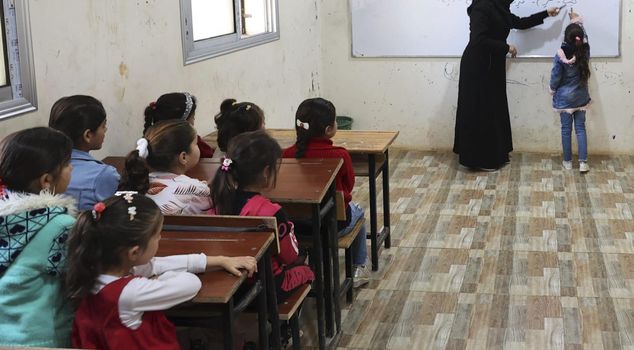
Kurdish has been included in the curriculum as an elective course under the implementation instructions issued by the Syrian Ministry of Education. If selected, Kurdish education will be provided for two class hours per week at all grade levels.
In schools in Syria, Kurdish will be offered as an elective course for the first time starting from the 2026-2027 academic year.
Within the scope of the implementation instructions published by the Syrian Ministry of Education and Instruction, Kurdish has been included in the curriculum as an elective course. If selected, Kurdish education will be provided for two class hours per week at all grade levels.
DEFINED AS A "NATIONAL" LANGUAGE
The grade obtained from the Kurdish course will be reflected in the student's overall achievement score but will not affect the student's status of passing or failing the grade.
The inclusion of Kurdish in the Syrian education system is based on Presidential Decree No. 13, issued by President Ahmed Al-Sharaa on January 16. In the first article of the decree, it is stated that Syrian Kurdish citizens are an original and fundamental part of the Syrian people, and it is expressed that the cultural and linguistic identity of Kurds is an integral element of the multicultural and united Syrian national identity.
In the third article of the decree, Kurdish was defined as a "national language" and it was permitted to be taught as an elective course or within the scope of cultural-educational activities in public and private schools in regions where the Kurdish population is present in significant proportions.
SIX-MONTH EFFORT FOR THE CURRICULUM
On January 26, the Syrian Ministry of Education and Instruction published instructions regarding the implementation of the decree. In line with the instructions, the Syrian National Education Curriculum Development Center was tasked with preparing the Kurdish course curriculum for all educational levels within six months. While it is planned that the preparation, approval, and printing processes of the curriculum will be completed before the start of the 2026-2027 academic year, on January 29, commissions including language and education experts from different provinces began the work of preparing the Kurdish curriculum.
On March 5, the Syrian National Education Curriculum Development Center also called for applications from educators wishing to take part in the preparation of the Kurdish curriculum. The applications required conditions such as a university degree, pedagogical formation, knowing Kurdish at the level of reading-writing and grammar, and experience in curriculum preparation.
KURDISH TEACHERS WILL BE EMPLOYED
The Education and Guidance Directorates in Syria were tasked with supplying the needed Kurdish teacher positions. It was planned that teacher candidates would undergo written and oral exams and then be admitted to training programs. On August 17, the Ministry of Education and Instruction also announced that it planned to employ permanent or contracted Kurdish teachers as needed.
WILL BE TAUGHT IN REGIONS WITH A HIGH KURDISH POPULATION
According to the decree, Kurdish will be taught in public and private schools in regions where the Kurdish population is present in significant proportions. Minister of Education and Instruction Muhammed Abdurrahman Türko stated that Decree No. 13 constitutes a historic transformation in terms of the approach to the Kurdish issue in Syria, and said that the implementation will cover different regions of the country, including Eastern Syria.
Türko, stating that curriculum preparations and teacher supply efforts have begun, emphasized that schools should be places where national belonging is strengthened, not discrimination.
KURDISH ENTERS THE EDUCATION SYSTEM AFTER YEARS
In Syria, Kurds faced discriminatory practices for many years due to the deprivation of citizenship of thousands of people following the census conducted in Hasakah in 1962 and restrictions on fundamental rights. It is noted that after the Baath Party came to power in 1963 and Hafez al-Assad took control of the administration in 1970, restrictions on the legal, cultural, and linguistic rights of Kurds deepened even further.
After the political developments following the civil war that began in Syria in 2011, steps have begun to be taken by the new administration to strengthen the principle of equal citizenship and to secure the cultural and linguistic rights of Syrian Kurds. This process was also supported by the agreements dated March 10, 2025, and January 29, 2026, which envisage the integration of the SDF into Syrian state institutions.