07.11.2026 20:01
Minister of Treasury and Finance Mehmet Şimşek said that the energy supply shock experienced at the TRT World Forum 2026 was the largest ever seen. Şimşek stated that the situation was twice the 1973-74 oil embargo and seven times the 2022 Russia-Ukraine energy crisis, noting that the global economy was not at a level to withstand this, and that if lasting peace cannot be achieved, Iran is a question mark.
Minister of Treasury and Finance Mehmet Şimşek said, “When we look at the short term, there is a very large supply shock, an energy supply shock. This is the largest we have seen so far. What we are currently experiencing is twice the 1973-74 oil embargo and seven times the Russia-Ukraine energy disruption in 2022. I hope it does not last much longer.”
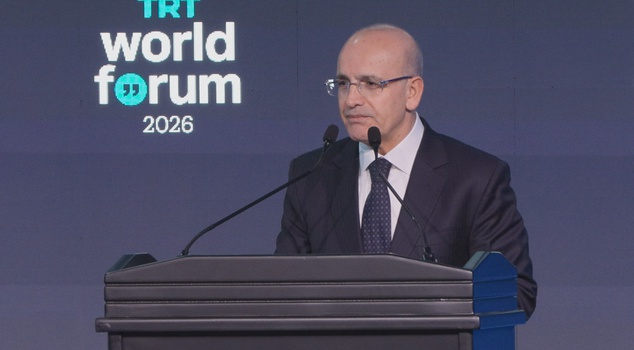
Minister of Treasury and Finance Mehmet Şimşek attended the closing session of the TRT World Forum 2026, which began yesterday. Şimşek delivered the opening speech of the session titled “Toward a Painful Recovery Process: National Economies After the Wars in the Middle East.”
THE GLOBAL ECONOMY IS NOT AT A LEVEL THAT CAN BEAR THIS
Şimşek said, “If you ask me, the global economy is not at a level that can bear this. These are quite large energy supply shocks, and we can see that they have created many problems. Now, when we look at the region, most of the regions are actually in decline; this is not very surprising, and of course, the countries on the front line have suffered great damage to their exports and import volumes at quite a significant level.”
Minister Şimşek said, “However, when you look at it from a global perspective, growth rates have decreased considerably. Financial conditions have been tightened further because inflation is rising. It is not all due to the war, but we can say that the war has also had a major impact. The IMF conducted a study; it examined 170 conflicts since 1946, and their finding is as follows: first, of course, in times when wars break out, an output loss can be found, and it can be between 3 percent and 7 percent. This is normally something that has entered into conflict in 170 wars. The point of recovery actually depends on whether peace is achieved. We have not yet achieved that peace. If a successful peace can be achieved, then we can say that we have entered the recovery process. Of course, recovery depends on how we move forward from here.”
THE GULF CAN RECOVER QUICKLY, IRAN IS A QUESTION MARK
Şimşek said, “I need to say this: the most affected countries here—I am talking about the GCC countries, the Gulf countries. Their resources are available. That is, recovery can be much faster. Because, as we said, they are in fiscal space, and they also have sufficient resources on hand. But Iran is a question mark. If there is no lasting peace in any way, it is a known fact that the war will also reshape the region. And as everyone knows, both inside and outside the region, people have actually begun to think about this: How can we get rid of dependencies or reliance? How can we get rid of these risks? For example, if you are dependent on the Strait of Hormuz, if you are dependent on a transit point, what kind of problem does this create? Because that is a key point, and this will enable more regional economic integrations. Of course, we will have more discussions on this.”
IT IS NOW A NECESSITY FOR TURKEY
Lastly, Minister Şimşek said, “Getting rid of strategic dependencies and key points. Countries are generally now looking at how to overcome infrastructure challenges—in cases where there is a better logistics system within countries, a better connectivity system, something like that. We are all reviewing these dependencies of ours. And at the same time, investment aimed at increasing regional connections is very important. This absolutely must happen. Multimodal trade corridors need to be created to reduce risk. Electrification needs to be accelerated. For a country like Turkey, for example, this is no longer a choice; it is a necessity. Strengthening energy security. So all of these are actually things that will shape the post-war region.”