03.08.2026 23:30
In England, doctors have performed an operation that will go down in medical literature. Noticing that the baby in the womb had its intestines outside, specialists took the risk and decided on prenatal surgery. With this delicate procedure carried out while the baby was still in the mother's womb, the organs were placed back where they belong. The process, which the family began with great anxiety, turned into a hopeful success story thanks to this bold move by scientists.
The life of a baby preparing to be born in England changed with an extremely unusual operation performed while he was still in the womb. Theo, whose intestines developed outside his abdominal cavity, was treated before birth with pioneering fetal surgery carried out in Houston, USA.
Maisie Savage, 29, and her husband Josh French, 36, learned during a routine ultrasound at the 20th week of pregnancy that their baby had a congenital anomaly called gastroschisis. In this condition, because the abdominal wall does not form completely, the intestines develop outside the body. After further examinations, it was determined that Theo's condition was complex gastroschisis, which has a more severe course.
HOPE FROM THE USA FOR THE FAMILY
After evaluation by specialists at Great Ormond Street Hospital in London, the family was included in a clinical trial conducted by Texas Children's Hospital in Houston. The research aims to treat complex gastroschisis before birth. The hospital's official research program also lists complex gastroschisis among ongoing clinical studies.
Before the operation, Savage received preparatory treatment at a center affiliated with KU Leuven in Leuven, Belgium. There, a botulinum toxin (Botox) injection was administered to relax the baby's abdominal muscles. The family then traveled to the USA for the main operation.
OPERATED IN THE WOMB AT 26 WEEKS
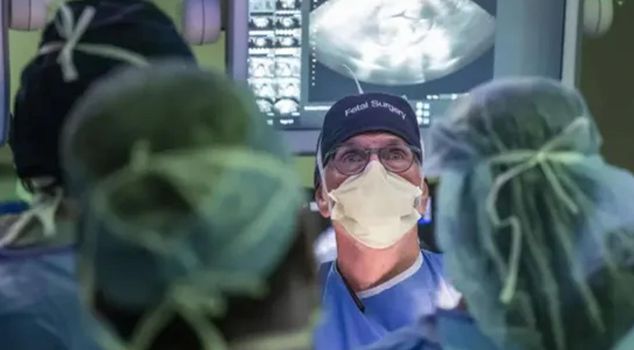
Savage underwent surgery in Houston at the 26th week of her pregnancy. The team, led by fetal surgeon Dr. Michael Belfort, accessed the mother's uterus and created a surgical field. Amniotic fluid was drained and carbon dioxide gas was introduced in its place so the surgeons could work.
Then, using a special closed surgical method, the baby's intestines, which were outside the abdomen, were carefully placed back into the abdominal cavity, and the opening in the abdominal wall was repaired.
With this operation, Theo became the third baby in the world to be treated with this method in the womb, and the first baby from England to undergo this procedure.
STAYED IN HIS MOTHER'S WOMB FOR ANOTHER 14 WEEKS
The pregnancy continued after the operation. Despite the major surgical intervention she underwent, Savage carried her baby for approximately 14 more weeks.
Theo was born in Houston in February. It was reported that the baby, who recovered much faster than expected after birth, began feeding within a short time and was discharged from the hospital four days later. Theo, now five months old, is said to be in good health and has returned to England with his family.
"COULD HAVE STAYED IN INTENSIVE CARE FOR MONTHS"
The team that performed the operation noted that Theo's condition could have turned into a much more severe picture after birth. It is stated that in cases of complex gastroschisis, serious damage to the intestines can occur, which could require prolonged intensive care, multiple surgeries, and in some children, lifelong nutritional support.
Dr. Belfort stated that Theo's ability to start feeding shortly after birth and leave the hospital within just a few days was extremely remarkable compared to the expected picture.
THE METHOD COULD BE BROUGHT TO ENGLAND
Experts state that if the clinical trial results are positive, the method could be applied in England in the future. Prof. Paolo De Coppi from Great Ormond Street Hospital stated that if the results are positive, fetal surgery could become one of the standard treatment methods for complex gastroschisis.
Thus, Theo's story has become more than just the story of a baby regaining his health; it has also become an important example of medical research that could pave the way for treating a congenital anomaly before birth even occurs.