09.07.2026 15:00
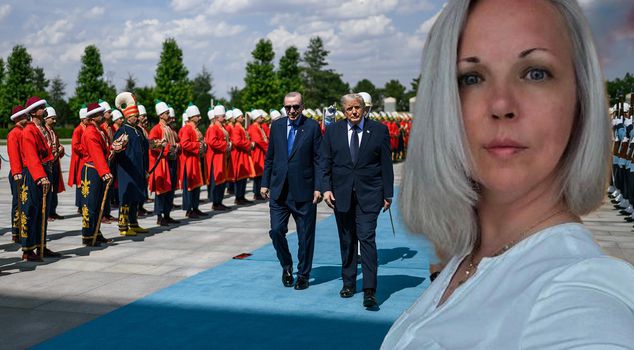
During the historic NATO Summit held in Ankara, the reception of world leaders by the Mehteran band at the Presidential Complex resonated widely on the international stage. In her highly acclaimed analysis, which received tens of thousands of likes, Bulgarian writer Sophia Proneikos stated, "The Mehter was never an ordinary military band; it was a weapon," and "The past is not a burden, but a language... Because sometimes a few drumbeats are enough." It was reported that the writer later deleted this article due to pressure.
Ankara, hosting the leaders of the world's most powerful military alliance, experienced one of its historic days. The summit organization turned into a veritable diplomacy and history feast with the magnificent hospitality and cultural touches offered to the leaders.
THE "JANISSARY" DETAIL IN THE HISTORIC WELCOME AT THE PRESIDENTIAL COMPLEX
Among the first moments that marked the day were the passage of US President Donald Trump, who came to the capital for the summit, from the airport to the Presidential Complex accompanied by mounted troops, his greeting of soldiers in Turkish, and the breathtaking demonstration flight of the Turkish Stars in the sky during this time.
However, the event that truly resonated was the heads of state being welcomed in the garden of the Presidential Complex by the mehter team, one of the world's oldest military bands. The historical pieces performed when the leaders got out of their vehicles left a great impression on the guests.
President Recep Tayyip Erdoğan described the reactions of world leaders to this historic welcome ceremony with these words:
“They all spoke highly of it, saying 'it was magnificent' while shaking hands. Some even said, 'We know your Janissaries.'”
BULGARIAN WRITER'S MEHTER ANALYSIS: ENCHANTING
The welcoming of NATO leaders with mehter marches drew the attention of historians as well as the world of politics and diplomacy. Bulgarian writer Sophia Proneikos, in a post on her social media account, described these moments as "enchanting."
WAS IT REMOVED DUE TO PRESSURE?
Proneikos's article, which noted that the mehter is not just music but a historical "weapon" and "language," was liked and shared by tens of thousands of people in a short time. The fact that the writer removed her post after a while following it going viral did not escape attention. It was stated that Proneikos removed the article due to neighborhood pressure she faced.
HERE IS THAT ARTICLE
Bulgarian writer Sophia Proneikos used exactly the following expressions in that magnificent article that received thousands of likes and comments:
“History has a habit that never ceases to amaze me: It almost never disappears. It just learns to present itself so elegantly that modern people start calling it 'ceremonial protocol.'
That is precisely why the most enchanting scene of the NATO Summit in Ankara did not take place around the negotiation table. This scene sprouted even before the first handshake, when the leaders of the most powerful military alliance of the twenty-first century were welcomed at the Presidential Complex by the sound of the 'Mehter,' the world's oldest military band, while facing soldiers in historical uniforms representing different centuries of the Ottoman Empire.
What an extraordinary sense of historical continuity: A military alliance founded in 1949 as a symbol of the post-war world was stepping into a presidential palace accompanied by the music of a military tradition whose roots go back to the thirteenth century.
The Mehter was never an ordinary military band; it was a weapon.
When Ottoman armies marched to Belgrade, Constantinople, Rhodes, Mohács, or Vienna, the first thing heard was the thunder of giant 'kös' drums, followed by the sharp sound of 'zurnas,' brass pipes, and clashing cymbals; because this music not only accompanied the army but was itself a part of the army. Its purpose was not to entertain the soldiers but to convince the enemy, even before the battle began, that a whole empire was advancing upon them.
It is no coincidence that after Europe's encounters with the Ottoman Empire, Western armies gradually adopted Ottoman drums, cymbals, and that 'Turkish style' (Alla Turca) which would later even infiltrate the music of Mozart, Haydn, and Beethoven; because history sometimes does not conquer a civilization with a sword.
A rhythm is enough.
That is precisely why I found this ceremony so enchanting; not because someone was trying to revive the Ottoman Empire, but because Turkey knew very well something that great civilizations have always understood: The past is not a burden but a language, and nations that know how to speak this language never tell their history only with words; because sometimes a few drumbeats are enough.”