14.11.2026 18:31
In Kırıkkale, a 30-year-old producer has begun harvesting saffron, known as the world's most expensive spice, which he decided to grow after being influenced by a news report he watched 2 years ago. Saffron, whose kilogram reaches up to 1 million lira, attracts attention with its high economic value.
Nuh İnanç, 30, who works as a project manager at a software company in Ankara, became interested in saffron cultivation about 2 years ago after being affected by a news story he watched. İnanç, who researched the plant's growing conditions for a year, contacted the producer he saw in the news and obtained his first saffron bulbs.
HE PLANTED 200 KILOGRAMS OF SAFFRON BULBS IN HIS HOMETOWN
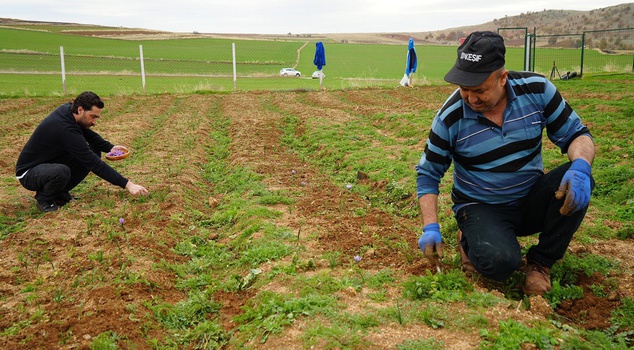
Last year, İnanç planted 20 kilograms of saffron bulbs on a 100-square-meter area in the Keskin district of his hometown Kırıkkale, and got positive results from the trial production. Thereupon, this year he increased the planting area to 1 decare and planted 200 kilograms of saffron bulbs. İnanç, who started the saffron harvest with the beginning of the flowering period, separates and dries the red parts of the flowers he collects in the morning. İnanç's father, Elvan İnanç, also supports him during the production and harvest process.
"I TRIED WITH 20 KILOGRAMS OF SAFFRON BULBS"
Explaining the process of starting saffron cultivation, İnanç said, "About two years ago I watched a news report about a saffron producer. Both its economic value and its growing conditions caught my interest. I did research for a year. Later I reached that producer. He guided me and I got my first bulbs from him. Last year I conducted a trial with 20 kilograms of saffron bulbs on a 100-square-meter area. I thought Kırıkkale's continental climate was suitable for this plant. When I got a yield, this year I increased the planting area to 1 decare and planted 200 kilograms of saffron bulbs," he said.
"150 THOUSAND FLOWERS ARE COLLECTED FOR ONE KILOGRAM OF SAFFRON"
Noting that intensive manual labor is effective in the high economic value of saffron, İnanç said, "Saffron is known as the world's most expensive spice plant. The reason is that all processes, from planting to care and from harvest to drying, are done by hand. It starts flowering once a year, from the middle of October. During the flowering period, which lasts about a month depending on weather conditions, we collect the flowers every morning. Then we separate the red female organs inside the flowers and dry them under suitable conditions. To obtain one kilogram of saffron, approximately 150 thousand flowers must be collected one by one," he stated.
"ITS KILOGRAM PRICE GOES UP TO 1 MILLION LIRA"
Stating that the kilogram price of saffron varies between 900 thousand and 1 million lira depending on its quality, İnanç said, "The most important components determining the quality of saffron are crocin, picrocrocin and safranal. These determine the color, taste and aroma of the product. As the values of these components increase, the quality and economic value of saffron also increase," he said.
"SAFFRON BULBS ARE ALSO AN IMPORTANT SOURCE OF INCOME"
Explaining that in saffron cultivation, in addition to spice production, bulb propagation also has economic value, İnanç said, "One of the important income sources of saffron is the propagation of bulbs. Here we see that eight shoots emerge from one bulb. When we remove these bulbs from the soil next June, we will be able to obtain eight separate bulbs. The kilogram price of saffron bulbs varies between 2 thousand and 4 thousand lira depending on their size and whether they are certified," he said.