05.09.2026 19:50
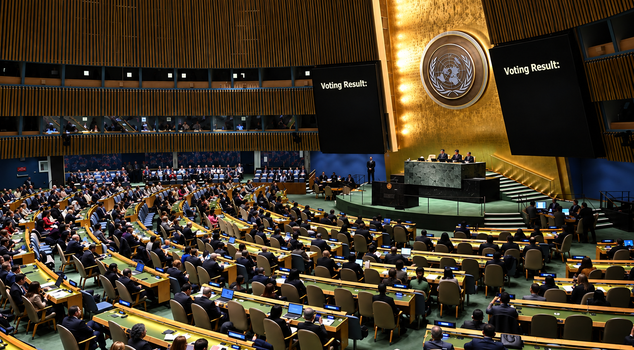
A striking resolution regarding the use of world maps was adopted with the support of 164 countries at the United Nations General Assembly. Only the US voted against the new map approach, which aims to reflect Africa's true surface area more accurately, while 6 countries abstained. Washington argued that the resolution carries an 'ideological agenda' beyond the cartographic debate and causes the UN to veer away from real global issues.
The United Nations General Assembly has endorsed a new world map approach as an alternative to the Mercator map, which has been widely used for nearly 500 years. With the resolution adopted under an initiative led by African countries, the use of the Equal Earth projection, which reflects the true surface areas of continents more accurately, was encouraged. The resolution received support from 164 countries, with only the United States opposing it; 6 countries abstained.
AN ALTERNATIVE TO THE 500-YEAR-OLD MAP SYSTEM
The Mercator projection, used worldwide for many years, was developed in 1569 by Flemish cartographer Gerardus Mercator, particularly for maritime navigation. However, this method depicts landmasses as larger than they actually are as one approaches the poles. Therefore, Greenland appears to be about the same size as Africa, while in reality, Africa's surface area is approximately 14 times that of Greenland.
AFRICA WILL APPEAR LARGER, EUROPE AND NORTH AMERICA SMALLER
In the Equal Earth projection supported by the UN, the surface areas of continents are reflected much closer to reality. Thus, Africa, which appears smaller in the Mercator map, will occupy more space, while the relative sizes of Europe, North America, and Greenland on the map will decrease.
This change does not alter the true surface areas of countries. What changes is how Earth's spherical surface is represented on a flat map.
THE RESOLUTION RECEIVED SUPPORT FROM 164 COUNTRIES
The initiative, prepared under the leadership of Togo and with the support of the African Union, was put to a vote at the UN General Assembly. The resolution was adopted with the votes of 164 countries. The United States was the only country to vote against the resolution, while Serbia, Estonia, Georgia, Lithuania, Moldova, and Ukraine abstained.
US REACTS TO 'IDEOLOGICAL AGENDA'
According to Reuters, the US argued that the resolution supported an "ideological agenda" and diverted attention from more important issues such as international peace, prosperity, and relations. Thus, Washington became the only country to oppose the resolution in the vote.
'CORRECT THE MAP' CAMPAIGN FROM AFRICA
Behind the initiative lies the "Correct the Map" campaign. Togo's Foreign Minister Robert Dussey argued that the Mercator projection's depiction of Africa as smaller than it is is not merely a technical map issue but also affects how people perceive the world. As part of the campaign, a wider use of the Equal Earth map in schools, textbooks, media outlets, and digital platforms is targeted.
MAPS WILL CHANGE, NOT THE WORLD
One of the most important details of the resolution is that it is not binding. The UN does not completely ban the Mercator projection. It is noted that Mercator continues to have certain technical advantages, especially in maritime and aviation. The new resolution encourages governments and institutions to use projections that more accurately depict the areas of continents.