20.11.2026 16:01
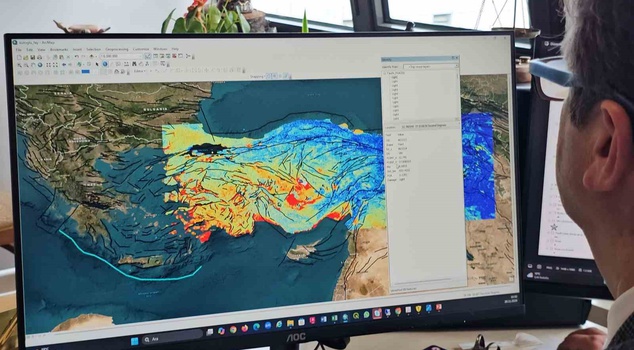
Prof. Dr. Şenol Hakan Kutoğlu from Zonguldak Bülent Ecevit University modeled the scenario of a complete rupture of the Hellenic Arc in the Aegean Sea. According to this, an earthquake above magnitude 8 will be felt in almost all of Turkey; the highest shaking risk is in areas with weak ground extending from the Aegean to the Marmara and Konya Basin. A 1-2 meter tsunami was calculated for the Aegean coasts.
Zonguldak Bülent Ecevit University faculty member Prof. Dr. Şenol Hakan Kutoğlu explained that in the model they developed regarding the possibility of the entire Hellenic Arc in the Aegean Sea rupturing, an earthquake with a magnitude above 8 could be felt in almost all of Turkey. Kutoğlu said that in a possible earthquake, the greatest damage could be seen in areas with weak ground, and if a tsunami occurs, wave heights of between 1 and 2 meters are calculated along the Aegean coasts.
Zonguldak Bülent Ecevit University (BEUN) Faculty of Engineering, Department of Geomatics Engineering faculty member Prof. Dr. Şenol Hakan Kutoğlu investigated, with an automatic damage assessment software they developed, the effects a major earthquake that could occur on the Hellenic Arc in the Aegean Sea might create in Turkey. Kutoğlu, who examined the scenario of the fault system rupturing completely, said the impact area of a possible earthquake would not be limited to the Aegean Region.
Explaining that the Hellenic Arc is a large subduction zone located within the sea, Kutoğlu stated that, like similar fault systems off Japan, it has the potential to generate earthquakes with a magnitude above 8 and tsunamis.
Noting that they did not come across a study in the literature regarding the damage such an earthquake could cause in Turkey, Kutoğlu said that with the software they developed, they modeled the possible effects across the country if the fault ruptures.
IT WILL BE FELT IN ALMOST ALL OF TURKEY
Evaluating the results obtained in the study, Kutoğlu said, "If this fault ruptures completely, it has the potential to generate an earthquake larger than eight. As you can see on the map, if this event occurs, this earthquake will be felt more or less in almost all of our country. This earthquake will be felt in almost all of Turkey's geography," he said.
Stating that the highest level of force the earthquake could create would be one-fifth of the force of gravity, Kutoğlu said that shaking at this level could cause damage in very weak and poorly maintained buildings.
Kutoğlu said, "For there to be heavy damage, the force applied by the earthquake must reach at least half of the force of gravity."
THE GREATEST RISK EXTENDS FROM THE AEGEAN TO THE KONYA BASIN
Explaining that on the map they prepared, the highest shaking effect and damage risk are concentrated in the areas shown in red, Kutoğlu stated that these regions are mainly in the Aegean and extend to Marmara and Central Anatolia.
Saying that the Konya Basin is also among these areas, Kutoğlu stated that the common feature of these regions is weak ground consisting of plains and depression areas.
Stating that faults located on land in Turkey could generate earthquakes with much more destructive consequences than the Hellenic Arc, Kutoğlu said that ground characteristics should be taken into account in urban transformation work.
Kutoğlu said, "When we carry out urban transformation, the areas where we will start priority urban transformation should be the areas we see in red on the map. Because an earthquake that occurs will cause the most damage in these regions."
1-2 METER TSUNAMI ESTIMATE FOR THE AEGEAN COASTS
Also evaluating the possibility of a tsunami forming after the rupture of the Hellenic Arc, Kutoğlu said that according to calculations by the World Tsunami Center, tsunami heights of between 1 and 2 meters could be seen along the Aegean coasts.
Stating that in areas where the coastal slope is very low, seawater could advance inland by as much as 25 to 30 meters, Kutoğlu said, "This would only cause seawater to enter 25 to 30 meters inland in areas with a very low coastal slope. However, this is not a tsunami of a magnitude that could cause major loss of life."