02.04.2026 00:24
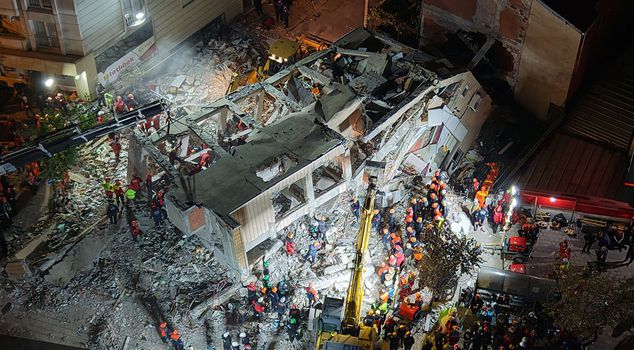
In the second report prepared by a scientific committee consisting of experts from different universities regarding the collapsed building in the Gebze district of Kocaeli, where four people from the same family lost their lives, it was stated that the collapse was not related to the metro.
While the official process regarding the incident in Gebze, which resulted in the death of four people from the same family, continues, it has emerged that there is a second report in addition to the local expert committee report. It has been learned that the second report, prepared by a scientific committee consisting of experts from different universities, sheds light on the contradictions in the local expert committee report.
FOUR PEOPLE FROM THE SAME FAMILY DIED IN THE COLLAPSED APARTMENT
The incident occurred on October 29 at around 07:00 in the Issıkgöl Street of Mevlana Neighborhood in the district. The seven-story Arslan Apartment, located on the street, collapsed with a loud noise. While Emine and Levent Bilir, a couple from the same family, and their children Muhammet Emir (12) and Hayrunnisa Bilir (14) lost their lives under the rubble, Dilara Bilir, who was 18 years old at the time, was rescued with injuries.
EMPHASIS ON "METRO CONSTRUCTION" IN THE PRELIMINARY REPORT
In the preliminary report prepared by the local expert committee consisting of eight members, including a construction engineer, a geology engineer, and an architect, as part of the investigation by the Gebze Chief Public Prosecutor's Office, it was stated that the cause of the collapse was influenced by the metro construction passing under the building.
Following these statements, a second report prepared by a scientific committee consisting of experts from different universities emerged. It was reported that the second report, which was completed quickly and contained contradictions, is a technical report that includes a deep analysis of geological and geotechnical evaluations.
WEAK SOIL CONDITIONS AND CONSTRUCTION DEFECTS IN THE BUILDING
The geological-geotechnical evaluation report prepared indicates that the collapse was due to the weak soil conditions where the building is located and construction defects in the structure. The report also states that the collapsed building was constructed on uncontrolled fill soil, which was an old riverbed and dumping area, and that its foundation was shallow and inadequate.
The report prepared as a result of the examination of the building states that there are no surface and subsurface drainage systems around the collapsed building, that the building has a slender geometric shape (fragile structure risk), that the ground and mezzanine floor used as a pharmacy create a soft story effect, that some concrete compressive strength test results are below the concrete class strength specified in the project, and that although a full basement was planned in the approved project, a complete basement was not constructed, and the building's foundation was built on uncontrolled fill at a shallow depth (without adequate socketing).
PUMP ARM FOUND UNDER THE BUILDING RUBBLE
The report also states that numerous illegal water wells known to exist in the area have caused significant changes in the groundwater level, and that a pump arm was detected during the debris removal operations, suggesting the presence of a water well, either currently or in the past, under the mentioned building, in other words, it is thought that there is a water accumulation point at this location.
The report indicates that the seasonal rise and fall of the groundwater level, combined with the soil not being fully consolidated and compacted, has caused voids to form within the soil, and this situation is considered another reason for soil erosion beneath the building foundation over time.
BUILDING REGISTERED AS A 7-STOREY OFFICE WHILE VISIBLE AS 9 STOREYS INCLUDING ROOF FLOOR
According to the examination of the architectural project and zoning status of the collapsed building; it was observed that in the 'Title Deed Type' description of the building registered in the land registry as parcel 1 of block 3008, it is recorded as a 5-story reinforced concrete apartment and its land, whereas it is understood that in the property and cadastral information system (TAKBİS), the building is registered as a '7-story reinforced concrete office-business and its land.' It was determined that the building was a total of 9 stories including the roof floor in the visuals before its collapse, and based on these findings, significant inconsistencies were identified between the building's permit, title-deed and cadastral records, and the actual number of floors. This situation is stated to invalidate the static calculations made for the structure as it alters the load and load balances of the building.
METRO TUNNELS BUILT IN SOLID ROCK UNIT
The report states that when the approved metro projects are evaluated, it is seen that the metro tunnel and station structures were designed appropriately in terms of engineering, architectural design, and technology, and it was noted that the constructions in the field were found to be fully compliant with the projects.
The report indicates that considering the tunnel route and cover thickness, it was passed from a depth of 17 meters below the surface, and that the tunnels were completed by being constructed within a solid rock unit, and during the construction phases of the tunnels, there were no adverse conditions outside tolerances in soil conditions and tunnel structure, and the interaction with surface structures remained within acceptable tolerance limits.
NO DIRECT CONNECTION ESTABLISHED BETWEEN THE COLLAPSED BUILDING AND METRO CONSTRUCTION
In the continuation of the report, it is stated that all ground movements that have occurred since the beginning of the metro project have been measured at a maximum of 5 cm, and this value cannot cause a 7-meter deep pit under the building. As a result of the technical evaluations conducted, it was concluded that the conditions of the ground on which the building sits and the surface and subsurface water conditions were effective in the building's collapse, and that no direct connection could be established between the building's collapse and the metro construction.