01.03.2026 15:02
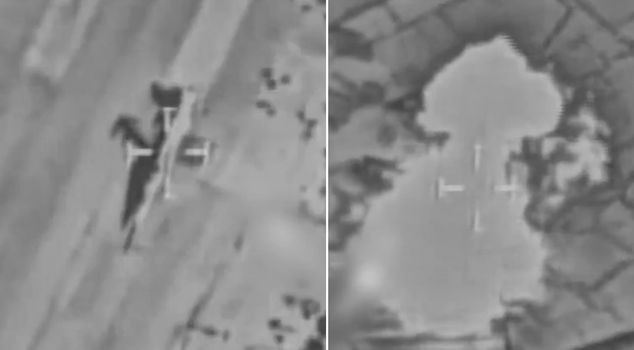
As the joint attacks by the US and Israel against Iran continue, the killing of religious leader Ali Khamenei and other high-ranking critical figures has raised tensions in the war. Israel destroyed Iranian F-4 and F-5 fighter jets that were "ready for takeoff" at Tabriz airport.
As the joint attacks of the US and Israel on Iran continue, the killing of Ayatollah Ali Khamenei and other high-ranking critical figures has further escalated tensions in the war. Most recently, Israel targeted Iranian F-4 and F-5 fighter jets that were ready for takeoff at Tabriz Airport. It was reported that the planes at the runway head were destroyed in the operation.
Israeli sources stated that the attack was a "preventive move" aimed at preventing Iran from deploying its air power. It was reported that the military infrastructure and hangar areas in Tabriz were also hit, causing severe damage to the runway. Satellite images showed burning aircraft wreckage and damaged facilities in the apron area.
F-4 AND F-5 FLEET IN THE CROSSHAIRS
Although the F-4 Phantom II and F-5 Tiger II aircraft in Iran's inventory are older generation platforms, they are kept active due to their heavy payload capacity and operational capability against ground targets. F-4s can reach speeds close to Mach 2 and can carry up to 8 tons of munitions. F-5s are known for their lighter, agile design, particularly suitable for short runway operations.
Recently, Iran had released preparatory footage of F-4 jets targeting US bases. The attack in Tabriz is considered a direct response to these preparations.
AIR DEFENSE SYSTEMS ACTIVATED
Following Israel's attack on Tabriz, Iran's air defense systems were activated. Radar activity increased in Tehran and the northwest region. Iran announced that it would respond to the attack and declared that "the struggle for air superiority has begun."
The US Department of Defense raised the alert level at bases in the region. It was reported that the Patriot and THAAD systems were fully operational, and personnel at American bases in the Gulf were directed to shelters.
BLOW TO COMMAND LEVEL, EXPANSION ON THE FRONT
Following Khamenei's assassination, a significant vacuum emerged in Iran's military and political leadership. The command chain suffered a severe blow with the deaths of the Security Council Chairman, Revolutionary Guards commanders, and the Chief of General Staff. Nevertheless, Iran is trying to demonstrate that it maintains its retaliation capacity by activating both hypersonic missiles and conventional air power elements.
Experts view Israel's attack in Tabriz as part of a strategy to neutralize Iran's air assets and conduct the conflict through unilateral air superiority. The possibility of the conflict progressing in the form of air and missile warfare without spreading to ground forces is becoming more prominent.
REGIONAL IMPACTS
After the attack in Tabriz, Iran's northwestern airspace was temporarily closed. Air traffic was reorganized in areas close to the Turkish border. Energy markets reacted sharply to the developments; oil prices rose, and demand for gold increased.
Calls for restraint are coming in succession from the international community. The United Nations announced that diplomatic efforts are ongoing to prevent the conflict from escalating into a regional war.
Developments on the ground indicate that the war has entered a new phase. Targeting Iran's air power strengthens assessments that the conflict could escalate into a broader air war.