23.10.2026 11:11
The harvest of geographically indicated mastic gum continues in the Çeşme district of İzmir. Mastic, which grows only in Çeşme and on the island of Chios, is sold at between 45,000 and 50,000 lira per kilogram. Since 2020, around 50,000 saplings have been added to the mastic trees, whose number had fallen to as low as 1,000; producers expect production, currently around 100 kilograms, to rise to 1.5–2 tons within 5 years.
The harvest excitement continues in the geographically indicated mastic trees in the Çeşme district of İzmir. After the trees are scored in July, the dripping mastic begins to be collected in mid-September. The mastic, which is then cleaned, is sold for between 45 and 50 thousand lira per kilogram.
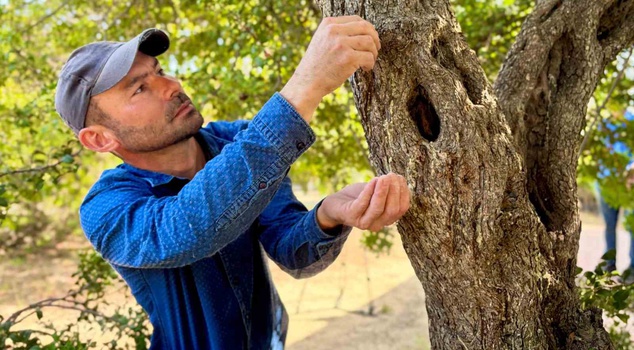
The harvest excitement continues in the geographically indicated mastic tree grown in the Çeşme district of İzmir. The scoring process on mastic trees is carried out at the beginning of July every year. The drops seeping from the scored trees are collected one by one from the base of the trees until mid-September. The collected drops are cleaned by workers and then prepared for use in various sectors such as the food, cosmetics, and pharmaceutical industries. One kilogram of mastic is sold for between 45 and 50 thousand lira.
THE NUMBER OF TREES HAD FALLEN TO A THOUSAND
Producer Hasan Ege Tütüncüoğlu, explaining that mastic is a geographically indicated product and grows only in Çeşme and on Chios Island, said, “It is an endemic plant specific to our region. Mastic has many benefits. Therefore, the tree also produces a very valuable product. The fact that it grows only in this region also makes it very valuable. Until about 5 years ago, during the Republican Era, the mastic trees had unfortunately disappeared. Their number had dropped to a thousand. Starting in 2020, through the efforts of both us and the Ministry of Agriculture and Forestry, approximately 50 thousand mastic trees have met the soil in Çeşme within 5 years.”
PRODUCED ON APPROXIMATELY A THOUSAND DECARES OF LAND
Stating that mastic production is carried out on an area of approximately a thousand decares in Çeşme, Tütüncüoğlu said, “It is very difficult to find land in Çeşme. This is a tourism region and the land is valuable. We have difficulty finding a place to plant mastic trees. The harvest of the mastic tree begins at the end of June or in the first week of July with the scoring of the trees. After the trees are scored, the flow of drops from these incisions continues for about 2 to 2.5 months. We wait for them to dry until mid-September. In mid-September, the mastic drops dry where they fall and become ready to be collected. This process, which begins in July, ends around mid-September and the mastic is collected. After that, the cleaning stage begins in homes. Over a period of about 1 to 1.5 months, until December, the cleaning process of the raw mastic takes place.”
Tütüncüoğlu, saying that a kilogram of mastic is sold for around 45 to 50 thousand lira, noted the following:
“It is a very valuable product. At the moment, we can still produce only around 100 kilograms. However, our newly planted trees will begin to yield mastic within 5 years. By then, we will be producing around 1.5 to 2 tons of mastic in Çeşme and will be able to meet part of our imports.”
THE RIGHT CRITERIA ARE IN ÇEŞME
İbrahim Topal, President of the Çeşme Mastic Producers Association and a producer, also included the following statements: “We founded the Çeşme Mastic Producers Association in June 2024. The purpose of the association’s establishment was that the geographical indication for Çeşme mastic had been obtained one year before the association was established. Geographical indication is an important brand. Since products in various parts of Turkey are also registered with geographical indications, it is known that geographically indicated mastic grows in Çeşme. It may perhaps exist elsewhere too, but the place with the right criteria and the right enzymes is Çeşme. Because the influence of the geography, the wind blowing from the sea, the sun, and the soil is great in this. A young friend of ours, a geomatics engineer, did a thesis study on this subject and identified the areas in Çeşme suitable for growing mastic. When you look at it in percentages, there are places that vary by one or two points even within Çeşme itself. In Çiftlikköy, ecological factors such as wind, sun, and soil provide 80-81 percent suitability, while in some areas of Alaçatı this rate drops by two points to 78 percent. In areas farther away, it goes down to 76 percent.”