10.07.2026 20:10
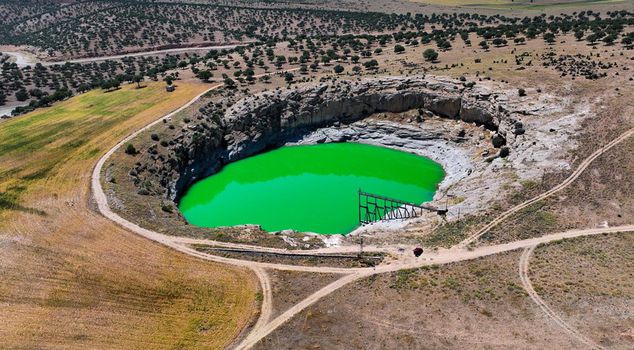
The historical Apasaraycık Sinkhole in Konya's Çumra district has regained its natural beauty lost due to drought after recent rainfall. This paleosinkhole, approximately 80 meters deep and 600 meters wide, has returned to its enchanting emerald green color thanks to microscopic algae and its mineral structure. KTÜ Sinkhole Research Center Director Prof. Dr. Fetullah Arık stated that this unique geological heritage, with its rising water level, awaits visitors like an evil eye bead.
Located on the shore of Apa Dam in the Çumra district of Konya, the sinkhole, approximately 80 meters deep and 600 meters wide, is among the significant karst formations of the Konya Closed Basin.
DRAWS ATTENTION WITH ITS EMERALD GREEN APPEARANCE
Shaped by thousands of years of natural processes, the sinkhole, with its steep slopes and elliptical structure, is regarded as one of the region's geological heritages. The sinkhole gets its emerald green color from factors such as its natural mineral structure and microscopic algae found in its still water. Depending on the sun's position in the sky, the sinkhole, which takes on different shades of green later in the day, was captured from the air.
"ITS FORMATION CAN BE DATED BACK THOUSANDS OF YEARS"
Prof. Dr. Fetullah Arık, Director of the Konya Technical University Sinkhole Research Center, stated that in previous years, due to the drop in water level, the rock layers at the sinkhole's bottom became exposed, and it lost its beautiful appearance. Arık noted that with the effective rainfall over the past year, the sinkhole's water level has increased considerably, and it welcomes visitors with its clear and emerald green appearance once again.
Explaining that the sinkhole is a paleo-sinkhole (a sinkhole formed in ancient geological periods), Arık stated, "This paleo-sinkhole formed when voids within Mesozoic (the era when dinosaurs emerged and dominated the Earth, covering roughly 252 to 66 million years ago) aged limestones dissolved and grew, causing the upper layer to collapse as it could no longer support its weight. Its formation can be dated back thousands of years."
"VISUALLY VERY IMPRESSIVE AND BEAUTIFUL"
Arık explained that since the sinkhole is located next to the Çarşamba Channel, which forms the Apa Dam, it appears as a water-filled sinkhole. He said, "There was water in the sinkhole at all times. However, it was severely affected by the drought in recent years, and the water level dropped significantly. This year, with the rains, the water level rose. Compared to other nearby water bodies, it has developed a much darker green color. It is visually very impressive and beautiful. When we consider sinkholes, many others in the region form within young units in clastic levels and cover material. The Apasaraycık Sinkhole differentiates itself as a paleo-sinkhole."
Emphasizing that the sinkhole welcomes visitors like an evil eye bead, Arık recommended that enthusiasts visit this beautiful landscape. Arık added, "The nearby Çarşamba Channel and Apa Dam add a special visual beauty to the scenery."