12.08.2026 13:10
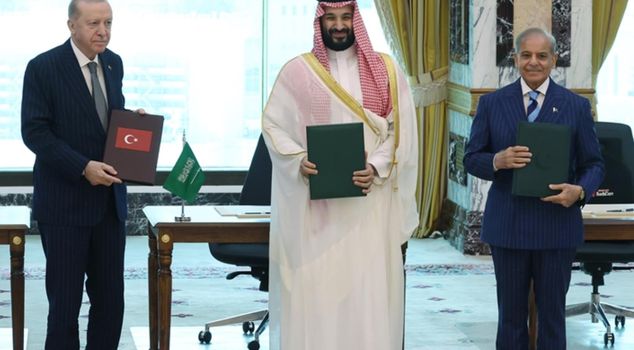
SETA Foreign Policy Research Director Murat Yeşiltaş analyzed the "Mecca Agreement" signed between Türkiye, Saudi Arabia, and Pakistan. Yeşiltaş stated that the main goal of acting jointly for the three states is "to multiply strategic options, reduce vulnerabilities, and expand the foreign policy space."
SETA (Foundation for Political, Economic and Social Research) Director of Foreign Policy Studies Murat Yeşiltaş, in his article on the "Makkah Agreement" signed between Turkey, Saudi Arabia, and Pakistan, presented striking analyses. Murat Yeşiltaş's noteworthy analysis is as follows:
THE CONCEPT OF "DETERRENCE"
The Makkah Joint Defense Agreement signed between Turkey, Saudi Arabia, and Pakistan introduces a new strategic framework that could yield significant consequences for the regional security architecture. The agreement, which stipulates that an armed attack against any of the parties shall be considered an attack against all three countries, goes beyond existing bilateral defense relations and is based on the concept of collective deterrence.
However, evaluating the agreement merely as the development of military cooperation among the three countries would be incomplete. The Makkah Joint Defense Agreement is a product of an era where uncertainty in the international system is deepening, the security commitments of major powers, particularly the US, are becoming more selective, and regional conflicts are becoming interconnected. The agreement also reveals how middle powers are trying to adapt to the changing international order, how they combine their different power elements, and how they expand their strategic maneuvering space.
To grasp the true meaning of the agreement, one must look at the issue through the lens of order, power, state capacity, and strategic autonomy. Just as important as the geopolitical drivers that brought the agreement about is how Turkey, Saudi Arabia, and Pakistan will transform their different capacities into a common deterrence framework. Therefore, the real question is not so much what the text of the agreement says, but rather to what extent political will can be translated into institutional and operational capacity. More importantly, the fundamental issue is how the agreement will be made operational if the motivation it presents is tested in a real conflict and crisis environment.
GEOPOLITICAL REASONS BEHIND THE AGREEMENT
The first significant reason behind the Makkah Agreement is the deepening uncertainty in the international security order. While the US military presence and regional partnerships in the Middle East continue, Washington's level and duration of responsibility in the face of any crisis are increasingly being questioned. The expansion of great power competition towards the Asia-Pacific also makes American security policy more selective. Consequently, regional actors in the Middle East are compelled to assume greater responsibility for their own security. Europe's quest to build a new security and defense architecture due to the security crisis caused by the Russia-Ukraine War and the emergence of regional initiatives like the Makkah Agreement in the Middle East share a similar foundation.
This situation does not mean that regional countries are completely distancing themselves from their relations with the US or other great powers. The main trend is to create alternative security channels while maintaining existing alliances, diversify partnerships, and reduce over-dependence on a single security provider. In this respect, the Makkah Joint Defense Agreement should be seen as the result of a search for strategic diversification rather than a break.
The second important reason is the increasing regionalization of conflicts in the Middle East. The war that began in Gaza has over time created a broader conflict area encompassing the security of Lebanon, Syria, Iraq, Yemen, Iran, and the Gulf. The proliferation of missile and unmanned aerial vehicle (UAV) attacks, energy facilities becoming targets, and threats to maritime trade routes have demonstrated that security can no longer be addressed solely within national borders.
"GEOGRAPHIC DISTANCE ALONE DOES NOT PROVIDE SECURITY"
In this new environment, geographic distance alone does not provide security. A missile launched from Iran or Yemen can target energy facilities in the Gulf, while a crisis in the Strait of Hormuz can affect the energy and trade security of a much wider geography, including Pakistan. A tension emerging in the Eastern Mediterranean or Syria can quickly become a direct security issue for Turkey. Air and missile defense, maritime security, protection of critical infrastructure, intelligence sharing, and cyber capacity therefore converge in the same security equation.
The third reason is that the use of military force in the region is becoming increasingly subject to fewer constraints. The conflict between Israel and Iran has transcended being merely a rivalry between two countries and has gained a character that directly affects the security of regional states. Israel's extension of its military operations to a widening geography, Iran's use of its missile and UAV capabilities in different arenas, and the involvement of non-state armed actors in conflicts increase the likelihood that any crisis could quickly escalate into a cross-border war.
Therefore, it would be incorrect to define the Makkah Agreement merely as a bloc established against Iran, Israel, or any other country. Behind the agreement lies a much broader security concern: the weakening of mechanisms that could limit military escalation in the region and the inadequacy of existing security guarantees against new threats.
"TECHNOLOGICAL TRANSFORMATION OF WARFARE"
The fourth reason behind the agreement is the technological transformation of warfare. The proliferation of missile, cruise missile, and UAV technologies makes critical infrastructure, energy facilities, and cities more vulnerable. Having a strong army is no longer sufficient on its own. There is a need for an intelligence network capable of detecting threats in advance, layered air defense, electronic warfare capability, uninterrupted logistical support, and a sustainable defense industry.
This environment increases the importance of middle powers. Middle powers cannot replace great powers on their own, cannot rebuild the international system, or completely alter the global balance of power. However, by combining their military, economic, diplomatic, and technological capabilities, they can become more influential in shaping the regional order. The capacity of middle powers stems not from their equality with great powers, but from possessing the tools to produce results in specific areas.
For Turkey, Saudi Arabia, and Pakistan, the primary purpose of acting together is not to establish a new balance against a great power. The real goal is to multiply strategic options, reduce vulnerabilities, and expand the foreign policy space. Although all three countries have different alliance relationships, they see that regional security cannot be provided solely from outside.
The long-developing bilateral relations among the three countries also facilitated the emergence of the agreement. Saudi Arabia-Pakistan defense relations, Turkey-Pakistan military cooperation, and the Turkey-Saudi Arabia rapprochement that has gained momentum in recent years prepared the political and military infrastructure for the trilateral framework.The Mecca Agreement thus brought relations that had previously been progressing on separate tracks onto a common strategic ground.
MIDDLE POWERS AND COLLECTIVE DETERRENCE
One of the most important features of the Mecca Agreement is that it brings together three middle powers with different power profiles within the same defense framework. The foreign policy priorities of Türkiye, Saudi Arabia, and Pakistan do not overlap on every issue, but full strategic alignment on all matters is not required for middle power cooperation to emerge. What is decisive is the identification of common threat areas and the ability to use different capabilities in a complementary manner.
Türkiye stands out with its advanced defense industry, position within NATO, broad military capacity, and operational experience gained in various conflict zones. Pakistan lends strategic depth to the agreement with its large army, deep-rooted military institutions, missile technology, and nuclear capability. Saudi Arabia, meanwhile, complements this structure with its economic resources, weight in energy markets, strategic geography, and political influence in the Arab and Islamic worlds.
The power profiles of the three countries are not the same, but the value of middle power cooperation also derives from these differences. If Türkiye's defense technologies, Pakistan's military capacity, and Saudi Arabia's economic resources can be combined through joint projects, a comprehensive security network could emerge. Air and missile defense, UAV technologies, electronic warfare, joint ammunition production, maritime security, and the protection of critical infrastructure could be priority areas for this cooperation.
THE REAL SIGNIFICANCE OF THE AGREEMENT
The real significance of the agreement lies in bringing these different power elements together within a common deterrence framework. The provision that an armed attack against one of the parties will be considered an attack against all is a powerful political message that could alter the cost calculation for a potential aggressor. However, deterrence depends not only on military capacity but also on the credibility of political will and the capacity for joint action.
Therefore, political will alone will not suffice. Without a common threat assessment, regular defense ministers' meetings, intelligence sharing, joint exercises, and command-and-control compatibility, it is impossible for a political declaration to transform into a genuine security mechanism. Joint production in the defense industry, technology sharing, strengthening ammunition stockpiles, and developing maintenance and repair infrastructure could also ensure the sustainability of the cooperation.
The Mecca Joint Defense Agreement is a natural extension of Türkiye's quest for strategic autonomy. Strategic autonomy does not mean moving away from existing alliances or acting independently of all external ties. The main issue is to increase options in foreign policy and security while maintaining alliance relations, reduce unilateral dependency, and preserve room for maneuver in the face of crises.
In this context, there is no necessary contradiction between Ankara's NATO membership and the defense cooperation it has developed with Saudi Arabia and Pakistan. While maintaining its existing alliance relations on one hand, Türkiye is increasing its strategic depth in the Gulf, the Middle East, and South Asia on the other. This approach aims not so much to eliminate dependency relations as to transform unilateral dependency into a more balanced and structured relationship of interdependence.
POSSIBLE COUNTER-MOVES
However, the new situation created by the agreement could also trigger calculations and possible counter-moves by other regional actors. On the Israeli front, approaches viewing the agreement as the emergence of a more assertive "Sunni axis" could gain strength. The coming together of Türkiye's military capacity, Pakistan's nuclear power, and Saudi Arabia's economic resources within the same framework is a development that Tel Aviv must closely monitor.
However, it would not be correct to cite Israel as the primary reason for the agreement. Saudi Arabia's main concern is how long it can hold out with its own means in an increasingly complex security environment. Iran's military capacity, Houthi attacks, the vulnerability of energy infrastructure, and uncertainties regarding American security commitments are driving Riyadh to seek additional strategic depth. At this point, Türkiye and Pakistan should be seen less as members of a front against Israel and more as two important partners that diversify Saudi Arabia's security options.
Therefore, the agreement does not entirely eliminate the possibility of future normalization between Saudi Arabia and Israel. Although Riyadh's defense partnerships and the future of its relations with Israel are linked, they can proceed on separate tracks. If Israel makes a serious and credible political move on the Palestinian issue, Saudi Arabia could reconsider the normalization option. In this context, the agreement does not remove this calculation but rather strengthens Riyadh's negotiating capacity vis-à-vis both Israel and the United States.
Israel's likely counter-move may be to narrow the limits of the new structure rather than directly clash with the agreement. Tel Aviv may try to limit Türkiye's role in Gulf security in Washington, strengthen direct security relations with Saudi Arabia, and deepen military and technological cooperation with its existing partners, especially the United Arab Emirates (UAE). Debates over whether Pakistan's nuclear capacity falls within the scope of the agreement could also be used to create international pressure. Another track for Tel Aviv is deepening its relations with India. New Delhi's approach towards Pakistan and Türkiye could also shift to a new level following this agreement. At this point, a move from India against Türkiye on the scale of the Eastern Mediterranean is also possible.
HOW MIGHT IRAN VIEW THE AGREEMENT?
Iran, for its part, may assess the agreement as a more serious strategic development than Israel. The initial reactions also confirm this. Türkiye, Saudi Arabia, and Pakistan do not want to enter into a direct conflict with Iran. All three countries have economic, political, and security relations that they need to maintain with Tehran, but what is decisive for Iran is not the current intentions of the three countries but the joint capacity they could produce together in the future. The establishment of regular military coordination among three major regional actors could change the fragmented regional security structure from which Tehran has long benefited.
Iran's initial reaction will likely be to exploit the differences among the three countries rather than openly confront the agreement. Tehran could develop separate relations with Türkiye through border security, trade, energy, and Syria; with Pakistan through Balochistan and border security; and with Saudi Arabia through Gulf stability and diplomatic normalization.Thus, it can be attempted to prevent the tripartite structure from forming a common Iranian policy.
The second tool Iran could use is its asymmetric pressure capacity. Increasing pressure on Saudi Arabia through the Houthis, targeting Turkey's interests through armed groups in Iraq and Syria, or raising tensions in the Persian Gulf and the Strait of Hormuz could test the durability of the agreement. Tehran's aim may be less about starting a direct large-scale war and more about seeing to what extent the parties will act together in the face of an attack.
The real test of the agreement will emerge at this point. Will Houthi attacks on Saudi Arabia bring direct military support from Turkey or Pakistan? Would the targeting of a Turkish-made platform used by Saudi Arabia be considered an attack on Turkey? More importantly, if Iran targets Saudi oil facilities in response to a potential American attack, what stance will Ankara and Islamabad take? The continuation of American and Israeli military pressure on Iran, in this sense, creates a fragile structural framework.
WHAT WOULD THE US REACTION BE?
The US approach may not be entirely negative. Riyadh's unwillingness to rely solely on Washington for its security indicates a relative decline in American influence. However, regional partners taking on more responsibility for their own security is a long-stated American expectation. If Turkey, Saudi Arabia, and Pakistan build a defense capacity that contributes to regional stability, it could reduce the US military burden.
From Washington's perspective, the key issue is the extent to which the new structure aligns with American interests. The agreement could be supported by the US if it deters Iran, strengthens the security of sea lanes, protects energy infrastructure, and creates a sustainable regional order. Conversely, if the structure turns into a political bloc independent of Washington, expands defense cooperation with China, or creates new pressure on Israel, the American approach could change. In that case, the US might try to limit the maneuvering space of the three countries through the terms of use of weapon systems, technology transfer, and intelligence sharing.
A NEW COMPETITION IN GULF SECURITY?
The UAE will also closely monitor the agreement. Abu Dhabi may cautiously evaluate Turkey's assumption of a more visible role in Gulf security in terms of its own regional influence. Although there has been significant normalization in Turkey-UAE relations in recent years, increased Turkish military influence in Gulf security could create a new area of competition.
The Mecca Agreement, in this regard, could produce two different outcomes. If it transforms into a defensive, transparent structure that supports regional stability, it could pave the way for a broader security dialogue. At this very point, there is also the possibility that the agreement could become an attractive center of power and gravity for other countries in the region. Conversely, if the agreement is perceived as an exclusionary bloc by Iran, Israel, or the UAE within the region, and is read as a threat by countries outside the region such as India, it could accelerate new balancing attempts, armament, and the search for counter-alliances. Therefore, the diplomatic management of the agreement is as important as its military dimension.
BUILDING A REGIONAL SECURITY ARCHITECTURE
In conclusion, the Mecca Joint Defense Agreement should be seen as a strategic framework open to construction rather than a fully completed military alliance. The agreement's impact will be determined not by the political symbolism of the signing ceremony, but by the institutional and operational capacity to be created in the coming period. Which threats the principle of common defense covers, how the decision-making mechanisms will function, and what concrete commitments the parties will undertake remain fundamental questions. On the other hand, if the crisis management capacity experienced for some time is provided with a new and robust framework through this tripartite mechanism, it could evolve into a sustainable and inclusive regional framework. Therefore, the greatest test of the agreement will occur not during periods of low-cost political solidarity, but at the moment when one of the parties is attacked and the others have to assume serious military costs.
Nevertheless, the Mecca Agreement points to a more comprehensive change in the regional security order. In an environment where great powers' commitments are becoming more selective, wars are regionalizing, and military technologies are expanding the threat area, regional powers are taking on more responsibility and taking a historic step towards building a collective deterrence architecture. The step taken by Turkey, Saudi Arabia, and Pakistan is also part of this new trend.