06.09.2026 17:30
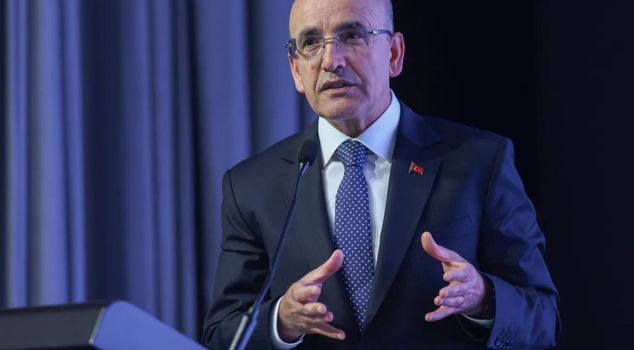
Minister of Treasury and Finance Mehmet Şimşek stated that within the scope of public savings measures, the number of rental vehicles was reduced by 21 percent, savings of 484 billion liras were achieved in current consumption, and no cuts were made to investments. He announced that audits on large companies have been increased for tax justice and that the share of indirect taxes has decreased.
Minister of Treasury and Finance Mehmet Şimşek drew attention to the measures taken within the scope of public sector savings, stating, "Following the publication of the Savings Circular, we reduced the number of rental vehicles by 21 percent during the renewal process of rental vehicles whose contracts had expired."
PUBLIC SECTOR SAVINGS MEASURES
Şimşek answered questions after the 2027-2029 period Medium Term Program (MTP) was announced by Vice President Cevdet Yılmaz at the Presidential Complex.
Providing information on the measures taken within the scope of public sector savings measures, Şimşek said that the perception that savings were achieved in the public sector through cuts in investments was not true.
Şimşek noted that the share of investments in national income in the 2027 budget did not decrease compared to 2026, stating, "On the contrary, with the appropriations we have parked in the reserve allowance and plan to use within the scope of accelerating investments, there is a slight increase in the share of public investments relative to national income. So, there is a situation like raising it to 1.8 percent. Therefore, the statement 'You are making savings by reducing investments' does not fully align with the facts."
Pointing out that there is success in public sector savings, Şimşek drew attention to President Recep Tayyip Erdoğan's strong will in this regard.
"SIGNIFICANT PORTIONS OF PUBLIC CURRENT CONSUMPTION ARE WITHIN THIS SCOPE"
Şimşek recalled that a different framework was established in the savings circular published in 2024, creating a strong monitoring, auditing, reporting, and sanction framework. Stating that the Ministry performs a very strong function in the monitoring, auditing, and reporting aspects, excluding the sanction aspect, and achieves results, Şimşek explained that significant portions of public current consumption, except for defense, fall within this scope.
484 BILLION LIRA SAVINGS
Referring to savings made in areas such as public vehicles, public buildings, communication expenses, travel expenses, energy, water, stationery, and fixtures, Şimşek said, "In the 10 years before the Savings Circular, the share of these items in budget expenditures was 4.6 percent. Today, the share of these items in the budget is 2.9 percent as of the end of 2025. It will probably not change much in 2026. When you look at current prices, this saving corresponds to 484 billion lira. This actually corresponds to a saving larger than the budget of 6 ministries. That is why we attach importance to this. For example, one of the issues our citizens most frequently communicate to us in the field is the use of vehicles in the public sector. For instance, following the publication of the Savings Circular, we reduced the number of rental vehicles by 21 percent during the renewal process of rental vehicles whose contracts had expired. So, let's say the rental contracts of 100 vehicles expired; when renewing them, we renewed 79. Therefore, there is very strong savings here. If you look at the investment dimension, we only reviewed service building constructions and limited them."
Emphasizing that they are cautious about the renovation of service buildings except for mandatory cases, Şimşek stressed that serious measures have been taken, especially in energy and water usage.
"WE TOOK SERIOUS MEASURES TO ENSURE TAX JUSTICE"
Şimşek stated that while combating informality, they prioritize voluntary compliance and do not have an approach of punishing segments that have problems with tax compliance. Stating that after determinations are made, the findings are shared with taxpayers and their representatives for correction before auditing, Şimşek continued as follows:
"So where is auditing concentrated? There is a different perception in the field, but we audit 31 out of every 100 large companies. That is, the audit rate for large companies is 31.3 percent for 2026. For example, in 2024 it was around 11 percent. Therefore, we have tripled the audit rate for large companies. We increased it from 3.6 percent to 7.3 percent for medium-sized companies. There is a perception in society that small businesses are being targeted, but there is no such thing. The audit rate for small-scale companies was 2.1 percent in 2024, and this year it decreased to 1.1 percent. Therefore, voluntary compliance is essential, guidance is essential, but of course, there is a concentration on the large ones here."
Şimşek emphasized that the number of income tax returns reached a record level of 5.5 million, up from 3.8 million, and drew attention to the fact that this situation is reflected in tax revenues. Sharing the information that the ratio of tax revenues to national income was 15.4 percent in 2022, increased to 16.6 percent in 2023, and exceeded 17 in 2026, Şimşek stated that the estimate for 2027 is 17.9 percent.
INDIRECT TAXES
Also touching upon indirect taxes, Şimşek made the following assessments:
"We took very serious measures to ensure tax justice, and thanks to these measures, we reduced the share of indirect taxes in total taxes. Look, in 2023, the share of indirect taxes in total taxes had risen to 65.5 percent. For 2026, our estimate is that it may decrease to slightly below 60 percent, that is, around 59 point something to 60 percent. This is significant progress; the rate is still high, but there is significant progress."
"IT WAS IMPORTANT THAT INFLATION DID NOT GET OUT OF CONTROL"
Şimşek drew attention to the fact that the performance of the programs is related to global and domestic conditions, stating that multiple shocks have been experienced in both the region and the global economy in the last few years. Noting that a difficult period with high risks is being experienced in a challenging geography, Şimşek emphasized that a more difficult process is faced compared to previous periods.
Stating that the most important benefit of the MTP is predictability, Şimşek expressed that targets can be debated, but the implemented program increases predictability. Stating that the rule-based approach and proactivity are essential in this period and that they have built buffers, Şimşek continued as follows:
"In this difficult geography, in this difficult period, there has been a serious increase in the economy's resilience to shocks, and this is reflected in the figures. There is very strong political will from our President to increase the program's resilience. In such a difficult conjuncture, inflation could have gotten out of control, let alone decreased, but it did not. Yes, we are not at the point we desired; of course, our targets were ambitious at the beginning. We probably underestimated inertia. Look, I speak openly. In this difficult conjuncture, besides external conditions, there are also the effects of the earthquake, FX-protected deposits (KKM), and early retirement (EYT), especially in 2023. In such a difficult conjuncture, it was important that inflation did not get out of control."
"CORE GOODS INFLATION FELL BELOW 16 PERCENT"
Minister Şimşek also stated that core goods inflation fell below 16 percent, and that the effects of previous regulations in some areas such as rents and education have been carried into this program period.
Şimşek also said that the decrease in vulnerability in the current account deficit and the absence of structural deterioration are very valuable.
Emphasizing that there has been an improvement in income distribution over the last 2 years and that further improvement is needed, Şimşek noted the following:
"KKM was a significant contingent liability, and exiting it was important for us."Despite all these shocks, our citizens' demand for foreign currency has significantly decreased compared to the past, meaning confidence in the lira is at a very different point. I see all of these as gains of the program. That is, I believe that the matter should not be merely a matter of tracking a few targets. "}
.