08.11.2026 11:51
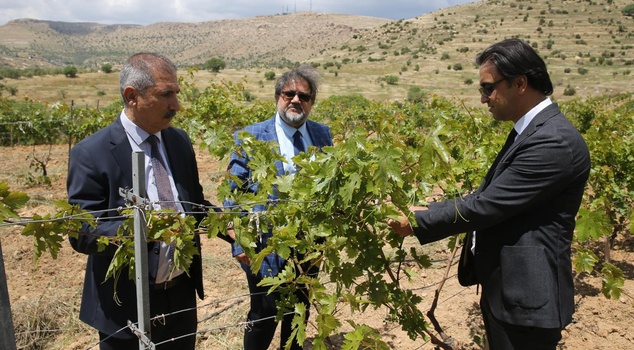
In the Breeding and Gene Garden established by the Provincial Directorate of Agriculture and Forestry in Mardin, 24 of the 28 local grape varieties grown in the city that were identified have been placed under protection. In the 20-decare garden where varieties such as Mazruna, Kerküş, Karfoki, and Zeyti are cultivated, the aim is to deliver the saplings produced to farmers. Mardin, which ranks second in Turkey in vineyard area, ranks fifth in grape production.
In the gene garden established in Mardin to preserve grape varieties specific to the region, 24 grape varieties are being cultivated. Expert teams continue their work to bring the 4 varieties that have not yet been found into the garden.
TURKEY’S SECOND IN VINEYARD AREA
Mardin ranks second in Turkey after Manisa with 34,777 hectares of vineyard area. With annual grape production of 113,142 tons, the city ranks fifth.
Viticulture, carried out largely under arid and barren conditions, is among the important sources of livelihood for producers in the city. Local grape varieties, which are part of the region’s agricultural and cultural heritage, play a role in the production of traditional products and in keeping viticulture culture alive.
11-DECARE GARDEN REACHED 20 DECARES
The Provincial Directorate of Agriculture and Forestry established a Breeding and Gene Garden on an area of 11 decares. The objectives of the garden were listed as follows:
- to preserve grape varieties specific to the city,
- to demonstrate modern production and vine-training techniques to producers in practice,
- to expand vineyard areas through healthy sapling production.
In the garden, which over time reached 20 decares, 24 grape varieties, including mazruna, kerküş, karfoki, zeyti, zeynebi, kerklav and şıtvi, were placed under protection.
“WE HAVE GRAPES GROWN FOR TABLE AND JUICE”
Ender Muhammed Gümüş, Provincial Director of Agriculture and Forestry, said that viticulture in Mardin is carried out largely under arid and barren conditions. Gümüş emphasized that despite harsh natural conditions, grape production is one of the most important sources of livelihood for producers in the region.
Gümüş noted that, with the support of the Ministry, they are carrying out work at the directorate’s sapling production site. He stated that the aim of this work is to protect the gene resources of local grape varieties that are part of the city’s cultural heritage and to ensure their sustainability.
Gümüş, noting that expert teams traveled district by district and neighborhood by neighborhood and identified and collected 24 of the 28 local grape varieties grown in Mardin, spoke as follows: “Our aim is, on the one hand, to keep breeding material ready and ensure that our farmers can start production when they need it, and on the other hand, to produce these varieties in our garden and pass them on to future generations in a healthy way. We have grapes here grown for table and juice use. Our colleagues are producing a total of 24 varieties.”
75 PERCENT GRANT-FUNDED EQUIPMENT FOR FARMERS
Gümüş explained that they are carrying out projects for the transition to the trellis training system with the contributions of the Ministry, the Governorship, the Metropolitan Municipality and the GAP Regional Development Administration. He stated that equipment such as a grape press, backpack sprayer and pruning machine is also provided to farmers with a 75 percent grant.
Gümüş stated that efforts to increase efficiency and production in viticulture would continue, and said: “We have approximately 35 thousand hectares of planting area and a production amount of 113 thousand tons. We rank second in Turkey in terms of planting area and fifth in terms of production amount. Grapes, which have high nutritional value and can grow under different climate and soil conditions, are very important for us in these respects. We established the garden to preserve gene resources, to bring viticulture, which has a history of thousands of years, to the position it deserves in Mardin and to pass it on to future generations. We are also preparing projects to bring the saplings produced here together with our farmers,” he said.
“WE HAD DIFFICULTY FINDING SOME VARIETIES”
Senior Agricultural Engineer Erdal Homan said that 3 years ago they started work with technical teams to find 28 grape varieties specific to the region. Homan stated that the 24 identified varieties are grown in the garden with the trellis training system and noted the following:
“We had difficulty finding some varieties. We also took and evaluated the ones we found. At present, our work to preserve these gene resources in our breeding garden continues. We want to find the other four varieties as well and at least collect in the garden the 28 grape varieties known by their local names in Mardin. We aim to establish a gene bank, to show the grape varieties to our producers in the field with the saplings we will produce here in the future, and to increase production.”
GRAFTED SAPLINGS WILL REACH PRODUCERS
Emphasizing that Mardin has significant potential for grape growing, Homan drew attention to the importance of preserving the diversity in the region. Homan stated that grapes can grow almost everywhere in the region, especially in mountainous areas. He conveyed that they aim to increase the production area and amount by producing grafted saplings from the varieties and delivering them to producers.
Explaining that they want to reach the level they deserve in Turkey in production, Homan said, “We will continue their production and, by preserving the gene source, we will provide these varieties to our producers many times over.”