26.08.2026 13:00
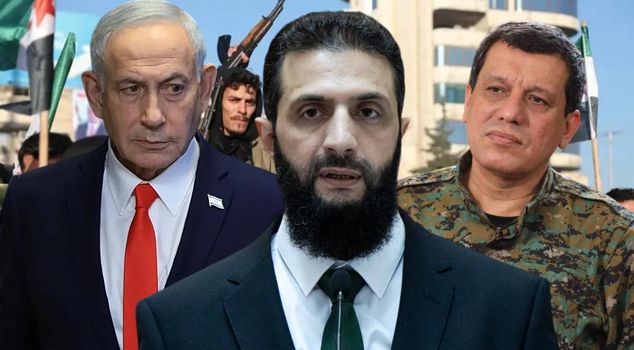
Ahmet Arda Şensoy, a researcher at the Türkiye Research Foundation, wrote about what the removal of Syria from the US list of 'State Sponsors of Terrorism' and the dissolution of the SDF mean. Şensoy said, 'While the US lifting its latest sanctions on Syria represents a new success for Damascus and Ankara, it can be interpreted for Tel Aviv as yet another failure to achieve what it wanted in the Syrian field.'
Researcher Ahmet Arda Şensoy at the Turkey Studies Foundation wrote about what the removal of Syria from the US list of "State Sponsors of Terrorism" and the dissolution of the SDF mean. Şensoy, while evaluating the organization's dissolution decision as "a victory for Turkey, a defeat for Israel," said, "The US lifting the last sanctions against Syria signifies a new success for Damascus and Ankara, while for Tel Aviv it can be interpreted as yet another failure to achieve what it wanted in the Syrian field."
TOOK EFFECT AFTER THE 45-DAY PERIOD
The decision by US President Donald Trump to remove Syria from the list of State Sponsors of Terrorism, taken after his meeting with Syrian President Ahmed al-Sharaa in Ankara within the scope of the 36th NATO Summit, went into effect with the signature of US Secretary of State Marco Rubio after the 45-day congressional objection period expired.
A GREAT VICTORY FOR THE DAMASCUS ADMINISTRATION
For the Damascus administration, which took enormous steps and achieved successes to integrate with the world diplomatically and economically after the fall of the Assad regime in December 2024, this latest decision by the US means a great victory. On the other hand, Israel's attack on the Abu al-Zuhur airbase near Idlib once again confirmed that Israel is the greatest threat to the country's reconstruction and healing the wounds of the civil war in the new era. Meanwhile, Ferhat Abdi Şahin, codenamed Mazloum Abdi, one of the organization's leaders, announced the dissolution of the SDF on the evening of August 25, declaring the integration process complete.
All these developments, and especially Syria's removal from the US list of "State Sponsors of Terrorism," show that Syria has gained significant momentum in becoming part of a new regional order in the post-Assad era, beyond being merely a signature lifting sanctions.
A SIGNIFICANT LEGAL AND POLITICAL OBSTACLE IS REMOVED
The US removal of Syria from the "State Sponsors of Terrorism" list means the end of a status that had been in place since 1979. While this decision demonstrates that Damascus is no longer classified as part of state-sponsored terrorism from the US perspective, it removes a significant legal and political obstacle in front of Syria, particularly regarding financial transactions, international banking, investment, and economic relations.
Syria's removal from the "State Sponsors of Terrorism" list should be read as a political and diplomatic victory before its economic consequences. Considering the other members of the list—Cuba, Iran, and North Korea—and given that Syria was the country that remained on the list the longest, the importance of the decision becomes clearer. Therefore, being on this list was valuable not just for economic sanctions but for understanding how the US positioned that country in the international system. Thus, Syria's removal from the list constitutes a declaration of how the Trump administration wishes to establish relations with Damascus.
WHAT WILL THE ECONOMIC CONSEQUENCES BE?
The second and perhaps most concrete dimension of the decision for Syria is economic. The US decision to remove Syria from the "State Sponsors of Terrorism" list constitutes one of the final major steps needed for the previously lifted sanctions to gain economic meaning. Because a significant portion of the legal and financial uncertainties preventing the private sector and international capital from entering Syria have now been removed. Especially regarding banking transactions and reintegration into the global financial system, a new era begins for Syria. Syria's need for approximately $260 billion for reconstruction makes this decision critical both for implementing existing investment agreements and accelerating new ones, and for the economy to recover and erase the traces of the civil war. However, it should not be forgotten that lifting sanctions will not automatically mean investment flowing into the country. This process needs to be put on a sound footing, particularly through legal regulations concerning banking, finance, and foreign investment.
The decision also means the removal of significant barriers limiting US civilian aid to Syria, military sales, and the transfer of dual-use technologies. More importantly, one of the fundamental legal obstacles to Washington providing military aid to Syria or signing a future military agreement has been removed. This shows that the decision opens a new door for Damascus's integration into the international system in the security and defense fields as much as in the economic field.
LOCAL AND REGIONAL CONTEXT
Developments inside and around Syria during the days the decision took effect show that this is also part of a larger struggle over the country's future. While Israel's attack on the Abu al-Zuhur airbase reveals that security risks that could undermine Syria's diplomatic integration and reconstruction process still persist, the fact that the US Congress raised no objections to the decision during the 45-day objection period was a notable development regarding political balances in Washington. It shows that even in Congress, where pro-Israel circles have influence, no overt political resistance has emerged against the Trump administration's Syria policy. It can be said that congress members, especially those in a midterm election process, are hesitant to contradict and openly oppose Trump's decision.
THE SDF'S DISSOLUTION DECISION
On the local front of these developments lies the SDF's dissolution decision. In the face of the Damascus administration's efforts to re-establish the country's territorial integrity, the change in US Syria policy also created a new equation for the SDF.
In an equation where Washington prefers to work with the Syrian central government, it was no longer possible for the organization, which had also lost its occupied areas east of the Euphrates, to survive as an independent politico-military structure.
This came to an end yesterday when Abdi announced the dissolution of the organization. Thus, while the SDF issue, one of the greatest threats to Syria's unitary state structure, has been largely resolved, the possibility of Israel making the terrorist organization functional in line with its dream of an unstable Syria has also been largely eliminated.
Nevertheless, given that Israel's occupation and attack moves against southern Syria continue, the risks remain alive. On the same day, Israeli Defense Minister Israel Katz's visit to the occupied Mount Sheikh, the protests of separatist Druze circles in Suwayda, and Hikmat al-Hijri's statement that they are an "inseparable part" of Israel show that the issue before Syria is not merely an economic restructuring.
A VICTORY FOR TURKEY, A DEFEAT FOR ISRAEL
The decision also has a special meaning for Turkey. The transformation in US Syria policy significantly overlaps with Ankara's vision for Syria and the region.The fact that the decision came after the meeting between Trump and Shara in Ankara for the NATO Summit is also symbolically striking. Washington's policy of reintegrating Syria into the international system parallels Turkey's goals of preserving Syria's territorial integrity, strengthening its central state structure, and economically reviving it.
Reactions to the Abu Zuhur attack show that the meaning the US attributes to Syria in its regional vision and Israel's approach are increasingly diverging. Despite Israel's demands over the past year and a half to condition the lifting of sanctions on specific terms, Washington's continued steps in favor of Damascus, the repeal of the Caesar Act, and finally this decision clearly demonstrate that Washington has made a strategic choice to establish a new relationship with Damascus and has limited Israeli influence on this decision. Indeed, the critical stance of the US Ambassador to Ankara and Special Representative for Syria, Tom Barrack, regarding Israel's Abu Zuhur attack, and especially his emphasis that the attack increased the risk of conflict with Turkey, can be read as an overt positioning against Israel and the Netanyahu administration.
In conclusion, while the US lifting of recent sanctions on Syria signifies a new success for Damascus and Ankara, for Tel Aviv it can be interpreted once again as failing to achieve what it wanted in the Syrian field. In the near future, we may also see significant steps taken in the reconstruction of the country, and especially on the separatist Druze issue in Suwayda, with diplomatic, economic, and possible military support from Turkey, the US, and regional countries.
[Ahmet Arda Şensoy is a researcher at the Foundation for Political, Economic and Social Research (SETA). ]
The opinions expressed in the articles belong to the author and may not reflect the editorial policy of Anadolu Agency.
.