09.11.2026 18:40
On the ceiling of the hospital of the Great Mosque and Hospital of Divriği in Sivas, a human silhouette resembling a man with almond-shaped eyes and a drooping mustache was noticed when viewed from a certain point. While journalist Sirer Doğan suggested that the figure could belong to Ahmed Shah, Sivas Cumhuriyet University Dean Prof. Dr. Uğur Tuztaşı said that the silhouette could be a metaphysical reflection of a secret love between Turan Melek and Ahmed Shah, and emphasized that it should be examined scientifically.
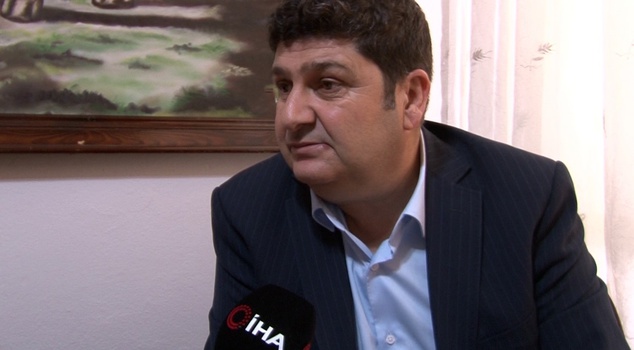
Prof. Dr. Uğur Tuztaşı, Dean of the Faculty of Architecture, Fine Arts and Design at Sivas Cumhuriyet University, said that the human silhouette identified in the hospital section of the Divriği Great Mosque and Hospital could be a metaphysical reflection of a secret love.
Described as the Alhambra of Anatolia and the first work in Türkiye to be included in the UNESCO World Cultural Heritage list in 1985, the Divriği Great Mosque and Hospital attracts attention with a new mystery every passing day. During the period of the Mengücek Principality, affiliated with the Anatolian Seljuk State, the mosque was commissioned by Ahmet Shah, son of Süleyman Shah, and the hospital section by Melike Turan Melek. The mosque, whose chief architect was Hürrem Shah of Ahlat, son of Muğis, was begun in 1228 and completed in 1243. According to historians’ accounts, Melike Turan Melek died before the work was completed. The fact that chief architect Hürrem Shah of Ahlat, son of Muğis, had no other works before this one and that no trace of him is found after it still preserves its mystery.
A NEW MYSTERY EMERGED 41 YEARS LATER
Veteran journalist Sirer Doğan from Sivas made headlines 41 years ago with photographs of people praying formed inside the mosque doors by sunlight falling on them. Following Doğan’s work, Japanese researchers announced this phenomenon to the world. Forty-one years later, Doğan has now revealed a different mystery with the photographs he took. When viewed from a point at the entrance, the ornaments on the ceiling of the hospital section resemble a human silhouette observed from the chin. In the silhouette, a man with slanted eyes, prominent cheekbones and a drooping mustache can be observed. Doğan claimed that this image, which should be investigated by scientists, may belong to Ahmet Shah.
Prof. Dr. Uğur Tuztaşı, Dean of the Faculty of Architecture, Fine Arts and Design at Sivas Cumhuriyet University, stated that the structure was an important center without parallel in its period and said, “I also saw the statements of the esteemed journalist and intellectual of our city, Mr. Sirer. First, it is necessary to define the space. Its founder was Turan Melek; this section is the hospital section, the main section where patients were treated. There are symbols both on the exterior and inside of this structure. There are some findings showing that this place was a hospital. There are also scientific studies indicating that the sound acoustics in this hospital have a scientific basis when considered physically and mathematically. There are concrete indicators related to this structure, as well as abstract indicators. Considering both its founder, its master, the way it was built, the way it was gifted, and the conditions of the period, it is an important center where important physicians treated patients.”
IT MAY BE A METAPHYSICAL REFLECTION OF A SECRET LOVE
Prof. Dr. Uğur Tuztaşı stated that the image could be a metaphysical reflection of a love between Turan Melek and Ahmet Shah and said, “As far as we learn from the documents, this place, with Turan Melek’s system of thought and the period’s physician Abdullah Bağdadi, was a place they pondered, and with its mosque, it is an important center without parallel in Anatolia in that period. When we look at the structure, we see various medical motifs that are still in use today. When we look, we see a human figure here. The emergence of this motif may prompt the following question: ‘There is a human figure here, and an abstract meaning has been attributed to it. Considering that its founder is Turan Melek, why is there a figure of Ahmet Shah, as Mr. Sirer says, rather than Turan Melek? This raises the following: there are very diverse debates about whether Turan Melek and Ahmet Shah were married and whether they were relatives. Some researchers argue that they were not married. Since this structure is one in which motifs laden with metaphysical meanings were worked, just as the architect hid his signature in a very small place, despite Ahmet Shah’s name not even being in the inscription, could he have had Ahmet Shah’s figure carved into such a main center to show the meaning of Turan Melek’s contribution? Has there really been an encryption so that such an image emerges here as a different dimension of the official love metaphysics of such a power? If it has been done, I would not be surprised,” he said.
Emphasizing that the figure should be examined scientifically, Tuztaşı said, “In the structure, we generally see various clear stone marks related to both Turan Melek’s and Ahmet Shah’s efforts and contributions in this structure and to the words they tried to say. This is somewhat more mysterious. I cannot say that this picture is definitely Ahmet Shah. You see the head part in the figure. The scale of the clothing is a little different. As I said, these need to be questioned somewhat scientifically. Since this structure contains various mysteries, we read it through symbols. We believe that there were various encryption methods for some meanings that those who commissioned it attributed to that structure. Both in the plan schemes and in the decorations. Is it not surprising? However, as I said, I think it should be evaluated by going down to its scientific basis.”
HIS NAME IS NOT IN THE INSCRIPTION; WAS IT CARVED ON THE WALL?
Prof. Dr. Uğur Tuztaşı, recalling that Ahmet Shah’s name does not appear in the building’s inscription, said the following:
“There are two human figures. We think one is Turan Melek and the other is Ahmet Shah. Because Ahmet Shah’s name does not appear in the inscription. Turan Melek’s does. Ahmet Shah is not present anywhere in the structure. But such a figure has appeared before us. Could Turan Melek have said, ‘I want to see Ahmet Shah here’? Could it have been made as a gift and surprise? The story of the building’s chief architect, Hürrem Shah, is also very strange. He was not alive when this structure was completed, and we do not see that he served as chief in another structure, made a design for any structure, or displayed these skills in another structure. There are similar symbols, but none directly in Sivas, either in Sivas city center or anywhere else in this structure. This silhouette needs to be reviewed again and again. As we said, if there is such a love in Turan Melek’s inner world, the meanings she attributed to this structure, and her love for Ahmet Shah, then through its metaphysical dimension she may have had it worked into the very center there.”