11.06.2026 15:41
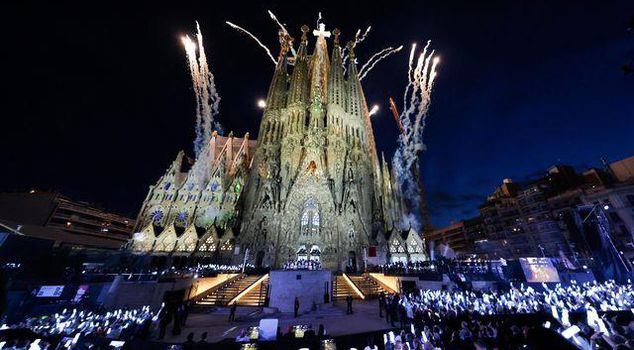
With the completion of the Jesus Christ Tower at Barcelona’s iconic Sagrada Familia, the church reached 172.5 meters, earning it the title of the world’s tallest church. The tower, inaugurated on the 100th anniversary of Antoni Gaudi’s death, was celebrated in a ceremony attended by the Pope and the Spanish royal family. The construction of the church, where Gaudi drew inspiration from nature and employed innovative structural solutions such as catenary arches, continues using modern technologies and engineering.
The completed Jesus Christ Tower at the Sagrada Familia has elevated the structure to a height of 172.5 meters, reinforcing its title as the world's tallest church. The inauguration took place on the 100th anniversary of Antoni Gaudi's death. After approximately 144 years of construction, another significant milestone has been reached at the Sagrada Familia. The newly completed Jesus Christ Tower stands out with its remarkable architectural and engineering features.
The tower was opened with a ceremony held as part of the 100th anniversary of the death of Antoni Gaudi, known as "God's architect." The ceremony was attended by Pope Leo XIV, as well as King Felipe of Spain, Queen Letizia, and Prime Minister Pedro Sanchez.
A LIFE ENDED BY A TRAM ACCIDENT
Antoni Gaudi was severely injured in June 1926 when a tram hit him while he was on his way to church. The famous architect, unrecognizable, was taken to a hospital for the poor and died a few days later.
Before his death, Gaudi had not completed the construction of the Sagrada Familia, which would become one of Barcelona's symbols. However, he had planned for the structure to be built in a way that would continue after his own death.
THE DREAM OF CREATING A STONE BIBLE
When viewed from a distance, the Sagrada Familia rises above the Barcelona skyline, and up close, it stands out with its detailed facades depicting scenes from the Bible.
According to art historian and Gaudi biographer Gijs van Hensbergen, Gaudi had two main goals: to create a stone Bible and to address the shortcomings of past architectural concepts.
To this end, Gaudi drew inspiration from the Taq Kasra structure in the ancient city of Ctesiphon, located within present-day Iraq. The catenary arch system used there played a key role in the architect's building design.
CHALLENGED TRADITIONAL ARCHITECTURE
Gaudi considered the flying buttresses used in the neo-Gothic cathedrals of his time to be unnecessary support elements. Instead, he aimed for the towers to bear their own weight using catenary arches.
As his knowledge of structural engineering grew over time, Gaudi reshaped his design and redesigned the Sagrada Familia three times. The tree-like columns inside the church also emerged as a result of this approach.
INNOVATIVE SOLUTION FOR HEAVY TOWERS
During the construction of the towers at the center of the Sagrada Familia, significant engineering challenges were encountered. The weight of the 138-meter-tall Mary Tower and the 172.5-meter Jesus Christ Tower posed a major problem.
Therefore, engineers moved away from traditional reinforced concrete methods and developed an innovative system consisting of pre-stressed stone panels and steel tension cables. This ensured that the towers were both lighter and more resistant to wind.
GAUDI'S EXPERIMENTS PAVED THE WAY
During his lifetime, Gaudi experimented with different construction techniques on the Saint Barnabas Tower he completed. Using stones quarried from the nearby Montjuic Mountain, the architect also incorporated Portland cement, a new material of the time.
According to experts, many of the modern engineering solutions used in the basilica today are a continuation of Gaudi's innovative approach.
SAGRADA FAMILIA STILL NOT COMPLETED
Despite the completion of the Jesus Christ Tower, the construction of the Sagrada Familia has not yet ended. There are important sections that need to be finished, particularly the Glory Facade, which is the main entrance of the building.
Today, artificial intelligence and unmanned aerial vehicles are also used to protect the basilica. Previously, crack and damage detection studies that took years can now be completed in much less time.
Authorities state that with the help of AI-powered systems, the entire basilica can be scanned within a month.
Under construction for about a century and a half, the Sagrada Familia continues to be one of the world's most remarkable structures, where architecture, engineering, and technology meet.
SAGRADA FAMILIA HISTORY
The Sagrada Familia is a massive Catholic church located in Barcelona, Spain, recognized as one of the world's most famous basilicas. Construction of the building began in 1882 and continues to this day. The basilica's foundation was laid on March 19, 1882, by architect Francisco de Paula del Villar. The initial project was designed in a traditional neo-Gothic style. However, due to disagreements between Villar and project managers, the architect stepped down shortly thereafter.
ANTONI GAUDI PERIOD (1883-1926)
In 1883, the project was taken over by the young Catalan architect Antoni Gaudi. Gaudi completely changed the existing plans and redesigned the structure with a unique architectural vision inspired by nature. Gaudi dedicated nearly the last 15 years of his life almost entirely to the Sagrada Familia. However, when he died in a tram accident in 1926, only about a quarter of the building was completed.
CIVIL WAR AND LOST PLANS
During the Spanish Civil War that began in 1936, Gaudi's workshop was looted. A significant portion of the models, drawings, and plans was destroyed. This caused construction to continue with great difficulty in the following years.
RECONSTRUCTION AND MODERN ERA
From the 1950s, work gained momentum again. Architects and engineers attempted to recreate Gaudi's designs using salvaged drawings and photographs. After the 1990s, the construction process accelerated significantly with the use of computer-aided design technologies.
UNESCO AND PAPAL VISIT
In 1984, parts of the Sagrada Familia were included in the UNESCO World Heritage List. In 2010, Pope Benedict XVI consecrated the structure and elevated it to basilica status. As of 2026, with the completion of the 172.5-meter Jesus Christ Tower, the Sagrada Familia holds the title of the world's tallest church. Work continues to complete the Glory Facade, one of the building's most important sections.