30.08.2026 07:40
The Great Offensive, which began on 26 August 1922 at Kocatepe under the commander-in-chief Gazi Mustafa Kemal Atatürk, went down in history with the decisive victory won at Dumlupınar on 30 August. The Great Victory, which was a turning point in the liberation of occupied Anatolia and paved the way for the Republic, is being celebrated with the same pride and enthusiasm in its 104th year.
The Great Offensive, which began at Kocatepe on August 26, 1922 under the command-in-chief of Gazi Mustafa Kemal Atatürk and concluded with a decisive victory at Dumlupınar on August 30, is being celebrated with the same pride on its 104th anniversary. The Anatolian lands, which were divided following the Armistice of Mudros, were reclaimed as a homeland through the Turkish army's resistance in the 22-day Battle of Sakarya and the subsequent Great Offensive.
FROM THE PRINCIPLE OF 'THERE IS NO LINE OF DEFENSE' TO THE GREAT OFFENSIVE
After World War I, the anchoring of the Allied fleets in Istanbul, the French occupation of Adana, the British occupation of various regions, and the Greek army's occupation of Izmir on May 15, 1919, ignited the fire of the National Forces (Kuvayımilliye) in Anatolia. When the occupying armies advanced as far as Polatlı in 1921, Mustafa Kemal Pasha issued that historic order that changed the course of the war: "There is no line of defense; there is a surface of defense. That surface is the entire homeland."
The Turkish army, which halted the enemy with the Battle of Sakarya lasting 22 days and 22 nights, moved from a defensive position to the offensive phase after a year-long preparation period.
KOCATEPE AT DAWN: THE MORNING OF AUGUST 26
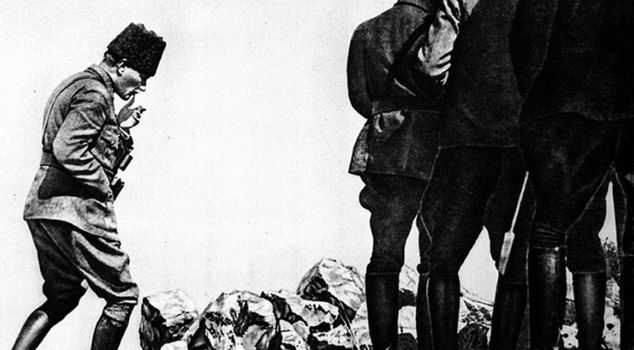
On the morning of August 26, 1922, Commander-in-Chief Mustafa Kemal, Chief of the General Staff Fevzi Pasha, and Western Front Commander İsmet Pasha took their positions at Kocatepe within the borders of Afyonkarahisar. On the first day of the operation, which began with artillery fire at dawn, Tınaztepe, Belentepe, and Kalecik Sivrisi were cleared of the enemy. While Afyonkarahisar was liberated from occupation on August 27, the enemy's 5th division was neutralized as of August 29.
On the morning of August 30, with the final attack order given at Zafertepe Çalköy, Greek units at Dumlupınar were encircled and completely destroyed. Senior figures of the Greek army, General Trikoupis and General Diyenis, were taken prisoner or fled the region.
THE ORDER THAT WENT DOWN IN HISTORY: YOUR FIRST TARGET IS THE MEDITERRANEAN!
Immediately after the Great Victory, on August 31, at Zafertepe Çalköy, the command staff, opening the map on a broken ox cart, set the target as Izmir to prevent the enemy from regrouping. In the proclamation he issued at Dumlupınar on September 1, Mustafa Kemal Pasha showed the armies their historic target: "Armies, your first target is the Mediterranean, forward!"
Following this order, advancing on three fronts, Turkish troops recaptured Gediz and Uşak on September 1, Eskişehir on September 2, Balıkesir on September 6, and Manisa on September 8, and successfully completed the operation by driving the enemy into the sea in Izmir on September 9.
THE HERO OF ÇİĞİLTEPE: THE HEAVY PRICE PAID BY COLONEL REŞAT BEY
One of the most dramatic moments of the offensive involved Colonel Reşat Bey, Commander of the 57th Division. On August 27, Reşat Bey, who had promised Mustafa Kemal Pasha that he would capture Çiğiltepe within half an hour, was deeply distressed when he could not reach his target on time. Leaving a note to the Commander-in-Chief's office stating, "Having promised you that I would capture that position within half an hour, and having failed to keep my word, I cannot live," Colonel Reşat Bey took his own life. Only 15 minutes after this tragic event, Çiğiltepe was captured by Turkish soldiers.
"THE FOUNDATION OF THE REPUBLIC WAS SOLIDIFIED HERE"
Two years after the victory, on August 30, 1924, the Great Leader Atatürk, returning to Zafertepe Çalköy for the foundation stone-laying ceremony of the Martyr Standard-Bearer Mehmetçik Monument, summarized the historic mission of August 30 with these words:
"It is evident that the foundation of the new Turkish state, the young Turkish Republic, was solidified here, and its immortal existence was crowned here. The Turkish blood shed in this field and the spirits of martyrs soaring in these skies are the immortal guardians of our state and our Republic."
August 30, which began to be celebrated as Victory Day in 1926 for the first time, continues to be lived with the same enthusiasm on its 104th anniversary as the greatest symbol of the independence struggle.