08.03.2026 13:41
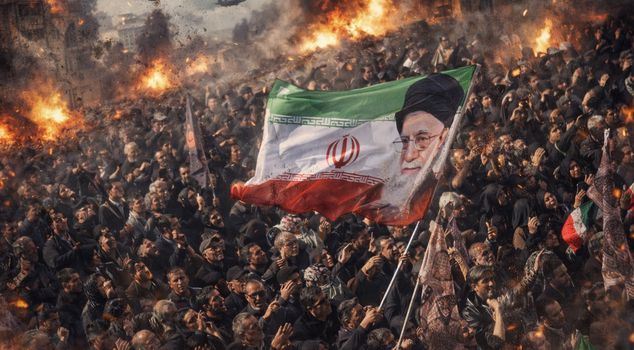
Following the attacks by the U.S. and Israel on Iran, the country's future remains uncertain, while the New York Times, one of the U.S.'s established newspapers, focused on six different scenarios for post-war Iran in its published analysis.
After the attacks initiated by the US and Israel against Iran, a significant uncertainty emerged both in the government ranks and in society. Following the attacks that resulted in the deaths of hundreds of civilians as well as important figures in the Iranian government, the Tehran administration responded to US and Israeli targets across the region.
6 DIFFERENT SCENARIOS CONSIDERED
While the whole world is focused on the region, an analysis published in The New York Times emphasized that the future of approximately 100 million Iranians has become increasingly uncertain with the escalation of conflicts. The analysis discussed six different scenarios that could emerge in Iran after the war.
According to the analysis, despite the killings of high-ranking officials, the political system in Iran has not completely collapsed. Due to the multi-layered structure of the Revolutionary Guards and state institutions, there is a possibility that the regime may survive. It is also noted that external attacks could strengthen nationalist sentiments in the country, creating a rallying effect around the regime.
- THE MILITARY MAY TAKE POWER
According to another scenario, the Revolutionary Guards, the strongest structure in the country after the war, may gain more power. Even if a new religious leader is chosen, it is stated that real political power could be concentrated in the hands of military structures. The analysis also mentions the possibility of a strong military leader emerging.
- OPPORTUNITY FOR POLITICAL CHANGE
According to the analysis, for some Iranians, the current crisis is seen as an opportunity for political change in the country. However, the destruction caused by the war and discussions of external intervention create serious uncertainty about how this process will progress.
While there are discussions in some circles about the potential return of Reza Pahlavi, the son of the Shah who was overthrown in the 1979 revolution, the analysis suggests that it seems quite difficult for a foreign-backed leader to gain legitimacy in Iranian society.
The analysis warned that if the Iranian state weakens or collapses, a new wave of instability could arise in the Middle East. It is stated that the fragmentation of a large country like Iran could lead to many issues, from migration crises to arms trafficking.
- THE PEOPLE OF IRAN MAY DETERMINE THEIR FUTURE
In the last scenario, it is noted that the economic crisis and social unrest in Iran could trigger political transformation. However, it is emphasized that for this to happen, the war must end, and Iranians should be able to determine their future without external intervention.