13.05.2026 15:40
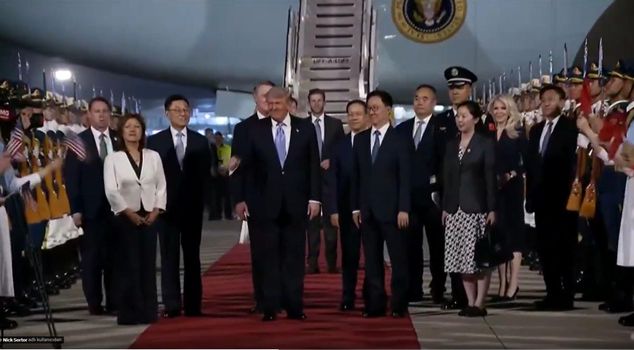
US President Donald Trump arrived in Beijing, the capital of China, to meet with Chinese President Xi Jinping. Trump, who paid an official visit to China after a gap of approximately 8.5 years, was delighted by the welcoming ceremony prepared for him.
The world's eyes and ears are now on Beijing. US President Donald Trump is making an official visit to China after about 8.5 years. As Trump's plane lands in China, both global markets and diplomatic circles have gone on alert ahead of the critical visit. The Iran crisis, Taiwan tensions, and economic sanctions are expected to be the main agenda items of the talks.
WILL LAST UNTIL MAY 15
Secretary of State Marco Rubio, Defense Secretary Pete Hegseth, Trade Representative Jamieson Greer, and White House Deputy Chief of Staff Stephen Miller will be part of the visit, which begins today and will last until May 15.
TRUMP BESOTTED BY THE WELCOME
Trump, who set foot in this country for a visit of critical importance for relations between the world's two largest economies, was captivated by the grand welcoming ceremony prepared for him.
ACCOMPANIED BY IMPORTANT FIGURES
Executives from some of America's largest companies, including Boeing, Citigroup, and Qualcomm, are accompanying Trump and are expected to make deals with Chinese firms. Among them are Apple executive Tim Cook and Tesla and SpaceX executive Elon Musk. The visit is also a crucial test for the fragile trade truce between Washington and Beijing. In April 2025, Trump imposed sweeping tariffs on many countries. One of the most significant consequences of this policy was the start of a trade war, with mutual tariffs between the US and China exceeding 100%. The tariffs were suspended after Trump and Xi's last face-to-face meeting in South Korea in October, but threats from both sides have persisted.
WHAT IS ON THE AGENDA THIS TIME?
Although a ceasefire on tariffs was reached last year, a permanent solution to the dispute has yet to be found. According to Tang, China's massive investment in production, combined with weak domestic demand, forces its companies to sell abroad. Tang says, "It will need the US. No other country is as large as a consumer market." However, Beijing enters this meeting from a position of strength. China's exports have reached record levels, a result of finding new trading partners worldwide while ties with the US have weakened.
Beijing has also continued heavy investment in robotics and accelerated efforts to produce its own advanced chips to reduce dependence on Western firms like Nvidia. The Trump administration is expected to pressure Beijing to buy more products from key US sectors, including soybeans and aircraft parts. However, the visit comes at a time when Trump's trade policies have suffered a blow following the US Supreme Court's cancellation of the tariffs he declared on what he called "Liberation Day." In this process, Trump resorted to a different law to impose a temporary 10% tariff on all countries and launched an investigation into unfair trade practices by China and other nations. Last week, a US trade court ruled that the latest global tariffs were unjustified, which could lead to new legal challenges in the future.
WHAT ABOUT THE IRAN ISSUE?
There is no doubt that the Iran war will occupy a significant place in the Trump-Xi meeting. Thanks to its vast oil reserves and diversified energy sources, China appears to have weathered the effects of the war better than most of its neighbors so far. China is a major oil producer and sources most of its imported oil from Russia. These factors have helped Beijing limit the impact of the conflict, even though it is Iran's largest oil buyer. Despite this, there are signs that the Chinese economy is also under strain as the war drags on: senior officials emphasize that strong measures will be taken to ensure energy security and protect supply chains. Therefore, both Beijing and Washington may be willing to end the conflict. However, differences of opinion on Iran are significant, and the world's eyes will be on whether these differences can be bridged.