15.10.2026 09:20
In the Karadeniz Ereğli district of Zonguldak, it was discovered that the main vessel carrying blood to the lower part of the body of 73-year-old E.K., who had been having difficulty walking for about a year due to back, hip, and leg pain, was completely blocked while he was preparing for lumbar hernia surgery. Cardiology Specialist Prof. Dr. Mehmet Yaman, who detected the blockage by manually examining the groin pulses, placed an artificial vessel in the patient using a non-surgical method. Yaman said the patient started walking half an hour after the procedure.
The source of the complaints of 73-year-old E.K., who had been receiving treatment in different specialties in Karadeniz Ereğli due to long-standing pain, was determined during a cardiology examination. It was found that the patient, who had undergone various treatments for about a year due to a herniated disc and knee problems, had a 100 percent blockage in the main vessel in the abdominal region that carries blood to both legs.
Cardiology Specialist Prof. Dr. Mehmet Yaman explained that while examining the patient's pulses in the groin area, they suspected vascular occlusion. Yaman stated that after confirming the blockage with angiography, they inserted a specially prepared artificial vessel by entering through the groin.
HE RECEIVED HERNIATED DISC TREATMENT FOR A YEAR
Prof. Dr. Mehmet Yaman, who said the patient's first complaints began about a year ago, described the process as follows:
“Our patient is a 71-year-old male. About a year ago, he began having complaints of difficulty walking, leg pain, and hip pain. Because of these complaints, the patient eventually experienced serious difficulty walking and applied to the relevant specialties. The first clinic he applied to was neurosurgery; a herniated disc was suspected and physical therapy was recommended. Our patient received physical therapy for a while, but his complaints did not improve with physical therapy. Later he went to orthopedics. In orthopedics, an intra-articular knee injection and again physical therapy were recommended on the possibility that there might be knee-related problems. The patient could not find relief from these either.”
“THERE ARE NO MISDIAGNOSES HERE”
Emphasizing that the previous evaluations should not be regarded as misdiagnoses, Yaman stated that the patient also had other age-related health problems:
“There are no misdiagnoses here. The patient is elderly, so there is age-related joint degeneration, and there are problems in his lower back. The complaints were attributed to these, and treatments for these were carried out. Later, the patient had accepted himself to the point of undergoing surgery for a herniated disc.”
DIAGNOSED BY GROIN PULSE EXAMINATION
Noting that the possibility of vascular occlusion was evaluated because the patient had smoked for many years, Yaman described the examination that led them to the diagnosis as follows:
“Meanwhile, our patient applied to us with the thought, ‘Could there be vascular occlusion because of long-term smoking? Or could there be an abdominal cause for these back pains?’ During the patient's examination, without performing any tests, simply by manually examining both groins, we saw that in fact neither groin pulse was present; his pulses were very weak. Without doing any test, we confidently told the patient, ‘There is a problem somewhere inside your abdomen, in the vessel carrying blood to the area below the navel.’”
Yaman, who stated that after the examination findings they decided to perform angiography directly, said, “We performed angiography, the gold standard diagnostic method for this. We did not feel the need to perform any additional MRI, CT, or Doppler because our examination finding was sufficient.”
MAIN VESSEL TURNED OUT TO BE 100 PERCENT BLOCKED
Explaining that in the angiography they detected blockage in both the heart vessels and the main vessel in the abdominal region, Yaman said:
“When we performed both the patient's heart angiography and leg angiography, we also detected vascular occlusion in the heart angiography. At the same time, in the abdomen, immediately after both renal arteries branch off—that is, in the section just below the navel extending to both hips, the leg side, and the tips of the toes—at a level that could, so to speak, divide the body in two, we determined that the vessel carrying blood to the lower part of the body was 100 percent blocked.”
Stating that the real source of the patient's back, knee, and hip pain was this blockage, Yaman used the following expressions: “We determined that the source of all the patient's complaints—namely his knee complaints, hip complaints, and back complaints—was the blockage of the vessel here.”
ARTIFICIAL VESSEL PLACED WITHOUT SURGERY
Describing that a special vessel was custom-made for the region where the blockage was located, Yaman shared the details of the procedure they performed without resorting to open surgery:
“We took images of the narrowing there and converted them into three dimensions. We had a special artificial vessel, which we call a ‘graft stent,’ produced for this area. We had this artificial vessel brought in. Without performing any surgery, using only a needle to enter through the groin with a special method, we placed that graft artificial vessel there.”
HE BEGAN WALKING HALF AN HOUR LATER
Reporting that the patient began walking shortly after the treatment, Yaman noted that in vascular occlusions, rapid results can be obtained once blood flow is restored:
“Immediately after the procedure, within exactly half an hour, the patient returned to his normal life, started walking again, and returned to his active life. His complaints also disappeared immediately. The most important thing here is this. In some diseases, you get a response within seconds after treatment. In vascular occlusions, as with heart attacks, it is the same here. You get a response within seconds.”
Also touching on the effect of the treatment on the patient's complaints, Yaman said, “You do not need to wait a day or two. Half an hour after the procedure was performed, the patient was walking, and with zero complaints and zero symptoms, he had been freed from all his complaints of a year.”
“BLOOD WENT REGULARLY TO BOTH SIDES”
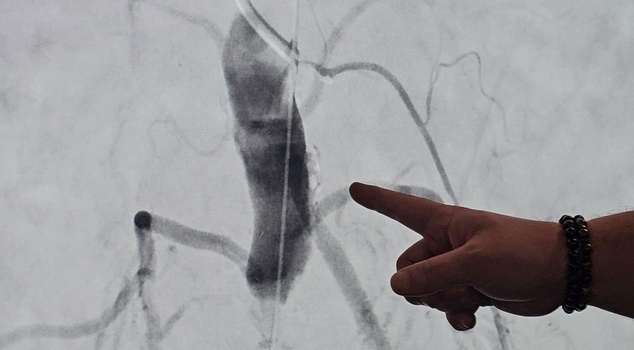
Also evaluating the patient's pre- and post-procedure angiography images, Yaman pointed to the region where the blockage was located and explained that the vessel was completely closed:
“The body's vessel, the vessel that splits to both legs. Look, right in the abdominal region, right at the level of the navel. Unfortunately, below this there is none. From the side, vessels are trying to supply this area, but it is not enough. Therefore, there is a blockage here.”
Stating that the blocked area was crossed with the help of a guidewire, Yaman said, “By taking the image, we also crossed the narrowing here by means of a guidewire from below. We crossed the narrowing here. Look, as you can see here, we see the vessel from above, and there is nothing below. There is no vessel going to either hip.”
Also sharing the images after the graft stent was placed, Yaman described with the following statements that blood flow was restored in the blocked area:
“Look, this thing you see is the artificial vessel we call an artificial vessel. After it inflated, the artificial vessel there now appears here, and that gap in between is gone. Blood went regularly to both sides.”