29.10.2026 11:51
As political uncertainty continues in Israel following the elections, hundreds of people took to the streets in Tel Aviv, Jerusalem and Haifa. Police intervened against protesters demanding the resignation of Prime Minister Benjamin Netanyahu and that Jewish-Arab parties form a joint government. The fact that no bloc was able to reach a majority to form a government on its own in the elections fueled coalition debates in the country.
As political uncertainty continues following the parliamentary elections held in Israel on October 27, protests were organized in Tel Aviv, Jerusalem and Haifa on the evening of October 28.
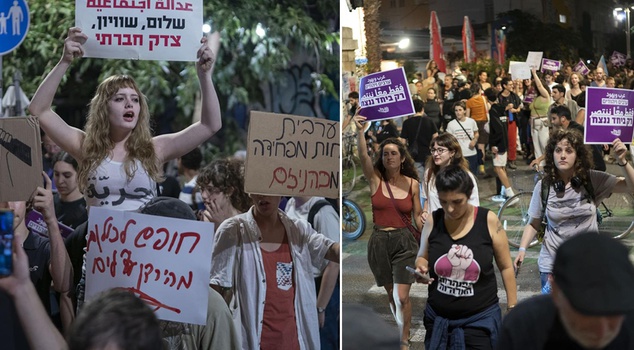
Protesters gathered at Mesila Park in Tel Aviv marched through the city streets with banners and slogans. After the march, the protesters staged a sit-in and demanded that Netanyahu resign and that a government be formed in which Jewish and Arab parties would take part together.
Similar demonstrations were also held in Paris Square in Jerusalem and UNESCO Square in Haifa. According to information in the Israeli press, about 300 people participated in the actions in the three cities.
POLICE INTERVENED AGAINST PROTESTERS
During the protest in Tel Aviv, police intervened after protesters blocked the road.
Security forces were seen trying to remove some protesters from the area by pushing them and dragging them on the ground.
Despite the intervention, the protesters continued their calls for political cooperation between Jewish and Arab communities.
"YES TO A JEWISH-ARAB GOVERNMENT"
The banners carried during the actions highlighted demands for peace, equality and shared governance.
Protesters chanted "Arab, Jewish, we will win together," "There is no difference between one blood and another," and "Peace, equality, social justice."
Some banners read "Freedom for everyone, from the river to the sea" and "Yes to a Jewish-Arab government."
ORGANIZERS' CALL FOR COEXISTENCE
Speaking to the Palestinian press, 26-year-old Adi Danino, one of the demonstration organizers, stated that the aim of the actions was to create a joint civil movement between Jews and Arabs.
Danino said they wanted the two communities to act together and send a joint message to elected politicians.
It was stated that the demonstrations were not limited to the demand for a change of government, but also included a call to strengthen political and social cooperation between communities.
NO MAJORITY FOR NETANYAHU IN THE ELECTION
Partial results announced after the elections held in Israel on October 27 showed that the government formation process could be difficult.
According to data announced by the Central Elections Committee on the night of October 28, with about 90 percent of votes counted, the right-wing bloc led by Netanyahu reached 53 seats in the 120-seat parliament.
The opposition bloc led by Gadi Eisenkot was projected to win 48 seats, and Arab parties 19 seats.
No bloc reached the 61-seat threshold required to form a government on its own. This picture increased the importance of Arab parties in coalition negotiations.
ARAB PARTIES BECAME KEY PLAYERS
According to the election results, the Joint List and Ra'am parties are expected to win a total of 19 seats. This figure represents a significant increase compared with the Arab parties' total of 10 seats in the current parliament.
If the 48-seat opposition bloc led by Eisenkot receives support from the Arab parties, it is mathematically possible for it to reach a majority of 67 seats.
However, the opposition of some opposition parties to forming a coalition with Arab parties before the election is seen as one of the main obstacles to realizing this option.
YAIR GOLAN CALLS FOR PARTNERSHIP AGAINST NETANYAHU
Democrats Party leader Yair Golan called on opposition parties to cooperate with Arab political formations after the election results.
Arguing that Netanyahu lost the elections, Golan stated that the opposition should evaluate the parliamentary majority.
It was reported that Golan plans to hold government formation talks with Gadi Eisenkot and other opposition leaders.
However, no common position has yet emerged among opposition parties on including Arab parties in the government to be formed.
NETANYAHU, MEANWHILE, IS TRYING TO KEEP THE RIGHT-WING BLOC TOGETHER
While the opposition's coalition efforts continue, it was reported that Netanyahu is also continuing contacts with his current political partners.
According to the Israeli press, in meetings with his far-right partners Itamar Ben-Gvir and Bezalel Smotrich, Netanyahu gave the message of preserving the unity of the right-wing bloc.
After the election results, the possibility of forming a national unity government also began to be discussed. However, the parties' current political positions show that there are serious obstacles to such a compromise.
EYES ON REMAINING VOTES AND COALITION TALKS
Vote counting in Israel has not yet been completed. The envelopes of soldiers, diplomats and voters who could not vote where they were stationed are being evaluated in the final stage of the count.
Final results are expected to be announced on November 4, while political parties continue preparations for government formation talks.
The demonstrations held in Tel Aviv, Jerusalem and Haifa showed that the coalition debates resonated not only among political parties but also on the street.