18.11.2026 00:01
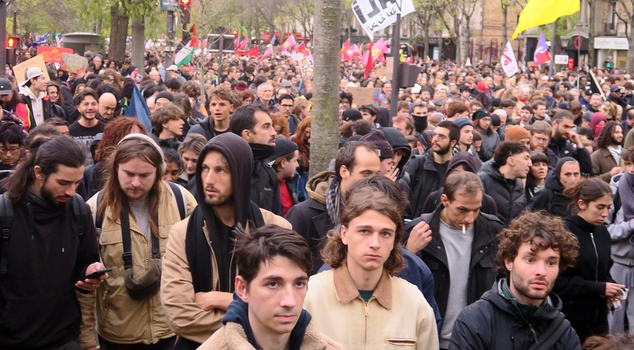
Following the unions' strike call in France, more than 140,000 people took to the streets to demand action on the high cost of living and wage increases. While the Ministry of the Interior announced that 146,000 people participated, the unions claimed that participation exceeded 500,000.
More than 140,000 people in France took to the streets demanding action on the cost of living and wage increases. Unions, considering the government's economic measures insufficient, announced they will continue actions until their demands are met.
MORE THAN 100,000 PEOPLE JOINED THE DEMONSTRATIONS
In France, after unions' nationwide strike call for wage increases, more than 140,000 people took to the streets demanding action on the cost of living and wage increases. While the Ministry of the Interior announced that 146,000 people across the country joined the demonstrations, unions claimed participation exceeded 500,000.
Teachers, healthcare workers, civil servants, private sector employees, and high school and university students took part in demonstrations across France. Protesters demanded higher wages in response to rising living costs and an increase in the budget allocated to public services.
AROUND 30,000 PEOPLE WERE ON THE STREETS IN PARIS
Protesters gathered at Place de la Nation in the capital Paris marched to Place d'Italie under the leadership of unions. Throughout the march, slogans were chanted for wage increases and more resources allocated to education and healthcare. Students participating in the demonstration called for improving education conditions and addressing staff shortages in schools. While the Paris Police Prefecture announced that 28,000 people joined the march, the General Confederation of Labour (CGT) put the number at 175,000.
Speaking before the march in Paris, CGT General Secretary Sophie Binet stated that they found the government's economic measures insufficient and gave the message that the actions would continue. Binet said, "Our message is very clear. Only meeting our demands can stop our actions. Nothing else can stop us."
Demanding that all wages be increased by at least 5 percent, Binet said, "The government must urgently invite all unions representing workers, youth organizations, and public employees to the negotiating table. We want immediate concrete announcements commensurate with the scale of the actions."
Binet, who also found the government's increase in the minimum wage insufficient, said, "There is unprecedented social anger. Yet the only response we have received is an addition of 5 euros a month to the minimum wage. This is not enough."
COURT SUSPENDS BAN ON DEMONSTRATIONS IN PARIS
In Paris, where demonstrations continue, the Administrative Court suspended the implementation of the Paris Police Prefecture's decision banning unauthorized demonstrations within 100 meters of 10 high schools and 5 university campuses in the capital.
The decision, taken by Paris Police Chief Patrice Faure and covering November 16-20, had been put into effect after student protests and incidents at the entrances of some educational institutions.
Examining the case upon the application of student unions, the court found the scope and duration of the ban disproportionate. The ruling stated that the changing nature of student movements did not justify a broad ban lasting five days, and that the regulation constituted a serious and clearly unlawful interference with fundamental freedoms.
Evaluating the ruling, National Student Union (UNEF) representative Alice de Brito said, "This is a victory for young people and a heavy defeat for the government."
Meanwhile, in the evening after the march in Paris, police intervened in an unauthorized gathering around the Bastille Opera and at the Bastille metro station. Security forces dispersed the protesters in the area.
DEMONSTRATIONS ALSO HELD IN OTHER CITIES
In addition to Paris, demonstrations were held in many cities, especially Lyon, Marseille, Toulouse, Lille, Nantes, and Strasbourg.
In Lyon, thousands of protesters were able to re-enter Place Bellecour, which had been closed to marches after the violent incidents on October 17, following a court ruling. While the Rhone Prefecture announced that 7,000 people joined the demonstrations, the CGT reported participation at 12,000. The Prefecture announced that 3 people were detained during the demonstrations.
In Marseille, while police announced that 4,900 people joined the demonstrations, unions reported the number as 80,000. The Bouches-du-Rhone Prefecture introduced new demonstration bans to be applied between November 18-20 around some educational institutions in Marseille and Aix-en-Provence.
STRIKE PARTICIPATION WAS LOW
According to provisional data announced by the Ministry of Public Accounts and Public Administration, 2.59 percent of staff working in central government institutions joined the strike. This rate had been recorded at approximately 10 percent in the November 5 strike. The strike rate in public hospitals was 3.93 percent, and in local administrations it was 1.96 percent.
NEW STRIKE CALL FROM UNIONS
The CGT called for new demonstrations, asking the government to respond to demands regarding wage increases and public services. The union announced that retirees would hold actions again on November 19, student and youth organizations on November 20, and protesters against the cost of living on November 21.