11.12.2025 13:50
A woman who lost her ear in an industrial accident in China's Shandong province was treated using a method rarely employed in the medical field. Doctors postponed the transplant due to damaged blood vessels and nourished the ear on the patient's leg for five months, before reattaching it to its original location once the tissue had strengthened.
A woman living in Shandong province, China, lost her left ear, scalp, and a portion of skin on her face in a horrific workplace accident.
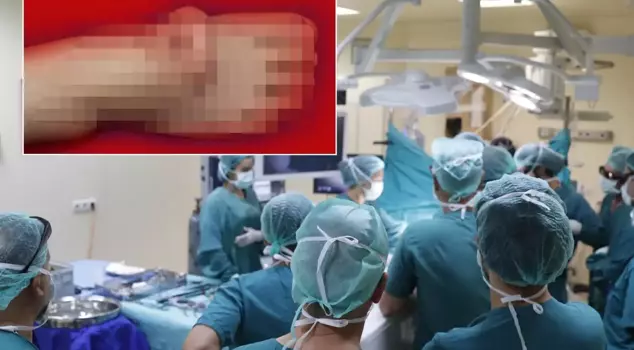
Although her life was not in danger, the accident caused serious injuries, and doctors resorted to an extraordinary method to reattach the ear: the woman's severed ear was nourished on the top of her foot for a full five months.
SEVERED EAR COULD NOT BE IMMEDIATELY REATTACHED
Doctors determined that the ear could not be directly reattached due to damaged blood vessels. The ear needed to heal properly and be revitalized. The most suitable place for this was chosen to be the inner part of the foot (instep), where the skin is thin and the vascular structure resembles that of the ear.
Connecting blood vessels that were less than a millimeter in diameter, only 0.2–0.3 mm wide, was an almost impossible task for the surgeons. The surgical team spent about 10 hours stitching each vessel one by one with needles thinner than human hair.
WAITING IN ITS NEW PLACE ON HER FOOT FOR FIVE MONTHS
The first days after the surgery were critical; as blood flow was not fully established, doctors intervened and managed to stabilize the transplanted ear. The ear turning pink again was a positive sign of tissue acceptance.
The woman carried her ear on her foot for five months; she only wore loose shoes when going out and walked carefully to avoid damaging the tissue. During this process, the wounds on her head also healed, preparing her for the second surgery.
CHALLENGING SECOND SURGERY: THE EAR RETURNED
In October, surgeons performed an operation to reattach the ear to its original place. Finding the blood vessels and nerves deformed by the accident in the scalp was an extremely challenging process. Doctors worked layer by layer under a microscope to identify usable blood vessels and nerve endings and reconnected them to the ear. After five months of patient waiting, the woman's left ear finally returned to its rightful place.